

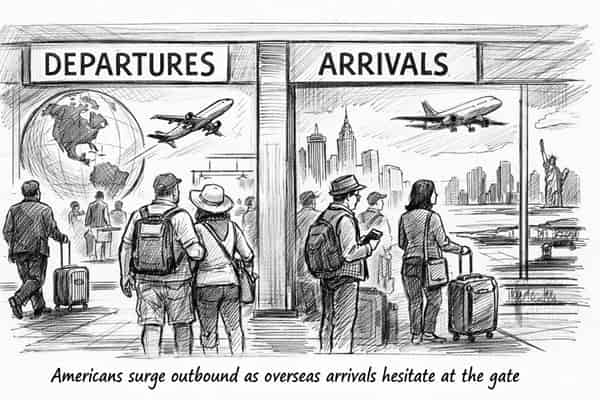
If global aviation were a weather map, December 2025 would show clear skies for American travellers heading abroad, but stubborn cloud cover hanging over inbound visitation to the United States. Fresh data from the National Travel and Tourism Office (NTTO) paints a picture that is neither boom nor bust, but something far more telling: a mature market recalibrating after the shock of the pandemic years.
International air passenger traffic to and from the United States totalled 23.2 million enplanements in December 2025, slipping a marginal 0.1 per cent year-on-year. On the surface, that looks like stagnation. In reality, it is the sound of an industry bumping up against its pre-COVID ceiling, operating at 109.9 per cent of December 2019 volumes. The machine is running hot, but not evenly.
Americans keep flying and then some
The real momentum is outbound. US citizen departures reached 6.9 million in December, up 3.2 per cent on last year, and a striking 30.3 per cent above pre-pandemic levels. Americans, it seems, have rediscovered their passports and are using them with gusto.
Mexico continues to wear the crown as the great American escape hatch, recording 4 million total passengers between the two countries for the month. Europe, too, is firmly back in favour. December outbound travel to the continent helped push Europe’s total US air traffic to 5.6 million passengers, edging 3.1 per cent above December 2019.
This is not pent-up demand anymore. This is a habit.
By October 2025, the trend was already unmistakable. Outbound US citizen travel hit 8.69 million departures, a 3.3 per cent year-on-year increase, and 114.2 per cent of pre-pandemic October levels. Europe alone accounted for 22 per cent of all outbound trips, with October departures to the continent rising 6.8 per cent year-on-year.
In plain terms, Americans are travelling more, further, and more confidently than before COVID ever arrived.
Inbound travel tells a softer story
Inbound travel, however, is still finding its stride. Non-US citizen arrivals by air fell 2.9 per cent in December to 5.3 million passengers, representing 93.8 per cent of December 2019 volumes. Overseas visitor arrivals, a narrower but economically crucial measure, reached 3.2 million, up from November but still 1.3 per cent down year-on-year.
There is improvement, but it is uneven and cautious.
The October numbers reinforce the point. International visitor arrivals to the US totalled 5.85 million, down 5.7 per cent from October 2024 and at only 87.4 per cent of pre-pandemic levels. Overseas arrivals declined 3.1 per cent, with softness particularly evident across long-haul Asia.
Asia remains the great laggard of the recovery. December air travel volumes between Asia and the US climbed 7.3 per cent year-on-year, yet still sit 15.9 per cent below 2019 levels. Business travel, student mobility, and group tourism from the region continue to recover more slowly, shaped by visa processing delays, currency pressures, and lingering structural caution.
Markets that matter and those that move the needle
Mexico and Canada remain the twin engines of inbound volume, together accounting for nearly half of all international arrivals. In October alone, Mexico delivered 1.57 million visitors, Canada 1.22 million. The United Kingdom remains the strongest overseas source market, followed by Germany and South Korea.
Business travel paints a more nuanced picture. October’s top overseas business arrivals came from the UK, India, Japan, Germany, and China, a reminder that while leisure leads the headlines, corporate travel is quietly reasserting its importance.
Student arrivals, though modest in volume, underline long-term confidence. China and India continue to dominate education-linked travel, reinforcing the United States’ gravitational pull in global higher education.
Airports tell the real story
The geography of recovery is written plainly in airport statistics. New York JFK led all US international gateways in December with 2.8 million passengers, followed by Miami, Los Angeles, San Francisco, and Newark. These are not just airports; they are economic barometers.
On the foreign side, London Heathrow topped the list with 1.4 million passengers, ahead of Cancun, Toronto, Mexico City, and Paris. The mix is telling: business hubs, leisure magnets, and diaspora connectors all jostling for position in a market that has matured but not cooled.
A recalibrated industry, not a retreat
For airlines, tourism bodies, and policymakers, the lesson is clear. This is not a downturn. It is a recalibration.
Outbound demand is structurally stronger than before the pandemic, driven by wealth effects, flexible work, and a renewed appetite for international experience. Inbound recovery, while slower, is steady and crucially, more sustainable than the initial post-COVID surge.
The United States is no longer chasing a rebound. It is managing success on one side of the ledger and rebuilding confidence on the other.
As 2026 unfolds, the question is not whether international travel will grow, but who captures the next marginal traveller. For now, Americans are answering that question decisively by boarding first.
by Jason Smith – (c) 2026.
Read time: 5 minutes.
About the Writer.
 Jason Smith has the kind of story you can’t fake, built on long flights, new cities, and that unmistakable hum of hotel life that gets under your skin and never quite leaves. Half American, half Asian, he grew up surrounded by the steady rhythm of the tourism trade in the U.S., where his family helped others see the world long before he did.
Eager to carve out his own path, Jason packed his bags for Bangkok and the Asian Institute of Hospitality & Management, where he majored in Hotel Management and found a career and a calling. From there came years on the road, Singapore, Malaysia, Vietnam, each stop adding another thread to his craft.
He made his mark in Thailand, eventually becoming Director of Sales for one of the country’s leading hotel chains. Then came COVID-19: borders closed, flights grounded, and a new chapter began.
Back home in America, Jason turned his knack for connection into words, joining Global Travel Media to tell the stories behind the check-ins written with the same warmth and honesty that have always defined him.











