

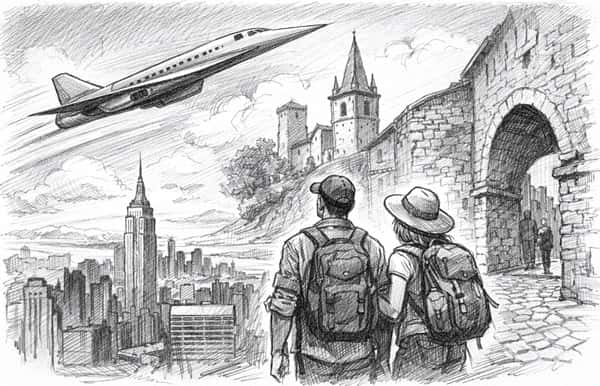
The idea of breakfast in New York and a late lunch in London has long stirred the traveller’s imagination. Now, with the prospect of quieter, faster supersonic aircraft edging back onto the aviation drawing board, that fantasy is again flirting with reality. But while the promise of speed excites some, today’s travellers are proving far more grounded than the Concorde-era jet set.
According to the latest Global Rescue Traveler Sentiment and Safety Survey, the world’s travellers are sharply divided on whether shaving hours off long-haul journeys is worth the price and the uncertainty. The survey paints a picture of a global audience that may admire technological progress, but still travels with one eye firmly on value, comfort and meaning.
American travellers, it seems, are the most willing to test the supersonic waters. Almost one in three US respondents (31 per cent) said they would happily book a US$3,500 return ticket on a low-noise supersonic flight between New York and London, cutting travel time to just three-and-a-half hours. Outside the United States, enthusiasm cools slightly, with 26 per cent prepared to open their wallets for the same experience.
Gender differences also emerged. Men proved marginally more adventurous, with 30 per cent keen to book immediately, compared with 27 per cent of women. Women, however, dominated the “maybe” camp, with 39 per cent preferring to wait and see, compared with 34 per cent of men, a reminder that caution, in travel as in life, often comes with wisdom.
“The data show a clear curiosity about the return of supersonic travel after a two decade absence, but travelers remain practical and cautious,” said Dan Richards, CEO of The Global Rescue Companies and a member of the US Travel and Tourism Advisory Board at the US Department of Commerce. “For many, speed is appealing, but not necessarily worth the cost or the unknowns of a brand-new travel capability.”
If supersonic flight remains a calculated gamble, airport efficiency is anything but. Here, American travellers are well ahead of the pack. More than 64 per cent already belong to trusted traveller programs such as TSA PreCheck or Global Entry, compared with just 20 per cent of non-US travellers. International travellers, however, are catching up fast, with 22 per cent planning to enrol soon — more than triple the proportion of Americans still considering it.
Women again edged ahead of men in participation, with 57 per cent already enrolled, compared with 52 per cent of men. But motivations differed. Men were driven by speed, with nearly half citing time savings as their primary reason. Women prioritised peace of mind, with 38 per cent highlighting reduced stress and smoother airport experiences.
For those yet to sign up, familiar barriers persist. Cost and the time required to apply topped the list, but women were almost twice as likely as men to raise privacy concerns, a telling insight in an era of biometric boarding gates and digital identities.
Yet for all the debate about speed, queues and convenience, the survey’s most striking finding lies elsewhere. Across borders and genders, travellers are increasingly united in what they actually want to see upon arrival.
Nearly two-thirds of respondents (65 per cent) said they prefer hidden gems over famous landmarks. Women (69 per cent) and non-US travellers (68 per cent) led the charge, gently rejecting overcrowded icons in favour of quieter, more personal discoveries. Even Americans, often stereotyped as lovers of the “big ticket” attraction, leaned the same way.
History, too, continues to trump modernity. Three-quarters of all respondents said historic significance matters more than contemporary appeal when choosing a destination. Women once again led the way, while US travellers proved more historically inclined than their international peers. This paradox suggests travellers may embrace faster ways of getting there, but still crave places where time has stood still.
“Today’s travellers are increasingly intentional,” Richards said. “They want experiences that feel authentic, immersive and personally meaningful, whether that means avoiding crowds, skipping the obvious stops or connecting more deeply with a destination’s history and culture.”
In an age obsessed with speed, this is a quietly reassuring conclusion. Technology may reshape how we move around the globe, but it has not rewritten why we travel. The romance of history, the allure of untold stories and the satisfaction of discovering somewhere unspoilt remain powerful forces.
Supersonic aircraft may yet reclaim the skies. But on the ground, travellers are voting with their hearts, and they are firmly anchored in authenticity.
For further insights, visit: https://www.globalrescue.com.












