

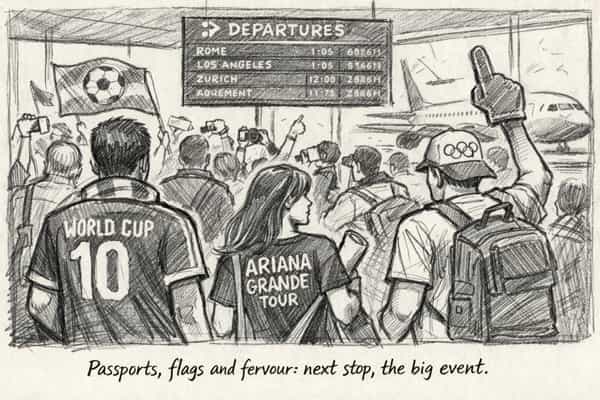
There was a time when travel was about escape: Sun, sand, a pool chair with someone else’s name on it. Increasingly, though, travel is about allegiance and in 2026, that loyalty is going to get expensive.
The following two years are shaping up as a kind of pilgrimage season: World Cups, Olympic Games, reunion tours, farewell tours, comeback tours. If there is a stadium, an arena or a stage involved, people are already circling dates on calendars they have not yet paid off.
What has changed is not the existence of significant events we have always had those, but the way people organise their lives around them. For younger travellers, especially, the event is no longer the highlight of a trip. It is the trip.
A new global study from travel research firm Arival puts some numbers around what anyone scrolling TikTok could already guess. Among Americans aged 18 to 34 who attend live sports, more than seven in ten consider themselves “high-level” fans. For music and performing arts, the figure is only slightly lower. These are not tourists who stumble into a show because it is raining. They are building holidays around kick-off times and encore rumours.
And they are spending like it.
Sports fans, the research shows, tend to book earlier and spend more than arts audiences, often locking in tickets months ahead and worrying about flights, accommodation, transport, and meals, all negotiable. Missing the match is not.
The pattern holds beyond the United States. Across Europe, roughly half of travellers in the same age bracket describe themselves as highly committed fans. Devotion, it turns out, travels well.
Social media has become the accelerant. Discovery no longer starts with a destination, but with a clip, a goal replay, a chorus filmed from row 12, a crowd shot that triggers something halfway between envy and belonging. TikTok and Instagram now outperform traditional search as inspiration engines, and decisions are fast. More than half of the respondents bought event tickets within a week of the performance.
The money, of course, has to come from somewhere.
Buy-now-pay-later options, already stitched into everyday retail, have quietly become part of the event economy. In the UK, flexible payment plans are now as standard as overdrafts, particularly among younger adults. The logic is simple enough: future-me can deal with it. Present-me has a seat.
Douglas Quinby, Arival’s chief executive and co-founder, puts it plainly. “Fandom is a powerful driver of travel intent,” he says. “Whether it’s a football final, a headline concert, or a cultural performance, travellers are prioritising what they love, and they’re willing to spend significantly to experience it live.”
The risk for the travel industry is assuming these people are casual customers. They are not. Quinby describes them as “deeply engaged” travellers whose decisions often hinge on a single event. Miss that emotional cue, and the booking goes elsewhere.
For destinations and experience operators, this changes the job description. It is no longer enough to sell beds and transfers. The work is about context, timing and emotional literacy, understanding why someone will fly across the world for two hours of noise and memory, then happily eat noodles for the rest of the week.
These themes will be further examined at Arival 360 in Valencia in April 2026, where industry players will explore how food, technology and live events intersect. There will be talk of artificial intelligence, of course. But the underlying truth is resolutely analogue.
People will cut back on many things. What they rarely cut back on is what they love.











