

There are moments in a city’s long commercial life when momentum becomes unmistakable. For Osaka, that moment is now.
Long admired for its merchant traditions, industrial pragmatism and quiet confidence, Osaka is rapidly emerging as one of the world’s most compelling life sciences hubs—an evolution accelerated, but not invented, by the Osaka–Kansai Expo 2025. For global businesses scanning the horizon for their next serious move in biotechnology, regenerative medicine or healthcare innovation, the timing could hardly be better.
Expo 2025: the catalyst, not the cause
Held under the theme Designing Future Society for Our Lives, Expo 2025 drew an estimated 29 million visitors and participants from 158 countries and regions, along with seven international organisations. Framed as a “living laboratory”, the event placed life sciences, AI, robotics and environmental technologies front and centre, with Osaka confidently presenting itself as both testbed and launchpad.
The Osaka Prefectural Government and the City of Osaka adopted an “All-Osaka” approach, collaborating with 118 sponsoring companies and 17 partner organisations to deliver the Osaka Healthcare Pavilion. Inside it, the Reborn Challenge showcased 432 SMEs and startups, each offering a glimpse of future-ready healthcare products and breakthrough technologies. It was a reminder that Osaka’s strength lies not only in blue-chip institutions but in the depth of its entrepreneurial bench.
A cluster strategy with substance
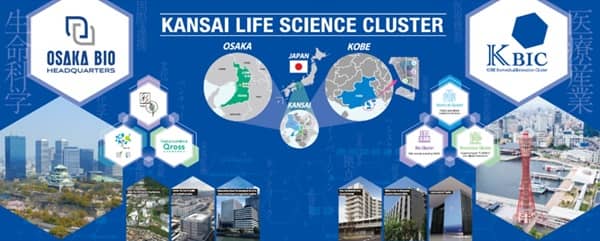
Crucially, Osaka’s life sciences story did not begin with the Expo—and it will not end with it. The city’s ecosystem is anchored by several purpose-built innovation districts, each with a distinct role.
Saito (彩都) has become a powerhouse for drug discovery and biomedical research, hosting national institutes alongside startups and established companies in a tightly integrated environment. Kento (健都), meanwhile, operates as an open-innovation district focused on health and medicine, centred on two national research institutions and surrounded by hospitals and private-sector collaborators.
Then there is Nakanoshima Qross, a flagship commercialisation hub dedicated to what Osaka calls “future medicine”. Built around regenerative medicine, the precinct brings medical institutions, companies, startups and support organisations under one roof, creating a continuous cycle of practice, creation and shared learning. In policy terms, it is rare to see translational research infrastructure executed with such clarity of purpose.
Partnerships that matter
What truly distinguishes Osaka’s current phase is its outward posture. In the wake of Expo 2025, the city and prefecture have signed multiple memoranda of understanding, taking international collaboration in life sciences to a more operational level.
A notable example is the partnership with Business Sweden. Discussions initiated during the Sweden Business Summit at the Expo site in May 2025 culminated in an MOU signed in October, aimed at promoting economic exchange in life sciences and startups. Given Sweden’s global standing in biotech and medtech, the alignment is commercially logical rather than merely symbolic.
Osaka Bio Headquarters has also deepened ties with leading global clusters in Canada, France and Italy. A September 2025 workshop at Nakanoshima Qross, jointly hosted with Italy’s Clust-ER Health, brought together experts from both regions and set the stage for ongoing business matchmaking and collaborative research initiatives. These are not courtesy visits; they are structured pathways to market.
Making it easy to land and stay
For foreign investors, enthusiasm matters less than execution. This is where Osaka’s support architecture quietly shines.
The Osaka Business and Investment Centre (O-BIC), established in 2001 by the prefecture, city and chamber of commerce, operates as a genuine one-stop shop for inbound business. From bilingual guidance on regulatory requirements to introductions to legal, tax and market-research professionals, O-BIC reduces friction at precisely the points where international ventures often stall.
Practicalities are not overlooked. Office and laboratory real estate, housing, schools and healthcare access are all part of the conversation. Incentives offered by local governments are clearly mapped. For executives used to opaque processes, Osaka’s transparency is refreshing—and commercially persuasive.
A traditional strength, future-focused
Osaka Prefecture has formally designated life sciences as a strategic growth sector, backing private-sector “challenges” that bring innovation into real-world application. Regenerative medicine and advanced healthcare sit at the centre of this strategy, supported by deep R&D capability and a talent pool shaped by decades of scientific excellence.
Geographically, Osaka remains Japan’s western gateway to Asia. Culturally, it retains a business mindset that values long-term relationships over short-term spectacle. That combination of global reach, anchored in traditional commercial discipline, is precisely what many international partners are seeking.
As the post-Expo chapter begins, Osaka is not asking the world to imagine its future. It is already building it, carefully, collaboratively and with an eye firmly on global relevance. For life sciences businesses considering their next move, this is one city worth watching—and, increasingly, worth joining.
Learn more:
Osaka Bio Headquarters: https://osaka-bio.jp/en
Osaka Business and Investment Centre (O-BIC): https://o-bic.net/
by My Thanh Pham – (c) 2025
Read Time: 5 minutes.
About the Writer.
 My Thanh Pham has worn more travel hats than most luggage racks could hold. After taking a course in travel and tourism, she found herself deep in the business of arranging itineraries across South-East Asia, matching travellers to temples, beaches, and the occasional night train, with a knack for making the complicated look easy.
Not content with life behind the desk, she joined a Vietnamese airline, juggling reservations one day and the frontline bustle of the airport the next. It gave her a ringside seat to the theatre of travel: the missed flights, the joyous reunions, and the endless stories that airports never fail to serve.
These days, My Thanh has swapped ticket stubs for a writer’s keyboard at Global Travel Media. Her words carry the same steady hand she once brought to bookings, guiding readers through the rich, unpredictable world of travel.











