

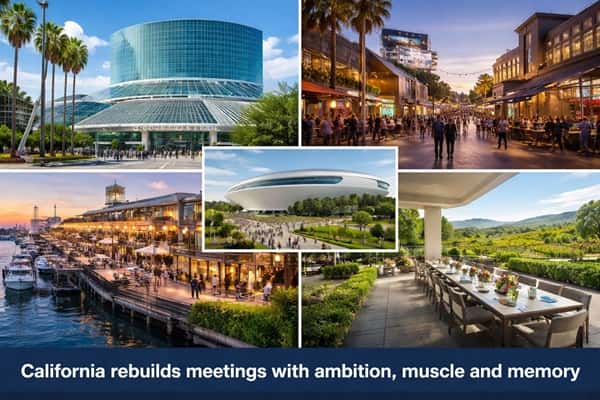
California has been here before.
Every decade or so, the Golden State decides it is time to remind the world that it still knows how to put on a show not just for tourists, but for boardrooms, conventions and corporate gatherings that travel with serious budgets and high expectations.
In 2026, California is doing it again. Only this time, the pitch is less about spectacle for its own sake and more about substance: smarter venues, broader precincts and experiences that feel less manufactured and more earned.
For an industry that has grown weary of identical ballrooms and identikit conference hotels, that matters.
“From massive convention centre modernisations to the growth of distinctive off-site venues like stadiums and entertainment districts and a slate of fresh hotel offerings across the state, 2026 truly represents a new chapter for meetings, events and corporate gatherings in the Golden State,” says Caroline Beteta, President and CEO of Visit California. “California is more than a place to meet it’s a place to connect, celebrate and be inspired.”
It is an ambitious claim. California has made ambitious claims before. But this time, there is steel in the ground to back it up.
Los Angeles finally fixes its most significant problem.
The most consequential change is unfolding in Los Angeles, where construction has begun on a long-discussed, long-delayed $2.6 billion modernisation of the L.A. Convention Centre.
For years, organisers have complained that the facility is vast but fragmented, struggling to compete with newer, more efficient convention centres elsewhere in the United States. The renovation aims to fix that in one decisive move.
When complete, the project will add 190,000 square feet of space and create a contiguous exhibition hall of more than 750,000 square feet, along with expanded meeting and multipurpose rooms. In practical terms, it allows Los Angeles to host larger global congresses, multi-stream conferences, and Olympic-scale events without forcing delegates to navigate a logistical obstacle course.
It is not a reinvention. It is a long-overdue correction and one that keeps Los Angeles firmly in the global conversation on conventions.
Meetings escape the ballroom.
Elsewhere in Southern California, the most interesting developments are happening outside traditional convention walls.
In Orange County, OCVIBE is taking shape as a 100-acre entertainment district built around the Honda Centre and the ARTIC transport hub. Opening in stages, the first major elements will debut in 2026, including Market Hall, a 50,000-square-foot culinary space with 21 chef-driven concepts, along with a flexible work hub, a 5,700-seat concert hall and a central urban park.
It is designed for events that want movement: meetings that break, wander, eat well and reconvene without ever feeling staged.
Ontario, east of Los Angeles, is making a similar play with ONT Field, a 190-acre sports and entertainment precinct that will become home to the Ontario Tower Buzzers, the Los Angeles Dodgers’ new Single-A affiliate. Opening in April 2026, the venue seats 4,500, offers more than 75,000 square feet of food and beverage space, and is divided into themed “neighbourhoods”, an American concept that, when done well, adds texture rather than gimmickry to events.
Down on the waterfront, West Harbour is poised to change how Los Angeles hosts groups by the sea. Opening in summer 2026 at the Port of Los Angeles in San Pedro, the 42-acre development will combine dining, retail, recreation and a 6,200-seat amphitheatre. It will also serve as the departure point for Harbour Breeze Cruises, allowing private charters and whale-watching excursions to begin conveniently, where the conference ends.
It is California leaning into what it has always done best: location.
Culture as currency
Not every new venue is about scale. Some are about meaning.
The Lucas Museum of Narrative Art, opening in September 2026 in Exposition Park, will bring 100,000 square feet of gallery space devoted to storytelling across painting, photography, film and sculpture. Founded by George Lucas, the 11-acre campus also includes two theatres, classrooms, studios and dedicated event areas.
For organisers chasing cultural credibility rather than corporate gloss, it offers something increasingly rare: a venue with intellectual weight.
In Truckee, near Lake Tahoe, the reimagined Old Lumberyard offers a quieter, more grounded alternative. Once an industrial site, it is being transformed into an open-air gathering space, with its first phase scheduled to open in May 2026. A second phase, including a 10,000-square-foot event centre and boutique hotel, will follow later in the year, blending heritage character with modern utility.
Hotels raise their game.
Venues are only half the story. California’s hotel pipeline suggests the state understands that meetings live or die on where delegates sleep, eat and gather informally.
In Napa Valley, Casa Mani Resort is transforming a former Embassy Suites into a Curio Collection property under the Hilton brand. The resort will offer more than 15,000 square feet of adaptable indoor and outdoor event space, including boardrooms, meeting rooms, and landscaped courtyards designed for natural collaboration.
Also in Napa, the Napa Valley Car Club provides a refreshingly eccentric option: an event space set among rotating collections of vintage and exotic cars, with curated driving experiences that turn incentives into something participants actually talk about afterwards.
In the mountains, the newly opened Limelight Hotel Mammoth delivers 8,000 square feet of event space across six venues, all steps from the gondola. It is a reminder that altitude can still add attitude to a meeting.
On the coast, Santa Cruz has entered the luxury conversation with the opening of La Bahia Hotel & Spa, the city’s first high-end resort. With 155 rooms, ocean views, a 4,000-square-foot ballroom, rooftop deck and multiple dining options, it signals that Santa Cruz is no longer content to be overlooked by group planners.
Add to that new or renewed properties across Inglewood, San Francisco, Santa Barbara, Beverly Hills, Palm Springs, San Jose and Big Bear, and the message is consistent: California wants meetings back properly.
A familiar ambition, better executed
California has always believed in reinvention. Sometimes it has overpromised. Sometimes it has delivered late. But the 2026 pipeline suggests a more measured confidence, one built on fixing old flaws, expanding beyond ballrooms and letting place do the heavy lifting.
For Australian organisers, long accustomed to flying delegates halfway around the world for something genuinely different, that may be the most persuasive argument of all.
California, once again, is not just asking the world to meet there.
It is daring not to.
by Octavia Koo – (c) 2025
Read time: 6 minutes.
About the Writer.
 Indonesian-born Octavia Koo arrived in Australia in the early 1980s, drawn by the creative promise of Sydney and a place at UNSW, where she studied Arts and soon discovered her flair for visual storytelling. She began as a graphic designer, quickly turning her sharp eye for detail towards the digital frontier, designing websites and crafting polished descriptions that draw people in and keep them reading.
Her next chapter took her to Singapore, where she built and managed blogs for several tourism platforms, uncovering a natural gift for SEO long before the term became fashionable. There, amid the buzz of ITB Asia, she met Stephen, who suggested she consider Global Travel Media. A few years later, she did just that.
Now part of GTM’s editorial family, Octavia brings a quiet brilliance to her work. She merges art, technology, and intuition to tell travel stories that charm and perform, much like their author.













