

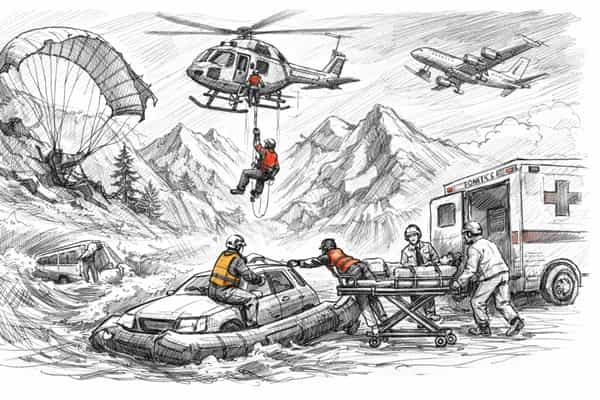
Travel in 2025 reminded us of a simple truth: the world is still wild, unpredictable and unforgiving. Adventurers continue to push deeper into remote regions, and even the most mundane outings can turn dangerous without warning. Rescue’s this year spanned deserts, coastlines, frozen landscapes and Himalayan peaks, and they revealed patterns we see every year: accidents, medical events, weather and equipment failures remain persistent threats. What changes is the terrain, the remoteness and the speed at which situations deteriorate.
Across six continents, we deployed medical, evacuation and rescue resources for travellers facing everything from high-velocity motorcycle trauma and paragliding crashes to flash floods, foodborne illness and high-altitude medical emergencies. The cases below illustrate the risks inherent to global exploration and the value of expert rescue coordination when lives hang in the balance.
Crashes, Collisions and High-Velocity Trauma
Motorcycle travel remains one of the highest-risk adventure categories. When speed, wildlife and remote road conditions intersect, consequences escalate quickly. In Victoria, Australia, a 59-year-old rider collided with a kangaroo and suffered serious head and neck injuries. His brother activated an SOS signal on a satellite device, triggering a coordinated response involving local responders and Global Rescue medical personnel. Timely triage and transport ensured he reached definitive care despite the remote location.
Mongolia delivered two more reminders of fragility in developing medical environments. One rider sustained a fractured humerus requiring surgical intervention at a local trauma hospital. Another traveller shattered the tibial condyle in his knee during a festival in Ulaanbaatar. We coordinated his evacuation to Newark, NJ, where he could receive specialised orthopedic care. These incidents reinforced the operational reality: in countries where medical capability varies widely, the difference between full recovery and long-term disability often comes down to rapid international coordination.
High-Altitude Threats: Frostbite, Allergic Reactions and AMS
At altitude, the margin for error narrows dramatically. Even well-conditioned climbers can face acute medical crises without warning. One of the year’s most dramatic missions involved an American climber at Ama Dablam Camp 2. He developed severe acute mountain sickness accompanied by respiratory distress. A long-line helicopter extraction lifted him from thousands of feet above the valley floor. After supplemental oxygen, medication and hospital evaluation, he made a complete recovery.
Elsewhere in the greater Himalayas, frostbite cases, snow blindness and allergic reactions continued to demonstrate the physiologic strain of high-altitude environments. What begins as discomfort can become life-threatening within hours, particularly when weather windows close or terrain limits self-rescue options.
Waterborne Emergencies: Floodwaters, Capsized Rafts and Rudderless Vessels
Water has a way of degrading a situation faster than almost any other element. Southern Australia experienced a flash flood that stranded a driver on the roof of his partially submerged vehicle. An SOS alert prompted Global Rescue to coordinate with the Australian Maritime Safety Authority, leading to a successful extraction before water levels rose.
Another case unfolded at sea when a vessel lost rudder control and began taking on water. The Marine Rescue Coordination Centre launched aircraft and dispatched a ship while Global Rescue maintained medical oversight until a helicopter crew hoisted the traveller aboard and transported him safely ashore.
Winter Terrain and Alpine Hazards
In northern latitudes and alpine regions, injuries often combine blunt trauma with environmental exposure. A snowmobile accident near Yellowknife sent a rider into a tree, resulting in severe back pain, neurologic symptoms and loss of bowel control. Given limited local resources, we arranged helicopter transport to Stanton Territorial Hospital, where imaging and treatment stabilised his condition.
Japan presented another challenge when a US traveller slipped, fracturing her patella and damaging associated tendons. After local stabilisation, the priority shifted to safe repatriation. Global Rescue arranged medical clearance, air travel, ground transfers and continuity of care back home.
In Patagonia, a Canadian traveller who was thrown from a horse suffered a significant ankle fracture that required evaluation in two hospitals and the application of an external fixator. Door-to-door medical coordination ensured she reached a North American surgical centre capable of managing the injury long-term.
Airborne Sports: Paragliding in China and New Mexico
Recreational flight carries inherent risk, and 2025 produced multiple paragliding emergencies. In New Mexico, a crash left a pilot with multiple fractures, internal bleeding and a collapsed lung. Following surgical intervention, Global Rescue provided medical oversight during business-class repatriation to ensure stability throughout transit.
In China, an Australian paraglider sustained a severe leg fracture. Coordinating escorts, mobility support and multi-segment flights, Global Rescue arranged his return to Brisbane for surgical repair.
Why Traveller Rescue Protection Matters
The through line across these cases is not the terrain or the mechanism of injury. It is the velocity at which leisure, adventure and business travel can shift into crisis. In the world’s remotest environments or busiest metropolises, local capabilities are not always enough. Add to that extreme weather, challenging geography, or insufficient infrastructure, and a medical or security emergency becomes more complex – all of which make obtaining traveller protection services, including field rescue, medical evacuation, expert medical advisory, and worldwide coordination, imperative.
By Harding Bush, Former Navy SEAL and Associate Director of Security, Global Rescue – (c) 2025











