

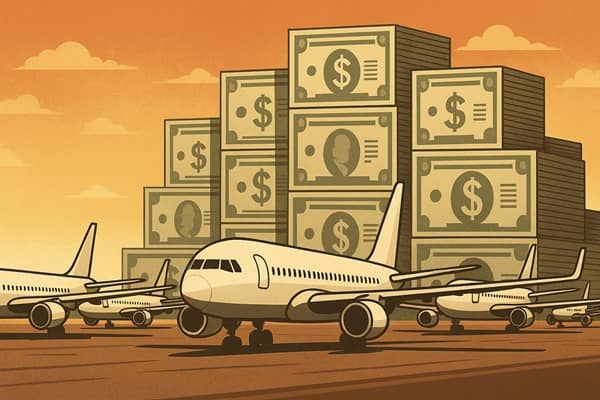
Airlines are not known for sitting on piles of spare cash. Margins are thin, costs are relentless, and nearly everything from fuel to aircraft leases is priced in hard U.S. dollars. Which makes the latest figures from the International Air Transport Association (IATA) particularly sobering: USD 1.2 billion in airline revenues remains trapped behind government currency controls, unable to be repatriated as of the end of October 2025.
That figure represents a modest improvement of around USD 100 million since April. But in an industry where liquidity keeps aircraft flying and routes alive, “modest” is hardly reassuring. More concerning still is where the problem is most acute: 93 per cent of the blocked funds sit in Africa and the Middle East, regions where aviation is often not a luxury but an economic lifeline.
IATA has renewed its call for governments to honour long-standing bilateral air service agreements, which guarantee airlines the right to repatriate revenues earned from ticket sales, cargo operations, and ancillary services—typically in U.S. dollars. Instead, carriers are facing a thicket of bureaucratic hurdles: delayed approvals, inconsistent processes, foreign-exchange shortages, and outright restrictions imposed by central banks.
“Airlines need reliable access to their revenues in U.S. dollars to keep operations running, pay their bills, and maintain vital air connectivity,” said Willie Walsh, IATA’s Director General.
“Governments have committed to unfettered repatriation of funds in bilateral agreements. With low margins and significant dollar denominated costs, airlines depend on governments fulfilling that commitment. It is also in the interest of governments to foster the economic catalyst that airlines provide by connecting their economies globally. That’s why we urge governments to facilitate the efficient repatriation of airline funds and prioritize this in foreign exchange allocations, even when currency is in short supply.”
Ten countries, nearly all the pain
The headline number hides a sharper reality. Just ten countries account for 89 per cent of the total blocked funds, USD 1.08 billion—spread across Africa, the Middle East and South Asia.
At the top of the list sits Algeria, which for the first time leads the table with USD 307 million trapped. IATA attributes the spike to a newly introduced approval requirement by the Ministry of Trade, layered on top of already onerous documentation demands. The industry body has urged Algerian authorities to remove what it describes as unnecessary processes that only slow cash flow without delivering economic benefit.
Next is the XAF Zone, encompassing Cameroon, the Central African Republic, Chad, the Republic of the Congo, Equatorial Guinea and Gabon. While the total here has edged down from USD 191 million in April to USD 179 million, airlines continue to face delays despite submitting all required paperwork. IATA is calling on the regional central bank, BEAC, to streamline its internal three-step validation process and clear the backlog.
Other notable contributors include Lebanon (USD 138 million), Mozambique (USD 91 million), Angola (USD 81 million), Eritrea (USD 78 million) and Zimbabwe (USD 67 million), with Ethiopia, Pakistan and Bangladesh rounding out the top ten.
Short-term controls, long-term costs
The underlying drivers are no secret. Political instability, economic fragility and pressure on foreign-exchange reserves have pushed governments to ration dollars. But IATA argues that blocking airline funds is a false economy.
“Political and economic instability are key drivers of currency restrictions across Africa and the Middle East, resulting in large sums of blocked funds,” Walsh added.
“We recognize that allocation of foreign exchange is a difficult policy decision, but the long-term benefits for the economy and jobs outweigh short-term financial relief.”
The logic is straightforward. Airlines that cannot access their own revenues cut capacity, reduce frequencies, or exit markets entirely. Tourism suffers. Trade slows. Jobs disappear. The very connectivity that supports economic recovery is quietly eroded, often without a single announcement.
A push for transparency
In a bid to keep the issue firmly on the agenda, IATA has launched a dedicated online tracker detailing blocked funds by country, updated quarterly. The move is designed to add transparency, highlight progress or the lack of it, and give governments nowhere to hide.
For an industry that thrives on movement, money stuck on the ground is more than an accounting inconvenience. It is a strategic risk. And until governments unlock the vault, airlines and the economies they connect will continue paying the price.
by Yves Thomas – (c) 2025
Read time: 4 minutes.
About the Writer.
 Something quietly magnetic about Yves Thomas is the poised calm of someone who’s seen the world from both sides of the reception desk. A graduate of Bangkok University International, Yves earned her Bachelor of Arts in International Tourism and Hospitality Management and stepped straight into the beating heart of Thailand’s travel industry.
She worked with some of the country’s finest destination management companies, mastering the art of making other people’s holidays unforgettable.
In time, the call of the open road grew louder than boardroom meetings. Yves packed her bags, swapped conference calls for compass points, and set off to rediscover the joy of travel on her own terms. Somewhere between Chiang Mai and Copenhagen, she began to write small reflections that soon became her travel blog, a journal full of warmth and insight.
Now calling Hua Hin home, Yves has joined Global Travel Media to share those reflections with a broader audience, not as a publicist, but as a storyteller with a traveller’s soul and a professional’s eye for detail.











