

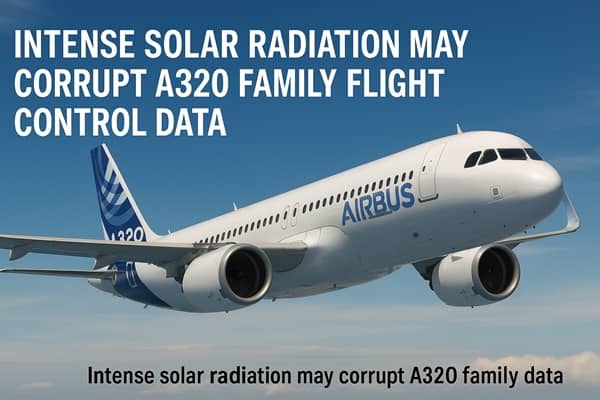
In aviation, few words command immediate attention quite like “precautionary fleet action”. This week, those words rippled across control towers, boardrooms and maintenance hangars worldwide after Airbus confirmed that intense solar radiation may have interfered with critical flight-control data on specific A320 Family aircraft.
It is, by aviation standards, a rare but serious electrical and data-integrity event — one that prompted swift regulatory action, urgent engineering mobilisation and, for passengers, a round of anxiety-tinged flight status refreshes.
A Solar Flare Meets Modern Flight Systems
Following analysis of a recent in-service event, Airbus disclosed that intense solar radiation may corrupt data critical to the functioning of flight controls. The manufacturer subsequently identified a significant number of A320 Family aircraft currently in service that could be affected by the anomaly.
The European plane-maker moved quickly. Working alongside aviation authorities, Airbus issued an Alert to Operators Transmission (AOT) calling for immediate implementation of software and/or hardware protections. The alert has since been formalised as an Emergency Airworthiness Directive (EAD) by the European Union Aviation Safety Agency (EASA) — the aviation world’s equivalent of a fire alarm.
Airbus did not downplay the disruption.
“Airbus acknowledges these recommendations will lead to operational disruptions to passengers and customers. We apologise for the inconvenience caused and will work closely with operators, while keeping safety as our number one and overriding priority.”
Behind that carefully measured corporate language sits an industry reality: when flight-control data integrity is in question, every aircraft stays on the ground until engineers, not public relations teams, give the final clearance.
AirAsia Moves First – and Fast
Among the first major carriers to execute the directive was AirAsia Aviation Group, which operates one of the largest A320 fleets in the Asia-Pacific region. In compliance with the urgent directive, the airline began mandated software rollbacks on 29 November 2025, confirming that the issue does not affect its A330 wide-body fleet.
Industry sources quoted by international media suggest the directive could affect around 6,000 aircraft globally, underlining the enormous scale of the operational coordination underway.
AirAsia notified affected passengers directly and activated service recovery arrangements. Guests were advised to monitor their journeys via the AirAsia MOVE app, the AskBo chatbot, or through registered email updates, modern tools for a very old-fashioned aviation problem: keep planes safe before anything else flies.
Group CEO Bo Lingam addressed the situation with characteristic candour:
“We are taking immediate steps to comply with the Airworthiness Directive and aim to complete the process within the next 48 hours, while ensuring minimal disruption to our guests. We seek our guests’ understanding, as these mandated measures are essential in upholding the highest standards of operational safety. We would also like to thank our engineering teams, who began the process immediately and are working around the clock to complete the required actions.”
24 Hours, Five Countries, One Coordinated Response
That 48-hour estimate proved conservative. In a display of logistical muscle rarely seen outside military operations, AirAsia completed full EASA compliance across its operational A320 Family fleet within 24 hours.
The Emergency AD reached AirAsia’s command centre at 3:00 am local time on 29 November, triggering an immediate activation of the Group’s Business Continuity Plan. What followed was a coordinated regional mobilisation across Malaysia, Thailand, the Philippines, Indonesia and Cambodia, bringing together:
-
Engineering
-
Flight Operations
-
Network Planning
-
Ground Operations
-
Customer Experience
-
Safety and Compliance teams
Maintenance crews worked through the night while operations teams reshuffled schedules to minimise disruption. Back-office teams handled the cascade of rebookings, logistics and regulatory reporting that inevitably follows these sorts of events.
Lingam later confirmed the outcome:
“Safety is core to the trust that guests place in us, and our response was immediate and thorough in this regulator-mandated action.
Our teams across the region were mobilised at once to meet all engineering, operations, safety and customer experience requirements, so that guests experienced as little inconvenience as possible. Thanks to meticulous planning and strong Groupwide coordination from our engineering teams supported by our ecosystem partner ADE compliance work for the aircraft was completed within 24 hours. Our operations teams continue to work to minimise disruptions. This concerted response is reflective of the agility, guest centricity and teamwork that define AirAsia.
We are grateful to our Allstars, regulators and airport partners across the region, and especially to our guests for their understanding and cooperation as we worked to implement this essential operational safety measure.”
By 30 November, AirAsia’s A320 operations were restored to normal, a turnaround that would make most global carriers quietly jealous.
Why Solar Radiation Matters More Than You Think
While “solar radiation” might sound like something from a Year 9 science textbook, its impact on modern aviation is anything but academic. Today’s aircraft rely on exquisitely sensitive digital flight-control systems — fly-by-wire computers that translate pilot input into aerodynamic response in milliseconds.
Intense solar activity can interfere with those systems at the data level. It does not bend metal or stall engines; it corrupts numbers. And in aircraft, corrupted numbers are never tolerated.
The precautionary response ordered by EASA was, therefore, not an overreaction but a textbook regulatory response to a low-probability, high-consequence risk.
For perspective, EASA’s emergency directives sit at the top of the regulatory pyramid, alongside events such as engine manufacturing defects or unexplained sensor anomalies. Once an EAD is issued, airlines have no discretion. Aircraft comply, or they do not fly.
Passenger Disruption – and Regulatory Confidence
For travellers, the short-term inconvenience was real: delayed departures, short-notice cancellations and tight reconnections. But the longer-term takeaway is far more reassuring. The aviation regulatory machine worked exactly as it was designed to.
From Airbus analysis to EASA enforcement to airline execution, the system functioned with almost military precision. The remarkable part is not that planes were briefly grounded, it is that tens of thousands of software modifications were verified, documented and re-cleared in barely a day.
Guests flying with AirAsia are still encouraged to verify their journey status via airasia.com/flightstatus or the AirAsia MOVE app, a sensible habit in a world where aviation now sits at the intersection of physics, software and space weather.
The Quiet Triumph of Safety Culture
There is a tendency in modern travel reporting to fixate on disruption. Yet moments like this reveal the aviation industry at its best — conservative, methodical and unapologetically safety-driven.
No airline gains commercially by grounding aircraft. No manufacturer enjoys issuing emergency directives. And no regulator takes pleasure in invoking its highest authority. But every one of them acted in lockstep because the industry holds to a simple, timeless principle: nothing flies unless it is unquestionably safe.
It is not glamorous. It is not always convenient. But it is why commercial aviation remains the safest mode of mass transport humanity has ever engineered.
By Soo James – (c) 2025
Read Time: 4 minutes.
About the Writer
 There’s nothing predictable about Soo James, and that’s precisely her charm. Of Malaysian descent, she set down academic roots at the University of New South Wales, majoring in Arts, before veering off into the unlikeliest of places: IT. It mightn’t sound romantic, but somewhere between data strings and deadlines, Soo found a fascination with how people and words connect.
What began as a curiosity soon turned into a craft. Over time, her writing slipped effortlessly into travel blogs and lifestyle features, each piece marked by her dry wit and a mind that notices the small, telling details others might miss. She writes with a traveller’s eye and a local’s heart, grounded, observant, and quietly amused by the world’s contradictions. Today, at Global Travel Media, Soo’s words do what travel should always do: take readers somewhere new, even if only for a few minutes.











