


By any sensible measure, Thailand has long been the gold standard for tourism crisis management in Southeast Asia. Earthquakes, tsunamis, monsoons, pandemics, the kingdom has weathered them all with a calm professionalism that would make most Western emergency rooms blush.
Now, as relentless rain swells rivers and submerges roads across its southern provinces, Bangkok has once again gone to work.
The Tourism Authority of Thailand (TAT) has formally activated its Tourism Crisis Monitoring Centre (TCMC), establishing a single national command hub to manage the fast-moving impacts of widespread flooding that has dislocated travellers, snarled transport networks, and placed parts of the deep south under intense operational strain.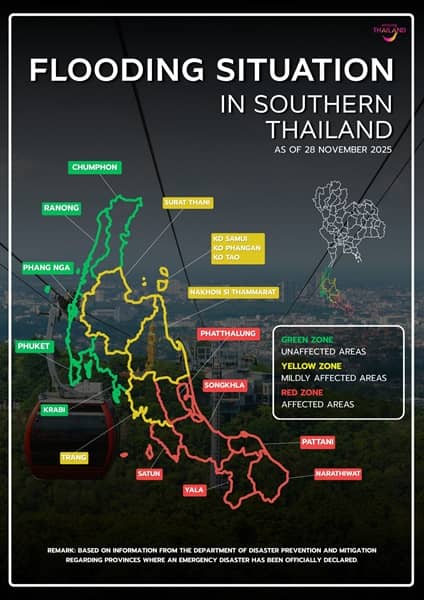
The move follows days of steadily worsening rain across Songkhla, Nakhon Si Thammarat, Phatthalung, Trang, Satun, Surat Thani, Yala, Pattani and Narathiwat, with Hat Yai, the commercial heart of the region, among the worst affected.
A central nervous system for a scattered crisis
For Bangkok’s seasoned disaster managers, the creation of the TCMC is less dramatic than it sounds; it is, relatively, a disciplined return to a tested playbook refined after decades of weather-driven disruption.
The centre now functions as the single point of coordination between:
-
Embassies and foreign missions
-
Provincial governments
-
Airports and transport operators
-
Tour companies and hotel operators
-
Emergency services and immigration authorities
Its mandate is simple: keep travellers informed, safe and mobile or sheltered when movement is impossible.
TAT Governor, Ms Thapanee Kiatphaibool, speaking with characteristic restraint, put it plainly:
“We recognise the concern and uncertainty that many travellers are experiencing, and our utmost priority is to provide clear information and coordinated support. TAT is working closely with authorities and tourism partners to ensure travellers receive timely guidance and assistance as conditions develop. We remain committed to transparent communication and to helping travellers navigate this challenging period safely.”
In the blunt language of crisis management, this is Thailand doing what Thailand does best: tightening lines, shortening decision cycles and keeping the tourism machine turning even through floodwater.
Hat Yai: airport running, city still limping
Nowhere has the balance between mobility and vulnerability been more obvious than in Hat Yai, the transport hub of southern Thailand and the main northern gateway to Malaysia.
Floodwaters have receded from several arterial roads, including Kanchanavanich Road, Punnakan Road, Supasarnrangsan Road and Thammanunvithi Road, restoring partial traffic flow through the city. The critical Hat Yai–Sadao cross-border corridor has also returned to normal operation — a vital commercial and tourism artery.
But the city is far from fully functional.
-
Taxi and minibus services remain suspended.
-
Several feeder roads are still impassable.
-
Sections of Highway 43 remain underwater.
-
Hat Yai International Airport is operational, though weather-related cancellations continue.
For stranded travellers, airport shuttle services operate on controlled routes, while the Sadao Border Checkpoint remains open, keeping land access to Malaysia technically viable.
In practical terms, you can still fly out of Hat Yai, but you may struggle to reach the terminal without careful planning.
Immigration relief: fines waived for stranded visitors
In a move that thousands of foreign visitors will quietly welcome, Thailand’s Immigration Bureau has announced a formal overstay fine exemption for travellers unable to depart flood-affected areas.
The exemption applies to visitors whose visas expire between 20 November and 31 December 2025 in eight southern provinces, including Songkhla, Pattani, Yala and Narathiwat.
It is a civilised decision in a region that depends heavily on tourism goodwill. No fines. No penalties. No bureaucratic theatrics.
Immigration officers nationwide have been instructed to apply the exemption automatically while maintaining routine security protocols.
It is, in effect, Thailand sending a quiet but powerful message: we understand that floods are not a lifestyle choice.
Airports are resilient, but ground transport is fractured
Aviation, Thailand’s great logistical spine, remains remarkably resilient.
-
Nakhon Si Thammarat Airport is operating normally
-
Trang Airport is open with extended arrival windows
-
Narathiwat Airport continues full service
-
Betong Airport (Yala) remains open
Yet, once travellers land, the journey often becomes more complex.
Bus services across Trang, Satun, Pattani, and Yala remain suspended. Rail services south of Thung Song have been heavily curtailed, and multiple State Railway of Thailand (SRT) services remain either suspended or truncated.
To its credit, the SRT has made real-time service mapping publicly available via:
https://ttsview.railway.co.th/v3/floodingNST/.
It is modern crisis management, transparent, digital, and live.
Islands open, seas unpredictable
While mainland transport has taken the brunt of the disruption, Thailand’s island destinations have fared better than many feared.
Phuket, Phang Nga, Krabi and Ranong are operating normally.
Ko Samui, Ko Pha-ngan and Ko Tao remain fully accessible, with:
-
Hotels are operating as usual
-
Land-based tours continuing
-
Ferry services are maintained mainly with weather-based adjustments
Only Songserm ferry services remain suspended, while high-speed catamarans continue under strict marine safety thresholds.
For travellers, the advice is traditional and timeless: check before you sail, and never argue with a monsoon.
The quiet economic war behind the weather
Beyond the immediate inconvenience to travellers lies a larger, more sobering reality for Thailand’s southern economy.
Tourism accounts for roughly 20 per cent of regional GDP in several of the affected provinces. Each cancelled flight, closed pier and shuttered national park is not merely an inconvenience; it is direct income lost to:
-
Hotel workers
-
Tour operators
-
Transport providers
-
Small hospitality businesses
The TAT has confirmed that once waters stabilise, a formal economic damage assessment will be launched, followed by targeted rehabilitation support for affected destinations.
It is an approach shaped by painful memory: Phuket after the 2004 tsunami. Bangkok during the 2011 floods. Tourism, Thailand has learned, does not rebound on goodwill alone; it rebounds on structured policy and fast capital.
Climate risk is no longer theoretical.
This flood crisis also carries a sharper edge: it is a living illustration of climate risk moving from future projection to present-time operational reality.
Southern Thailand has experienced:
-
Higher rainfall intensity
-
Longer wet seasons
-
Increased flash-flood frequency
-
More volatile marine conditions
For airlines, rail operators and tourism insurers, weather volatility is now a balance-sheet issue, not a meteorological curiosity.
What unfolds in Songkhla today will inform aviation and tourism risk modelling across Southeast Asia tomorrow.
And in boardrooms from Bangkok to Brisbane, those risk models now carry a new weight.
Communication is the real crisis infrastructure.
What separates a manageable disruption from a reputational disaster is not the rain.
It is communication.
On that front, Thailand has been institutionally disciplined:
-
24-hour Tourist Police hotline (1155) with multilingual support
-
TAT Call Centre (1672) is dedicated to travel logistics
-
Live rail and municipal updates
-
Embassy coordination through the TCMC
This layered communication model ensures that travellers are not left chasing rumours on social media, a lesson learned the hard way during past regional disasters.
As one senior Bangkok aviation executive remarked privately:
“Rain we can handle. Panic is the real operational threat.”
What travellers should realistically expect
For Australians currently travelling or planning to travel to southern Thailand, the reality is nuanced:
-
Most major airports remain open
-
Most resort destinations remain accessible
-
Urban public transport in several provinces remains curtailed
-
Marine travel is proceeding with caution
-
Border crossings remain selectively operational
In practical terms, flexible itineraries and generous buffer time are no longer luxuries. They are essentials.
A familiar test of Thailand’s tourism machine
Thailand’s global tourism brand has been built not only on beaches and cuisine, but on something far more prosaic: its competence under pressure.
This flood emergency once again places that reputation at the centre of international attention.
So far, the machinery is holding.
Communication is flowing. Immigration is flexible. Airports are functioning. Embassies are coordinated. Information is centralised. And recovery planning has already begun.
No amount of rain can fully neutralise a country that learned long ago that tourism is an industry only as strong as its worst weather day.
Key Traveller Contacts (Thailand)
-
Tourist Police: 1155
-
TAT Contact Centre: 1672
-
SRT Railway Hotline: 1690
-
Hat Yai Municipal Hotline: +66 74 20 0000
By Supaporn Pholrach – (c) 2025
Read Time: 6 minutes
About the Writer
 Supaporn Pholrach has never been content to watch from the wings. From her early years selling airtime when advertising meant handshakes and deadlines scribbled on paper, she’s been right in the thick of the action. With a bachelor’s in general management and a Diploma in Marketing, she married training with tenacity, quickly earning a reputation as a professional who gets results without losing her humanity.
Fifteen years at Bangkok Shuho proved her stamina in a business where many burn out. Now, as Sales Manager with Global Travel Media, she steers tourism brands through the noise with a steady hand, a touch of humour and the kind of personal warmth clients remember. Supaporn doesn’t simply close deals; she builds connections in the old-fashioned way with trust, loyalty, and heart. Little wonder she has become a quiet anchor in a restless industry.











