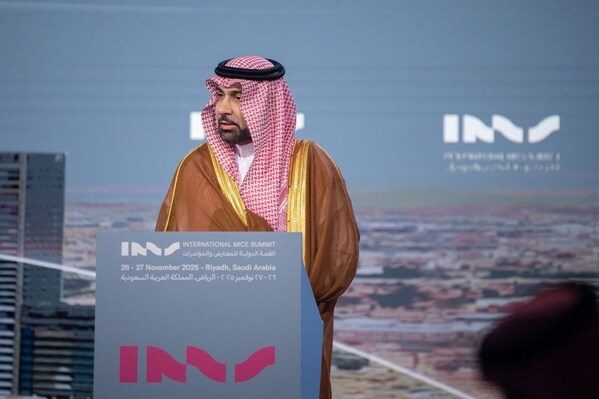
Riyadh does not often whisper its ambitions; it tends to announce them with architectural confidence and economic consequence. This week, at the opening of the International MICE Summit 2025 (IMS25), the Saudi capital did exactly that, delivering a sweeping statement of intent that left little doubt about the Kingdom’s arrival as a decisive force in global business events.
More than 3,000 industry leaders packed the opening day, far exceeding the expected 2,000, for what became one of the most consequential single days in modern MICE history. By the time the final applause faded, 20 commercial agreements and memoranda of understanding had been unveiled, involving companies with a combined global turnover exceeding USD 9 billion.
It was not merely symbolic. It was transactional. And it was transformational.
At the centre of the announcement cascade was a who’s who of the international exhibitions elite. Messe Frankfurt, Koelnmesse, MCH Group and Oak View Group confirmed plans to open new Saudi offices, while Comexposium and Honegger placed formal market-entry markers for 2026. In industry terms, this is the equivalent of a heavyweight migration.
From Europe’s grand exhibition halls to the Kingdom’s emerging mega-venues, the signal was unmistakable: Saudi Arabia is now open for business in global events, and the world is responding.
A Market No One Can Ignore
For veterans of the exhibition world, these are not exploratory toe dips. These are strategic relocations of capital, talent and intellectual property. Together, these companies manage some of the largest and most commercially significant trade fairs on the planet. Their collective move into Saudi Arabia speaks less of opportunity and more of inevitability.
Even more telling were the launches of flagship global events tailored specifically for the Kingdom. Messe Munich confirmed that BAUMA Saudi Arabia will debut in the region — an extraordinary coup given BAUMA’s status as the world’s most significant construction and heavy-machinery exhibition. The move aligns neatly with Saudi Arabia’s vast infrastructure pipeline and urban development agenda.
Meanwhile, RX Global revealed plans to launch MIPIM Arabia, effectively transplanting the world’s premier real estate investment forum into one of the fastest-growing property markets on earth. When the guardians of global capital follow the cranes, markets tend to listen.
Strategic partnerships were also confirmed with GL Events, Clarion, DMG Events and Koelnmesse, further entrenching Saudi Arabia’s evolving position as a pivot point for global exhibitions and large-scale convening.
The Infrastructure Tells the Real Story
If the deal announcements were the headlines, the data delivered the spine. The Saudi Conventions and Exhibitions General Authority (SCEGA) used the summit to launch its 2025 Saudi Venue Infrastructure Report, revealing a striking 32 per cent year-on-year increase in venue capacity across 923 accredited venues nationwide.
Perhaps more remarkable is the longer-term trajectory. Since 2018, Saudi exhibition space has expanded by 320 per cent, now exceeding 300,520 square metres. That is not organic growth; that is industrial-scale construction aligned to a national economic strategy.
While Riyadh, Makkah and the Eastern Province continue to anchor the bulk of this capacity, led by the Riyadh Exhibition & Conference Centre, Jeddah Superdome and Dhahran Expo Centre, the decentralisation trend is accelerating. New centres in Madinah, AlUla, Asir and Najran are broadening the Kingdom’s geographic footprint and creating genuine regional competition for international bids.
In plain terms, Saudi Arabia is no longer building venues for ambition. It is building them for utilisation.
A Government-Backed Growth Engine
Six new memoranda of understanding were inked with the Ministry of Interior, the Hail Region Development Authority, the Saudi Water Authority, Elm Company, the Authority for the Care of People with Disabilities, and the National Centre for Social Studies and Research. These are not ceremonial alliances. They embed the events industry into the machinery of national development.
Among the most significant developments is a dedicated multipurpose convention centre in Jizan City, forming part of the broader Jaydana Waterfront project, valued at USD 2.9 billion. Once again, the numbers are significant, but the intent is larger: the MICE sector is now a core economic lever, not a peripheral attraction.
His Excellency Fahd bin Abdulmohsen Al-Rasheed, Chairman of SCEGA, captured the moment succinctly:
“The scale and diversity of today’s announcements show how Saudi Arabia’s business events industry has become a powerful driver of economic transformation and global connectivity.”
He added:
“The partnerships delivered through the International MICE Summit will strengthen the Kingdom’s infrastructure, empower Saudi talent, and reinforce Saudi Arabia’s position as a global hub for international collaboration, in support of Vision 2030.”
In diplomatic language, this is what strategists call structural commitment.
Why the World Is Watching
The international community’s enthusiasm is not driven solely by new buildings or sovereign investment. It is driven by velocity. Saudi Arabia is executing development at a tempo few nations can match, and the business events sector thrives on momentum.
For global organisers, Riyadh now offers what many mature markets increasingly struggle to provide: political alignment, infrastructure delivery at speed, regulatory coordination and a pipeline of publicly backed mega-projects that guarantee exhibitor demand for years.
For Australian exhibitors, suppliers and business-tourism operators, the implications are material. Saudi Arabia is rapidly becoming a destination where entire industry ecosystems will convene, trade, invest and expand, often backed by government-level participation.
What Comes Next
IMS25 continues with dedicated sessions on MICE investment models, innovation clusters, workforce development through the Future MICE Leaders Platform, and concludes with a global gala honouring excellence across exhibitions and events.
If day one was any indication, the remainder of the summit will focus less on aspiration and more on execution. The Kingdom has passed the signalling phase. It is now firmly in delivery mode.
For a sector long dominated by Europe, North America and select Asian powerhouses, the global events map is being redrawn and Riyadh is increasingly sitting at its centre.
Not quietly. Not cautiously. But decisively.