

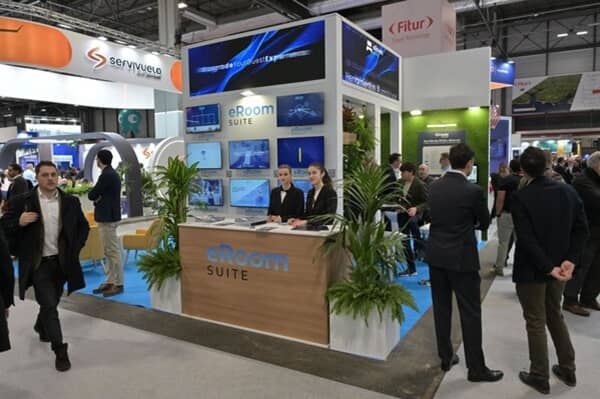
When FITUR 2026 gets underway from January 21 to 25, its Travel Technology precinct will be 50 per cent larger than last year, a physical statement of just how central digital innovation has become to the global tourism economy. And this time, it won’t be tucked away on the fringe. It will sit right at the heart of the fair, inside a newly built Knowledge Hub in Hall 12, a deliberate move that says plenty about where the industry believes its future now lies.
More than 150 technology companies from over 20 countries will occupy the space, turning what was once a specialist corner of the fair into one of its most heavily trafficked trading floors. The list of participating nations reads like a diplomatic roll-call from Spain and Switzerland to Brazil, China, the UAE, the UK and the United States — signalling that this is no regional experiment. It is a global pivot.
And make no mistake: this isn’t about showing off shiny gadgets for the sake of it. The message coming out of FITUR is distinctly practical. Technology is now where the real commercial battles in tourism are being fought: efficiency, sustainability, pricing, data, mobility, and the end-to-end traveller experience.
The new Knowledge Hub has been purpose-designed as more than just exhibition floor space. It will host live demonstrations, training environments and collaborative business zones focused on the machinery now driving tourism behind the scenes: artificial intelligence, automation, data analytics, distribution platforms, digital marketing systems, smart mobility and immersive experience design.
In short, it’s where tourism’s back office meets its front window.
Among the better-known names already confirmed are Amadeus, Travelgate, Roommatik, Septeo, Juniper Travel Technology, BEONx, Tech Tourism Cluster and Roiback companies whose platforms quietly shape how many hotels are priced, how rooms are cleaned, how guests check in, how airlines distribute seats and how operators chase yield in real time.
France will also make a pointed appearance through Business France, which will bring a cohort of emerging French start-ups into the spotlight. It’s another sign that FITUR increasingly sees itself not just as a marketplace for destinations, but as a launchpad for tourism’s next generation of digital operators.
For years, travel technology sat politely on the edges of industry conversation, proper, necessary, but rarely headline material. That era is gone. Today, digital platforms decide who wins market share, who controls distribution, who captures data, and who keeps margins intact in a brutally competitive environment.
The expanded Travel Technology zone reflects that shift. Its growing importance mirrors the industry’s own recalibration: destinations are no longer competing only on natural beauty or marketing spend. They are competing on connected systems, seamless platforms and the intelligence built into every stage of the traveller journey.
Automation now trims labour costs and human error. AI reshapes pricing and demand management by the minute. Data analytics redraw marketing strategies by the hour. What was once support infrastructure has become core commercial weaponry.
FITUR’s decision to place this precinct inside a dedicated Knowledge Hub is also symbolic. It marks a quiet but deliberate repositioning of the fair itself from being merely a vast shopfront for destinations into a forum where the operating logic of global tourism is increasingly negotiated.
For investors, operators, regulators and destination authorities, Hall 12 will be where tomorrow’s commercial models are quietly tested and stitched together.
For the wider industry watching from markets like Australia, the lesson is unambiguous: the competitive advantages of the next decade will be built less on brochures and more on code, connectivity and computational intelligence.
The crowds will still flock to FITUR for beaches, cities and cultural spectacle that’s the theatre of tourism, and it always will be. But behind the scenes, in the humming nerve-centre of the Knowledge Hub, the industry’s real future will be taking shape in lines of software, predictive algorithms and intelligent networks.
And that, more than any ribbon-cutting or marketing slogan, explains why FITUR’s Travel Technology footprint is growing so rapidly, because the business of travel itself is being quietly rewritten.
More information is available at IFEMA Madrid: https://www.ifema.es/en/fitur.
By Bridget Gomez – (c) 2025
Read Time: 4 minutes.
About the Writer
 Bridget has never been one to sit still. Of Portuguese heritage, she first trained as a nurse. She threw herself into work at the Commonwealth Veteran Affairs Repatriation Hospital, tending to old soldiers with stories almost as colourful as her own would become. It was rewarding, steady work — but wanderlust has a louder voice than routine.
So, she swapped starched uniforms for a backpack and set off on a twelve-month gallop around the globe. Along the way, she scribbled in journals, capturing the dust, the laughter, the odd missed train, and the occasional glass of wine too many. Those notebooks soon became a travel blog, her way of reliving and sharing the journeys with anyone willing to read.
Eventually, Bridget stumbled across Global Travel Media and, in her words, “the rest is history.” Now she writes with the same mix of heart and mischief that fuelled her travels.











