


There’s a certain rhythm to Flight Centre’s AGMs. The shareholders turn up for the dividends, the analysts hover for hints of recovery, and Graham “Skroo” Turner takes the microphone with the steady assurance of a man who has seen more turbulence than a Boeing test pilot.
This year, that rhythm returned. After a rocky 2025, Flight Centre Travel Group used its annual meeting to tell investors that the world’s appetite for movement for boarding passes, business trips, and long-delayed holidays is stirring again. More importantly, Flight Centre is positioning itself to make money from it.
A Tailwind at Last
“The fundamentals remain strong,” Turner declared to the Brisbane room on Wednesday morning, not in the inflated tones of corporate optimism, but with the calm pragmatism that has marked three decades of his leadership. “We expect to return to profit growth this year.”
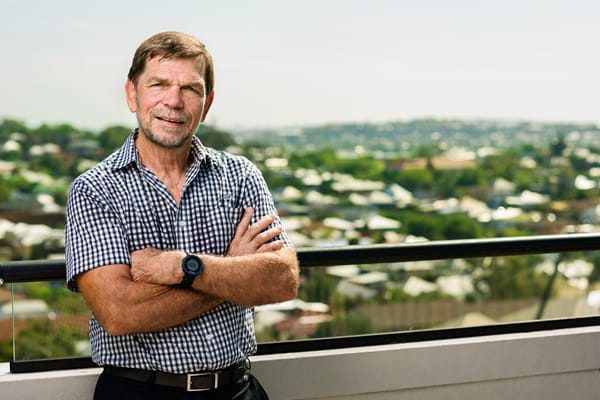
Managing Director Graham “Skroo” Turner.
And for once, the numbers seem willing to back him up. First-quarter total transaction value rose almost seven per cent, with corporate travel leading the climb and leisure bookings showing the first real signs of life since last year’s wobbles.
Asia, long the company’s headache, is back in modest profit. Flight Centre’s corporate pipeline has swelled to nearly $400 million, and the group’s full-year profit target sits between $305 million and $340 million, up as much as 17 per cent on FY25. For investors who spent last year white-knuckled through currency shifts and cost blowouts, that’s the kind of forecast that steadies the hands.
Gary Smith’s Balancing Act
Chairman Gary Smith opened the morning with a dose of realism, the kind the AFR usually admires. FY25, he conceded, “fell short of expectations.” The underlying profit before tax came in at $289.1 million, disappointing after a string of record years. Yet Smith was quick to remind the room that Flight Centre has still posted TTV growth in 26 of its 30 years as a listed company.
“We’ve taken decisive steps to position the company for renewed growth,” he said, outlining a year in which the group bought back shares, declared fully-franked dividends, and issued new convertible notes to keep its balance sheet flexible. “Early trading this year is encouraging.”
It was a chair’s speech in the old style, not a pep rally, but a reminder of continuity and stewardship. The subtext was clear: this is a company that knows how to survive a headwind.
The Corporate Engine
Behind the optimism lies the corporate arm, now the group’s powerhouse and profit engine. FCM Travel and Corporate Traveller delivered a combined $12.3 billion in TTV last year and $190 million in underlying profit, a record despite Asia’s drag.
If you run a business anywhere from Auckland to Atlanta, chances are one of those two brands books your flights. FCM handles the big end of town; Corporate Traveller courts the SMEs — the restless middle that never sits still long enough for a video call.
Corporate Traveller is closing in on $5 billion TTV, propelled by strong growth in the US. Its hybrid model, with local consultants armed with savvy tech, is proving to be the sweet spot for mid-market firms too small for a procurement department but too busy for DIY travel.
Melissa Elf, FCTG’s Global Chief Operating Officer for Corporate, explained it with typical understatement.
“The ANZ market remains the bedrock of our corporate operations,” she said. “Our local know-how combined with global reach provides unmatched value to Australian and New Zealand businesses.”
She added that AI now routes client enquiries to the most suitable consultant, a subtle example of technology serving people rather than replacing them. “It supports the human relationships that remain central to our business philosophy,” she said, a line that drew approving nods from old-school travel managers still allergic to chatbots.
Technology, but with a Human Face
Turner is no evangelist for shiny objects, but he’s pragmatic enough to know the future is digital. The company’s partnerships with Quantium and Anthropic have brought a quiet revolution to its back rooms: AI systems now sift through millions of customer requests, shaving 64,000 hours of manual work and rerouting queries faster than a seasoned travel agent could dial an airline.
Two digital assistants, Sam for FCM and Mel for Corporate Traveller, are already at work, part concierge, part clerk, never the star of the show. Turner calls them “agentic AI”, a term that sounds faintly sci-fi but translates simply to better service.
“Mel leverages decades of expertise and data to deliver a smarter, more personalised experience while keeping human service at the core,” he said.
In the leisure arm, AI is being tested to predict what travellers might want next, a modern version of the travel agent’s sixth sense. Flight Centre is experimenting with co-consulting tools that suggest “next best actions”, though Turner insists the human stays in the loop. “It’s about enhancing the conversation, not ending it.”
Leisure Learns to Travel Light
If the corporate side is purring, leisure is still tuning its engines. FY25 delivered $11.8 billion in TTV and $175 million in profit before tax, a step down from the previous year but still 35 per cent above pre-COVID.
The difference is in the structure. The leisure business is no longer the sprawling shopfront network of the nineties; it’s now a slimmed-down ecosystem of 590 stores, online channels, and niche brands. Turner put it neatly: “We’re achieving 86 per cent of our record FY19 TTV with only 42 per cent of the workforce.”
A new customer loyalty program, launching before Christmas, will stitch those brands together. Its aim: keep Flight Centre front of mind long after the boarding pass fades.
Luxury and cruise travel, once fringe, are now proving lucrative. The acquisition of Cruise Club UK has lifted October TTV 70 per cent year-on-year, while Scott Dunn, the London-based luxury operator bought in 2023, continues to outperform. Even the resurrected Cruiseabout network, still absorbing early losses, is steering toward profit.
Leisure, in short, has learnt to travel lighter and charge smarter.
A Strategy That Sounds Almost Old-Fashioned
Turner’s roadmap for FY26 is deceptively simple, the kind of plan a hard-headed manager could sketch on a beer coaster:
-
Keep costs flat.
-
Trim capital expenditure by up to 20 per cent.
-
Drop dead weight.
-
Invest only where the margins justify it.
It’s less a reinvention than a return to first principles. The Global Business Services division is already cutting support costs of roughly $20 million a month while freeing up capital for high-yield bets: AI, loyalty, cruise, and events.
The tone is unmistakably Skroo: measured optimism, backed by a calculator.
People and Planet, Not Just Profit
In a nod to the zeitgeist, both Smith and Turner highlighted sustainability and staff culture not as brochure slogans, but as part of the business model.
Through its Planting for the Planet program, Flight Centre has committed to planting 2.7 million trees worldwide. Its Fijian projects, run through Travel Associates, focus on reforestation and local food security, a quiet but practical contribution.
Internally, the company’s “brightness of future” mantra remains strong. About a third of all vacancies last year were filled internally, and legacy staff perks such as Moneywise, Healthwise, and Travelwise are being revived after the pandemic hiatus.
The rollout of Workday HCM gives management real-time visibility across 20,000 employees — not bad for a company once run out of a single Brisbane shopfront.
Smith’s summation could have come straight from the AFR’s own editorial desk: “The most satisfying investments we make each year are in developing and supporting our people.”
A Veteran’s Perspective
As the AGM drew to a close, Turner allowed himself a brief glance in the rear-view mirror. “On December 1, we’ll mark 30 years as a listed company,” he said. “In our first year we generated $1 billion in TTV and $19 million in profit. Last year, one of our smaller brands Travel Money did almost the same.”
The comparison raised a chuckle, but it also made a point. In three decades, Flight Centre has evolved from a single-brand leisure chain to the world’s third-largest corporate travel manager, with fingers in everything from touring to fintech.
“I’m reasonably optimistic about FY26,” he said with a shrug. “Just as I was 30 years ago.”
Coming from Turner, that qualifies as exuberance.
Reading the Runway
For analysts, the signals are clear. The travel rebound that began in fits and starts is settling into a more sustainable rhythm. Flight Centre’s decision to favour profit discipline over headline growth and to let AI do the heavy lifting behind the curtain could give it an edge in a sector where too many chase volume for vanity’s sake.
The share buy-back continues, dividends remain intact, and debt is under control. If corporate travel keeps its trajectory and leisure avoids another geopolitical squall, FY26 could finally deliver the clean recovery investors have been waiting for.
That said, no one in this company is pretending the skies are cloudless. The memory of pandemic chaos still lingers, and global uncertainties remain. But the difference this time is confidence, the kind that comes from a battered veteran who still enjoys the flight.
The Final Word
Turner ended the meeting as he began it practical, unsentimental, and quietly bullish. “Business travel remains fundamental to how Australian and New Zealand companies grow,” he said. “Our job is to make sure they can do it with confidence — across the Tasman or around the world.”
For a man whose first shopfront sold paper tickets and travellers’ cheques, it’s a fitting line. The tools may have changed, but the premise hasn’t: people still need to move, and Flight Centre still knows how to get them there.
By Prae Lee – (c) 2025
Read time: 9 minutes
About the Writer
 You can tell a lot about a person by how they handle a busy Bangkok morning. Prae Lee doesn’t rush; she glides through it. There’s a calm certainty about her, the sort that comes from knowing where you come from and where you’re going.
Educated at Chulalongkorn University, she took her business degree with the quiet pride of someone who believes in doing things correctly. Her travels for further study in Singapore and Australia didn’t change her; they polished what was already there: curiosity, discipline, and grace.
She returned to her family business in Bangkok, breathing a little modern life into it. She handled social media with the intuition of someone who listens and sells with the gentle persistence the Thais do so well.
Prae doesn’t make a fuss, but everything she touches shines brighter.
Now part of the Global Travel Media family, Prae brings authenticity and quiet confidence to her writing, drawing from a life steeped in culture, travel, and connection.











