

It’s the sort of idea that makes airport architects shudder and accountants grin, the suggestion that the great divide between international and domestic terminals might finally be ready for demolition.
A new study from the International Air Transport Association (IATA), produced with global engineering firm AtkinsRéalis, argues that biometric digital ID can safely do what concrete and glass have done for decades: keep passenger streams separate, satisfy border rules and still save airports a fortune.
In short, the report says: tear down the walls.
“Regulatory requirements and technology limitations have meant that domestic and international departure passenger flows need to be physically separated at many airports. That’s no longer the case,” said Nick Careen, IATA’s Senior Vice President for Operations, Safety and Security. “Digital ID powered by biometrics can achieve the needed segregation without duplicated facilities, which are inefficient and costly.”
It’s the kind of talk that might once have been dismissed as futurist fantasy. Yet IATA’s 2025 Domestic and International Passenger Integration Program (DIPIP) is nothing if not pragmatic. It calculates in painstaking detail how shared terminal space, verified by digital identity checks, could reduce costs, emissions and traveller frustration, all while keeping security watertight.
AtkinsRéalis aviation director Gareth Vest described the findings as “key in understanding how digital identity and biometrics can improve passenger experience and create substantial cost savings.”
Cheaper, quicker, cleaner
The study paints an appealing picture. By removing the physical barriers that divide domestic and international passengers, airports can consolidate check-in, security and retail areas, trimming costs and queues in equal measure.
IATA’s data is compelling: connection times could fall by almost 20 per cent, staff costs by up to 11 per cent, and annual savings for a major airport could exceed USD 5 million. A medium-sized airport handling ten million passengers might avoid some USD 80 million in future capital works while cutting its annual carbon footprint by 18,000 tonnes — the same as taking 4,000 cars off the road.
For passengers, it means fewer detours and less guesswork in sprawling terminals. For airports, it means sweating the same real estate harder instead of forever building more of it. And for governments grappling with climate targets, it’s a modest environmental win baked into efficiency.
The three-stage roadmap
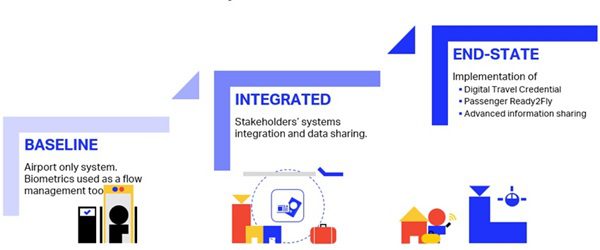
DIPIP sets out a three-stage evolution: Baseline, Integrated, and the fully digital End-State.
The first step allows airports to use biometrics within existing layouts, essentially overlaying digital verification on top of traditional zones. The second begins to merge domestic and international spaces more thoroughly.
The final vision is the bold one: travellers verifying identity and travel credentials remotely before they ever reach the terminal, then gliding through the airport as seamlessly as a domestic commuter.
That’s not science fiction. It’s an extension of existing trials, including those already running in parts of Europe, the Middle East and the Asia Pacific, where boarding gates recognise faces faster than any passport swipe.
What about the rules?
IATA insists none of this requires tearing up regulation, just better coordination.
“Implementation can begin within existing regulatory frameworks,” the report notes, provided airports, airlines and border authorities cooperate closely.
Careen agrees that collaboration is the real key.
“Airports, airlines, and governments each have a role to play. By working together within existing frameworks and progressively modernising them we can deliver seamless, secure, and efficient travel while maintaining the highest standards of safety and compliance.”
For border agencies, it’s a delicate dance: balancing data-driven identity checks with sovereignty and privacy. But the technology, IATA argues, is mature enough to handle it with audit trails, encryption and consent protocols now part of standard design.
Australia’s opportunity
For Australia, this could be transformative. With major airports like Sydney and Brisbane already bursting at the seams, integrating flows could defer the need for new terminals for years. It also dovetails neatly with Canberra’s ambition for digital borders and faster processing.
The numbers tell their own story. If Sydney Airport adopted even a fraction of the DIPIP recommendations, the capital savings could run into tens of millions. Regional hubs could benefit too, especially as domestic and short-haul international routes blur under open-skies agreements.
And at a time when passengers expect faster, cleaner travel, it’s the sort of change that might actually make the airport experience pleasant, a word seldom heard in the departures hall.
Not without caution
Still, not everyone is ready to surrender physical walls for digital ones. Privacy advocates warn that biometric systems, once normalised, risk creating databases too tempting for hackers or surveillance-hungry states. IATA’s report acknowledges those fears and recommends transparent governance and rigorous data protection.
It also notes that benefits depend on each airport’s scale and regulatory environment. What works in Singapore or Heathrow might not translate neatly to Alice Springs. But the principles of efficiency, shared space, and sustainability are universal.
The bigger picture
For all the spreadsheets and acronyms, DIPIP is ultimately a philosophical challenge. The walls dividing domestic and international travel were built for an era of paper tickets and rubber stamps.
Now, with digital identity fast becoming the new passport, those walls may soon look as antiquated as the duty-free ashtrays they once lined.
If the aviation industry embraces that change, travellers might finally see what every architect and bureaucrat claims to want: an airport that works like clockwork, costs less to run, and doesn’t need to keep growing to cope.
In other words, less wall, more welcome.
By Alison Jenkins – (c) 2025
Read time: 4 minutes.
About the Writer
 Alison Jenkins has spent much of her career at thirty thousand feet or at least close to it. Having worked in several sales roles with several airlines, she built a reputation for knowing her clients and flight schedules. Quick with a smile and sharper still with a deal, she became one of those rare people who could charm passengers and partners without losing her professional edge.
Trade shows and FAMILS were all part of the territory, and Alison became a regular on the circuit, with suitcases, smiles, and a notepad never far from reach. Somewhere between airport lounges and hotel lobbies, she discovered she loved telling the stories behind the journeys. Her post-FAMILS reports, meant for internal newsletters, began to take on a life of their own, lively, observant, and unmistakably hers.
That’s when Alison realised she wasn’t just selling travel, she was meant to write about it.











