

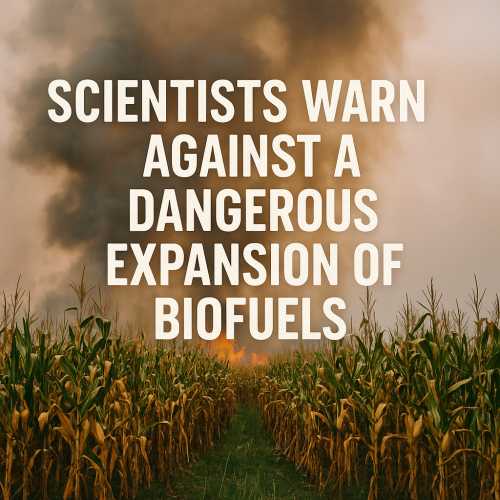
Ahead of the COP30 climate change negotiations, which open next week in Belém, Brazil, over 100 members of the global scientific community, including representatives from the Union of Concerned Scientists and the World Resources Institute, have signed on to a letter calling on global leaders to limit a dangerous expansion of biofuels.
The letter comes as Brazil seeks high-level support for a leaders’ pledge to quadruple so-called “sustainable fuel” use—including a doubling of biofuels consumption—as a major component of the international community’s response to the climate crisis.
But mounting scientific evidence shows that, far from being a climate-friendly solution as many governments claim, on average the energy source is responsible for 16% more emissions than the fossil fuels they replace. It is estimated that doubling biofuel production would increase net global greenhouse gas emissions by nearly 34 MtCO₂e annually, the equivalent of putting 30 million new diesel cars on the road.
The letter also warns that such an expansion would have devastating environmental impacts in some of the world’s most biodiverse regions, consume scarce water resources, and contribute to agricultural runoff. Moreover, the scientists also caution that increased biofuels use will exacerbate global hunger by raising food prices, intensifying food price volatility, and diverting calories from human consumption.
Curbing unrestrained biofuels use is not without precedent. In 2020, the EU agreed to cap conventional (first-generation) crop-based biofuels at a 7 percent share of its transport energy, while waste- and residue-based biofuels are limited to 1.7 percent to encourage fuel innovations and reduce land-use impacts.
In biofuel producer nations, like Brazil and Indonesia, local NGOs are calling for a holistic approach to manage negative impacts, including caps on cultivation, better traceability, and investments in community-based governance and decentralized energy.
Brazil’s biofuels push reflects a dangerous resurgence of biofuels as a global commodity that threatens to repeat the mistake of the “biofuels gold rush” in the mid-2000s that prompted large-scale deforestation, biodiversity loss, and human rights abuses.
“The evidence is clear, burning crops for fuel is a bad idea. We can’t ignore the effects they have on the climate, ecology and food security. Governments must turn to truly sustainable alternatives rather than pushing solutions that, in many cases, do more harm than good,” said Cian Delaney, biofuels campaigner at T&E.
The letter comes as Brazil seeks high-level support for a leaders’ pledge to quadruple so-called “sustainable fuel” use—including a doubling of biofuels consumption—as a major component of the international community’s response to the climate crisis.
But mounting scientific evidence shows that, far from being a climate-friendly solution as many governments claim, on average the energy source is responsible for 16% more emissions than the fossil fuels they replace. It is estimated that doubling biofuel production would increase net global greenhouse gas emissions by nearly 34 MtCO₂e annually, the equivalent of putting 30 million new diesel cars on the road.
The letter also warns that such an expansion would have devastating environmental impacts in some of the world’s most biodiverse regions, consume scarce water resources, and contribute to agricultural runoff. Moreover, the scientists also caution that increased biofuels use will exacerbate global hunger by raising food prices, intensifying food price volatility, and diverting calories from human consumption.
Curbing unrestrained biofuels use is not without precedent. In 2020, the EU agreed to cap conventional (first-generation) crop-based biofuels at a 7 percent share of its transport energy, while waste- and residue-based biofuels are limited to 1.7 percent to encourage fuel innovations and reduce land-use impacts.
In biofuel producer nations, like Brazil and Indonesia, local NGOs are calling for a holistic approach to manage negative impacts, including caps on cultivation, better traceability, and investments in community-based governance and decentralized energy.
Brazil’s biofuels push reflects a dangerous resurgence of biofuels as a global commodity that threatens to repeat the mistake of the “biofuels gold rush” in the mid-2000s that prompted large-scale deforestation, biodiversity loss, and human rights abuses.
“The evidence is clear, burning crops for fuel is a bad idea. We can’t ignore the effects they have on the climate, ecology and food security. Governments must turn to truly sustainable alternatives rather than pushing solutions that, in many cases, do more harm than good,” said Cian Delaney, biofuels campaigner at T&E.











