

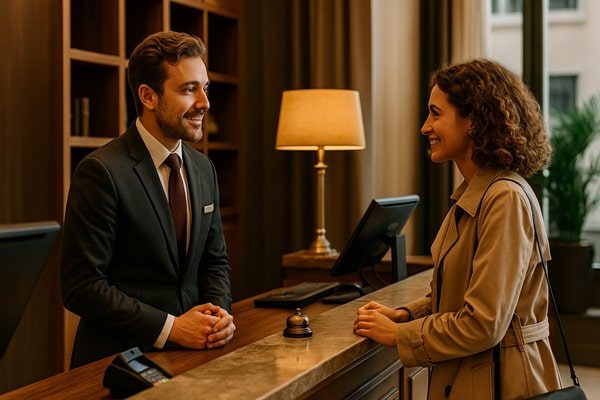
It’s one of the grand ironies of modern travel: the more “hospitality” talks about people, the less hospitable it seems to become. Somewhere between the spreadsheets, acronyms and analytics dashboards, the welcome mat has been quietly rolled up and stored in the server room.
A new report by Skift and Mews delivers an uncomfortable truth. Hotels, it says, have grown so obsessed with counting heads in beds that they’ve forgotten to value the heads and hearts themselves. The industry’s fixation on metrics such as RevPAR and ADR has turned guests into data points and experiences into transactions. In doing so, the sector may be leaving millions of dollars and a fair bit of dignity on the table.
The Soul Has Left the Lobby
“Hospitality is bigger than heads in beds,” declares Richard Valtr, founder of the property-management innovator Mews. “We’ve let spreadsheets define success.”
He’s right. For too long, hoteliers have treated warmth as a line item and rapport as an optional extra. The result? Properties that resemble accounting exercises with minibars.
Valtr’s plea is simple enough to sound revolutionary: stop measuring rooms and start measuring relationships. A hotel, he argues, should be a community platform, a place where locals linger, travellers connect, and every square metre earns its keep not through extraction but through experience.
When the Numbers Don’t Add Up
For an industry so fond of metrics, the numbers aren’t looking friendly. Global hotel investment has sunk to its lowest level in a decade, with US private-equity deals down 85 per cent year-on-year. Occupancy is forecast to dip to 62.5 per cent in 2025, and RevPAR, that sacred cow of revenue acronyms, is expected to fall slightly.
“If you think of a hotel purely as a ‘bums-in-beds’ business,” says Greg Naidoo, Mews’ Chief Evangelist, “you’re trapping yourself in a limited-growth zone.”
Translation: the safe old model isn’t safe anymore. Investors sniff it, shrug, and move on to sexier assets. Guests, meanwhile, are seeking something warmer than algorithmic efficiency, a sense that someone, somewhere, actually cares whether they slept well.
Community: the New Asset Class
Naidoo believes the future belongs to properties designed around people, not pillows. It’s an idea that would have scandalised the 1980s developer class but makes perfect sense now that the neighbourhood café doubles as a workspace and the hotel bar hosts locals who never check in.
In this new arithmetic, every visitor counts the co-worker renting a meeting nook, the parent booking a birthday brunch, the traveller who pops in only for the spa. Each interaction builds what Valtr calls affinity, the industry’s forgotten currency.
“Guests don’t want more options,” says Dina Belon, president of Staypineapple Hotels. “They want better ones.”
And better, it seems, begins with belonging.
From Gold Coast to Global Case Study
Australia’s Paradise Resort Gold Coast has quietly rewritten the rulebook. Instead of flogging rooms, it now sells experiences: ice-skating, water parks, laser tag —anything that keeps guests smiling and tills ringing. By focusing on Revenue Per Available Guest rather than room, the resort lifted profits and staff morale in one go.
“The change was massive,” says Rebecca Lane, the resort’s revenue manager. “We stopped pushing paper and started talking to people.”
Across the world, brands are following suit. Strawberry Hotels in Scandinavia uses flexible tech to personalise stays down to the housekeeping schedule. Hey Lou Hotels markets itself as a “third place” not home, not office, but somewhere human in between. Even Ennismore, part of Accor, reports that 60 per cent of its revenue now comes from something other than beds.
Investors, once allergic to emotion, are beginning to notice that loyalty pays dividends.
Technology With a Pulse
Now for the paradox: the more hotels rely on technology, the more human they can become if they use it properly.
“Technology doesn’t replace hospitality, it reveals it,” says Imke Rottschäfer, digital chief at Hey Lou Hotels. “By removing friction, we make space for what guests truly remember feeling seen.”
It’s not about robots at reception; it’s about data that behaves politely. Systems like Mews integrate booking, dining, and loyalty information so that the next time you stay, the hotel already knows you prefer extra pillows and oat milk. Swiss Hotel Apartments does this across 48 properties, and guests respond with glowing reviews and repeat visits.
Some call it artificial intelligence; others, good manners.
Rethinking the Scorecard
The report proposes retiring the old yardsticks, RevPAR, ADR, GOPPAR, and replacing them with a more holistic measure: RevPAG, or revenue per available guest. It’s not catchy, but it’s clever.
As Belon notes, “A high RevPAR can be misleading if it’s built on discounting or poor margins. Guest-centric metrics tell you whether you’re actually succeeding.”
For the mathematically cautious, this doesn’t mean abandoning profit; it means acknowledging where it truly comes from. As Barry Sternlicht, founder of Starwood Hotels, told a conference recently, “Guests don’t rave about your balance sheet — they rave about Stacy at the pool.”
That line should be engraved above every hotel reception desk in the country.
Bringing Back the Human Welcome
In an era when “experience” has become a buzzword, genuine hospitality still has one unbeatable advantage: it feels real. Guests can tell when they’re valued, and staff perform better when they’re trusted to be warm rather than scripted.
Valtr puts it neatly: “Hotels should expand their reach into guests’ lives not to interfere, but to extend true hospitality.”
It’s a gentle reminder that good service isn’t a commodity; it’s a conversation. And conversations, unlike room rates, have infinite return.
The Bottom Line
Hospitality was never meant to be an algorithm. It was meant to be an act of welcome, something closer to art than arithmetic. Yet many hotels still chase efficiency at the expense of empathy, mistaking automation for advancement.
If they genuinely wish to prosper, they might consider the radical notion of caring again, not as a slogan, but as a strategy.
Because when a guest leaves with a story to tell instead of a receipt to file, that’s not sentimentality. That’s good business.
By Jason Smith – (c) 2025
Read time: 5 minutes.
About the Writer
 Jason Smith has the kind of story you can’t fake, built on long flights, new cities, and that unmistakable hum of hotel life that gets under your skin and never quite leaves. Half American, half Asian, he grew up surrounded by the steady rhythm of the tourism trade in the U.S., where his family helped others see the world long before he did.
Eager to carve out his own path, Jason packed his bags for Bangkok and the Asian Institute of Hospitality & Management, where he majored in Hotel Management and found a career and a calling. From there came years on the road, Singapore, Malaysia, Vietnam, each stop adding another thread to his craft.
He made his mark in Thailand, eventually becoming Director of Sales for one of the country’s leading hotel chains. Then came COVID-19: borders closed, flights grounded, and a new chapter began.
Back home in America, Jason turned his knack for connection into words, joining Global Travel Media to tell the stories behind the check-ins written with the same warmth and honesty that have always defined him.











