

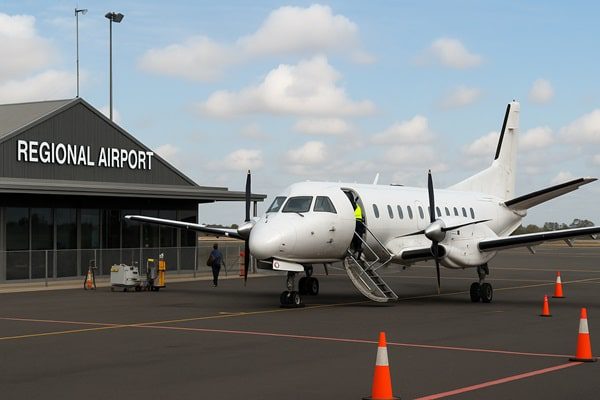
Regional Australia has long been used to making do, a patient sort of stoicism born from distance, drought and diesel. But even the hardiest regional communities can’t do without one thing: a plane that actually turns up.
That’s why Regional Capitals Australia (RCA) has warmly welcomed the launch of two fresh inquiries into the health and sustainability of the nation’s regional aviation network. This industry has been flying through some rather bumpy air of late.
The first inquiry, by the Productivity Commission, will investigate what drives the cost of regional airfares, a topic known to make country mayors sigh and accountants sweat. The second, a Senate committee inquiry, will examine the overall state of Australia’s aviation sector and its ability to deliver reliable, affordable services to the towns and cities that form the nation’s backbone.
RCA Acting Chair Cr Kevin Mack said the inquiries signalled an overdue opportunity to address long-standing inequities between metropolitan and regional air services.
“Regional aviation is essential to the economic and social well-being of regional Australia,” Cr Mack said.
“Air travel provides fast and efficient connections for residents, businesses, emergency services and tourists, and access to healthcare, education and jobs. Without it, people needing to travel between regional capitals and the city would need to drive hundreds, if not thousands, of kilometres.”
It’s hard to argue with that logic. When Bonza Airlines collapsed and Rex Airlines slipped into voluntary administration last year, the turbulence rippled far beyond airport tarmacs. Towns were stranded. Tourism sagged. And locals were left wondering whether their next medical appointment might require a tankful of unleaded and a packed lunch.
A sector under strain
Cr Mack, who led an RCA delegation to Canberra last week, said the twin inquiries provided a crucial chance to ensure the country’s air links remain viable and resilient.
“The collapse of Bonza and the near-loss of Rex exposed the vulnerability of regional aviation routes,” he said.
“The Government’s swift action during Rex’s administration period shows it understands how vital regional air services are to rural and remote Australia.”
But understanding is one thing; action is another. To that end, RCA has called for a genuine partnership with the Federal Government to shore up the future of regional airports, which are, in Mack’s words, “the beating hearts of regional communities.”
More than 60% of regional airports operate at a loss, and nearly 40% expect ongoing deficits, primarily due to ageing infrastructure, onerous security requirements, and high compliance costs that seem better suited to Sydney or Melbourne than Mildura or Wagga.
The case for reform
RCA has urged the Commonwealth to take three decisive steps:
-
Secure the long-term viability of regional aviation routes.
-
Establish a recurrent federal funding stream for capital upgrades and operational security costs.
-
Rebalance aviation security regulations so low-risk airports aren’t forced to bear the same financial burdens as international hubs.
It’s a pragmatic wish-list that recognises that regional airports may never profit, but their value extends far beyond the balance sheet. They are, quite literally, lifelines.
“Regional capitals are growing quickly,” Cr. Mack added. “We need Federal Government investment to operate and maintain infrastructure like airports, ensuring our cities remain liveable, connected and resilient.”
Indeed, the numbers speak volumes. RCA represents 21 regional capital city councils, supports over nine million Australians, and generates over $225 billion annually for the national economy, not exactly small change.
Keeping the regions in the sky
The inquiries come at a pivotal time for the sector. With domestic tourism rebounding and regional migration accelerating, air connectivity is now seen as critical national infrastructure, not a luxury, but a lifeline.
For policymakers, this means recognising that reliable air links don’t just move passengers; they move economies, communities and futures. It’s about something simpler for regional Australians: being able to fly out on Monday and fly back Friday, without fearing the airline has folded mid-week.
Suppose the inquiries deliver the clarity and commitment RCA is seeking. In that case, the country’s regional airports might finally have cause to exhale — and passengers from Dubbo to Devonport might enjoy the small luxury of booking a flight with confidence it will actually take off.
For more on the Productivity Commission inquiry, visit pc.gov.au/inquiries.
For details of the Senate committee inquiry, see aph.gov.au.
By Karuna Johnson – (c) 2025
Read Time: 5 minutes
About the Writer
 Karuna Johnson has one of those rare careers that could only belong to someone who genuinely loves travel. A Thai national with dual citizenship, she’s as comfortable swapping stories over street food in Bangkok as she is discussing strategy in a Sydney boardroom.
Educated in Thailand and Australia, Karuna speaks several languages fluently, a skill that’s served her well across a career that’s taken her through the inner workings of three Destination Management Companies and a string of hotels. She’s done everything from sales to admin, always with the kind of quiet competence that keeps things moving while everyone else still finds the coffee.
Her travels have taken her far and wide across Asia, Europe, and the United States, yet she still finds joy in the details: the people, the culture, and the stories behind every journey.
She’s worldly, poised, and precisely the kind of voice Global Travel Media was made for.
==================================











