

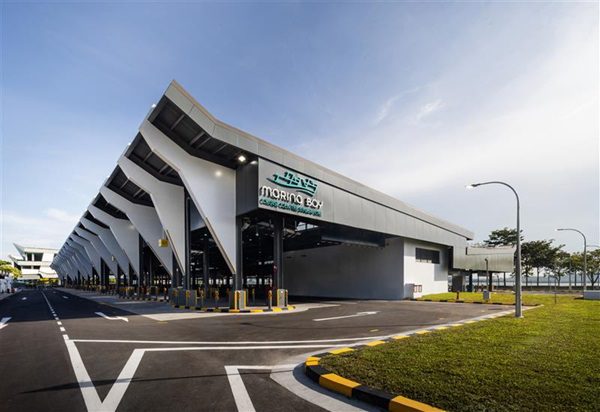
If Singapore ever decided to enter a global efficiency contest, the Marina Bay Cruise Centre would be its victory lap.
After a S$40 million refit, the terminal now gleams like a freshly buffed deck, proving once again that when it comes to travel infrastructure, Singapore doesn’t tinker – it perfects.
The country’s cruise gateway has been given the kind of overhaul that turns a port of call into a point of pride. It’s not just a facelift; it’s a quiet statement that Asia’s cruise capital intends to keep its title.
Check in, sit down, sail away.
At the heart of the upgrade is a new check-in hall on Level 1—a 70-counter, 500-seat marvel designed to handle the ebb and flow of thousands of passengers boarding two mega-ships at once.
For the uninitiated, “dual calls” used to mean chaos. Now, it means choreography.
Meanwhile, Level 2 retains its familiar check-in role for Pier 1. Both halls are blessed with VIP lounges for those who prefer to sip their bubbles rather than line up in them.
It’s as if Changi Airport lent its playbook across the harbour, all polished floors, smiling staff, and a distinct absence of panic.
Wider roads and shorter sighs
The once-narrow approach roads have been widened, coach bays have been multiplied, and a new ground transport area that makes sense of the words “arrival experience” has been introduced.
Thanks to early baggage drop-off, bags can now go straight to the ship, freeing passengers from the familiar ritual of wrestling their wheelies over kerbs.
Ride-hailing lots have doubled, and a looped shuttle now links Marina South Pier MRT to the terminal, proof that Singapore can turn even a bus timetable into a work of art.
Drivers can now book carpark spaces 60 days ahead (at discounted rates, naturally), while those with limited mobility can summon a buggy for a smooth glide to the terminal.
The kind of orderliness would make even the Swiss take notes.
Cruising light
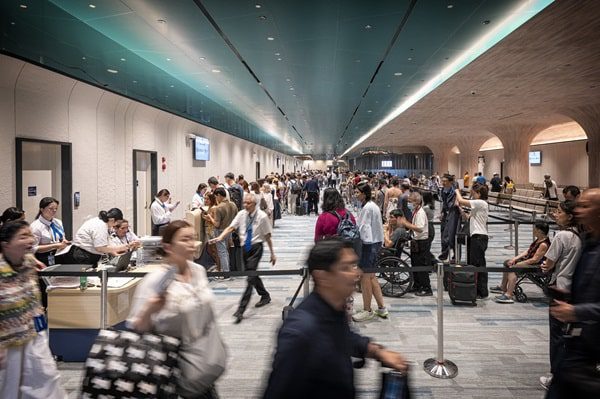
SATS_MBCCS_New Check-in Hall
The terminal has gone one step further to make travelling smoother than a glassy sea.
Partnering with third-party providers, baggage transfer services send luggage to any Singapore hotel or directly to Changi Airport. At the same time, shuttle buses ferry visitors to Gardens by the Bay and Chinatown on select cruise days.
For passengers disembarking in Singapore, the revived Cruise-Fly Service lets them check in and tag their baggage for same-day flights.
The result: a few more free hours to explore the city, without lugging around a bag big enough to fit a small planet.
The quiet genius below deck
What passengers don’t see is just as clever. Behind the scenes, MBCCS now runs a Vehicle Slot Management System, a digital dance floor where every delivery truck knows its turn.
Food, linens, and ship stores are coordinated to the minute, keeping the quayside as calm as the air-conditioned lounges.
Then there’s the PortDeck, an invention that sounds dull until you realise it’s a convertible bench-table system that saves space and smooths operations during peak times. A modest marvel, really, the kind of thing only Singapore would bother to engineer and then quietly perfect.
The captains speak
Gregory Tan, CEO of SATS-Creuers, calls the overhaul “a transformative step for MBCCS”.
“By streamlining check-in, introducing early baggage drop-off, upgrading ground transport and deploying innovative back-end systems, we’re improving efficiency and convenience for passengers and cruise operators alike,” Tan said.
In other words, less queuing, more cruising.
Chairman Bob Chi echoed the sentiment, adding:
“This extensive upgrade underscores our commitment to growing Singapore’s cruise industry in partnership with the Singapore Tourism Board. Together, we aim to raise service standards, attract leading cruise lines, and unlock greater opportunities for Singapore’s dynamic tourism ecosystem.”
In a country that treats tourism like a national sport, “service standards” aren’t just a phrase; they’re a promise.
The bigger voyage
According to Ong Huey Hong, Assistant Chief Executive at the Singapore Tourism Board, this revamp isn’t just about shiny tiles and air-conditioning.
“The enhanced Marina Bay Cruise Centre Singapore exemplifies our Tourism 2040 ambition of creating an attractive destination by strengthening our tourism offerings… delivering world-class infrastructure that meets evolving traveller expectations.”
Translation: Singapore intends to keep its ships full, its tourists happy, and its reputation unsinkable.
Global backing, local precision
Even Mehmet Kutman, Chairman and CEO of Global Ports Holding (the parent company of Creuers), had his say:
“This milestone reflects our shared vision with SATS and the Singapore Tourism Board to make Marina Bay Cruise Centre a benchmark for operational excellence in Asia.”
It’s the sort of partnership Singapore does well: multinational, meticulously managed, and miraculously on schedule.
Singapore’s quiet confidence
For all its gleaming metal and measured logistics, there’s something almost poetic about Singapore’s cruise ambitions.
While other ports talk about “future readiness,” Singapore quietly builds one berth and system and satisfies passengers at a time.
The Marina Bay Cruise Centre’s makeover isn’t just about making embarkation smoother; it’s about keeping Singapore exactly where it likes to be at the front of the fleet, polished shoes and all.
By Soo James – (c) 2025
Read time: 6 minutes
About the Writer
 There’s nothing predictable about Soo James, and that’s precisely her charm. Of Malaysian descent, she set down academic roots at the University of New South Wales, majoring in Arts, before veering off into the unlikeliest of places: IT. It mightn’t sound romantic, but somewhere between data strings and deadlines, Soo was fascinated with how people and words connect.
What began as a curiosity soon turned into a craft. Over time, her writing slipped effortlessly into travel blogs and lifestyle features, each piece marked by her dry wit and a mind that notices the small, telling details others might miss. She writes with a traveller’s eye and a local’s heart, grounded, observant, and quietly amused by the world’s contradictions. Today, at Global Travel Media, Soo’s words do what travel should always do: take readers somewhere new, even for a few minutes.











