

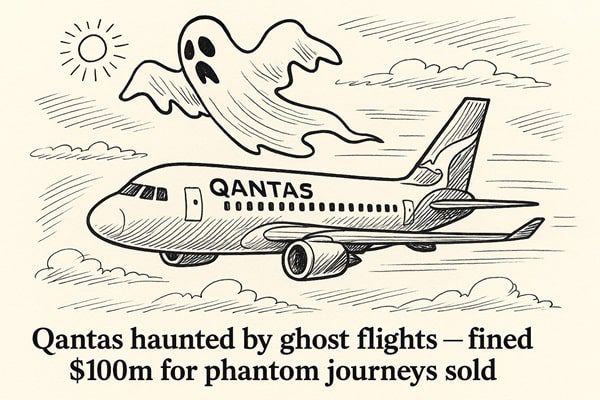
On 8 October 2024, the Federal Court ordered Qantas to pay penalties of $100 million for misleading 86,597 public members by selling bookings on cancelled flights and for misleading 883,977 public members by promptly notifying flight cancellations.
The decision is Australian Competition and Consumer Commission v Qantas Airways Limited [2024] FCA 1219 (Rofe J).
Earlier, on 5 May 2024, Qantas gave a court-enforceable undertaking to the Australian Competition & Consumer Commission (“ACCC”) to pay $20 million (in total) as cancellation compensation to the members of the public who were misled.
This is a commentary.
How was the public misled?
Qantas misled the public (called ‘consumers’ in this article) in two ways:
- Continued Sale Conduct
For more than two years (between 21 May 2021 and 26 August 2023), Qantas continued to sell tickets for flights scheduled to depart between 1 May 2022 and 10 May 2024 after it had decided to cancel the flights.
- Delayed Notification Conduct’
Qantas continued to display flight details on the ‘Manage Booking’ page for ticketholders who had booked flights for two or more days after Qantas had decided to cancel the flight, with no indication that Qantas had already decided to cancel the flight.
Qantas cancelled more than 82,000 flights.
These are two examples from the ACCC Media Release of 31 August 2023 –
- Qantas flight QF93 was scheduled to depart from Melbourne to Los Angeles on 6 May 2022. On 28 April 2022, Qantas decided to cancel the flight. Despite this, Qantas did not remove the flight from sale until 2 May 2022, and did not inform existing ticket holders of the cancellation until 4 May 2022 (two days before the flight).
- Qantas flight QF1785 was scheduled to depart from the Gold Coast to Sydney on 1 May 2022. On 17 February 2022, Qantas decided to cancel the flight. Despite this, Qantas did not remove the flight from sale until 15 March 2022 and did not inform existing ticket holders of the cancellation until 16 March 2022.
Refer to our earlier article, “Qantas hits turbulence for selling airfares on 8,000 cancelled flights” (4 September 2023), which provides the background for the proceedings. Also, our article “Is an air ticket a right to fly or only a bundle of rights to fly?“ analyses Qantas’ defence.
The Court noted that the cancelled flights are colloquially called ghost flights.
The Australian Consumer Law breaches
The contraventions (‘breaches’) of the Australian Consumer Law were: misleading or deceptive conduct (s 18(1)); and false or misleading representations (ss 29(1)(b), 29(1)(g) and 34).
The conduct and representations were:
Continued Sale Conduct
After it had cancelled the flights, Qantas stated that:
- The relevant flights with the corresponding stated flight number and scheduled date and time were still available; and
- Qantas will reasonably try to operate the relevant flights on the scheduled date and time.
Delayed Notification Conduct
After it had cancelled the flights, Qantas represented that:
- The relevant flights with the stated flight number and scheduled date and time displayed on the ‘Manage Booking ‘page were unchanged; and
- Qantas will make reasonable endeavours to operate the flight displayed on the ‘Manage Booking’ page at the scheduled time and date.
Calculation of the penalty
The penalty for breach of the Australian Consumer Law can be substantial: the greater of $50 million or three times the benefit or 30% of the annual turnover.
The Court takes many factors into consideration in calculating the penalty. In this case, the factors were: the size and financial position of Qantas; the duration, extent and nature of the offending; knowledge of senior managers; impact of Qantas’ offending; resources at Qantas’ disposal; Qantas’ prior conduct; and mitigating factors.
In particular, the Court considered the number of consumers affected, the number of cancellations, the harm suffered by the consumers and the financial benefit Qantas received.
Continued Sale Conduct
- 86,597 consumers had paid the airfare for a flight that was cancelled.
- On average, tickets for the cancelled flights were offered for sale for about 11 days after cancellation, and in some cases, for up to 62 days after cancellation.
- Consumers suffered harm by being likely to pay more for an alternative flight, which may have been inconvenient or unsuitable because it was an indirect route and/or had a different arrival time.
- Qantas benefited by obtaining and retaining the amount paid by consumers for the tickets, which was $170.9 million over more than two years.
This was the more serious breach. The penalty for this breach was $70 million.
Delayed Notification Conduct
- 883,977 consumers were affected – 806,406 held bookings on a domestic/trans-Tasman flight and 77,571 held bookings on an international flight.
- Qantas cancelled 60,297 flights – 57,274 domestic/trans-Tasman and 3,023 international.
- On average, it took Qantas about 11 days to notify the ticket holders of the cancellation of their flight. In some cases, it took up to 67 days.
- Consumers suffered harm because of the greater cost, inconvenience or unsuitability of making alternative arrangements closer to the scheduled departure date.
- Qantas, benefitted by retaining revenue from consumers who, having purchased a ticket from Qantas, were less likely to change carrier when they were ultimately notified their flight was cancelled.
The penalty for this breach was $30 million.
Qantas gave an undertaking (see below) to implement an Australian Consumer Law compliance program and a consumer compensation scheme.
The Court considered the compensation scheme to be a mitigating factor in calculating the penalties because consumers suffered more harm than an alternative flight or refund might provide:
- “The offer of an alternative flight did not address the harm associated with a passenger’s loss. Some passengers may have suffered loss as a result of making travel or other arrangements based upon expected flight schedules”.
- “For example, consumers may have paid for travel arrangements which were not flexible or refundable, or which became non-refundable in the period between the date on which the consumer booked the relevant flight and the date on which Qantas notified the consumer that the flight had been cancelled.”
Consumer Compensation
When the ACCC prosecutes breaches of the Australian Consumer Law, it does not seek Court orders to compensate consumers for their loss.
Consumer compensation was available in this case because Qantas offered a court-enforceable undertaking as part of the agreement with the ACCC to resolve the proceedings. In the undertaking, Qantas made admissions of liability, agreed on the penalty of $100 million, agreed to implement an Australian Consumer Law Compliance Program and a consumer compensation scheme.
The ACCC described the scheme in ACCC Media Release of 8 October 2024:
“In addition to the $100 million in penalties, Qantas has undertaken to pay around $20 million to consumers who made bookings on flights that Qantas had already decided to cancel, or were reaccommodated onto these flights after the cancellation of another flight.
Consumers who made a booking (or were reaccommodated) on a flight two or more days after a decision had already been made to cancel that flight are eligible to receive payments of $225 for domestic/trans-Tasman passengers or $450 for international passengers.
These payments are in addition to any remedies consumers already received from Qantas, such as alternative flights or refunds.
Qantas contacted the majority of eligible consumers on or before 10 July 2024. Consumers have until 6 May 2025 to submit their claim for a payment through the Qantas Customer Remediation Program.
Qantas is required to make all payments to eligible consumers within 60 days of payment information being provided by the consumer (or a person on their behalf) and acceptance of this information by Qantas/Deloitte.
Payments are made using the banking details nominated by the relevant person. The intention is that payments will be made to affected travellers.
If the amount paid does not reach $20 million at the conclusion of the remediation program (6 May 2025), the residual balance will be donated to a charitable organisation to be approved by the ACCC.”
Comments
It was a smart move by Qantas to offer consumer compensation because Australian airlines offer only an alternative flight, or if none is available, a fare refund for a flight cancellation. They do not offer lump sum compensation, unlike in Europ,e where the EU Air Passenger Rights Rules require airlines to pay lump sum compensation for flight cancellations.
Therefore, the fact that Qantas has undertaken to pay lump sum cancellation compensation to affected passengers is highly unusual and is attributable to the ACCC’s pursuit of Qantas for breaches of the Australian Consumer Law. It also influenced the ACCC to reduce its demand for a penalty of $250m to $100m.
Marketing Commentary by Michael Field from EvettField Partners
Broken Promises, Broken Trust: Why the ACCC’s Action Against Qantas Signals a Reckoning for All Brands Dependent on Customer Bookings
The recent case involving Qantas and the ACCC highlights a growing issue in the airline, travel, and broader service industries: the erosion of customer trust due to inadequate communication about cancellations and service disruptions.
When customers book flights, hotels, or other experiences, they trust the brand to deliver on its promises. Qantas’s delayed notification of cancelled flights undermines this trust, leaving customers disappointed and financially and emotionally impacted by disrupted plans.
This results in damage to the brand and reputation. For customers, last-minute cancellations without prompt compensation or alternatives feel like a violation of trust, often prompting them to rethink their loyalty to a brand.
The ACCC’s decision to impose financial penalties on Qantas should serve as a wake-up call for any business that relies on bookings.
As a result, travel, hospitality, events and entertainment companies need to prioritise transparent communication and swift redressal mechanisms to mitigate consumer dissatisfaction and prevent churn. Businesses that continue to disregard these aspects risk legal consequences and long-term damage to their brand loyalty and customer retention.
Two lessons from the Qantas ghost flights debacle
- Don’t promise what you aren’t able to deliver. Qantas advertised 82,000 flights between 2022 and 2024 that it cancelled because of ‘operational difficulties’.
- If a service or event is cancelled, let the customers know immediately. Please don’t wait more than two days to tell the customers, like Qantas did.
The Federal Court ordered Qantas to pay a fine of $100m because its systems allowed it to accept payments and not notify customers who had booked for more than 2 days after the flights were cancelled.
By Tony Cordato – Contributor, Global Travel Media – (c) 2025
About the Author
 Every Monday, Tony Cordato walks into his Sydney legal office with the same curiosity that has fuelled his career for decades: What remarkable problem will land on my desk this week? He never has to wait long.
A sharp legal mind with a flair for practical problem-solving, Cordato has built his reputation on finding pathways where others see roadblocks. He’s fond of quoting financier J.P. Morgan’s wisdom: “I don’t want a lawyer who tells me why something can’t be done, I want one who tells me how to do it.” It’s a philosophy he’s lived by.
Tony’s practice covers the full spectrum of business and property law from investment and development to vendor finance, trusts, SMSFs, and the ever-intriguing realm of travel law. When disputes arise, he handles litigation and mediation with the calm precision of a craftsman who knows his brief and clients.
A regular contributor to Global Travel Media, Cordato decodes complex travel-industry legal issues with clarity, wit, and old-fashioned professional integrity, a steady voice in a restless world.











