

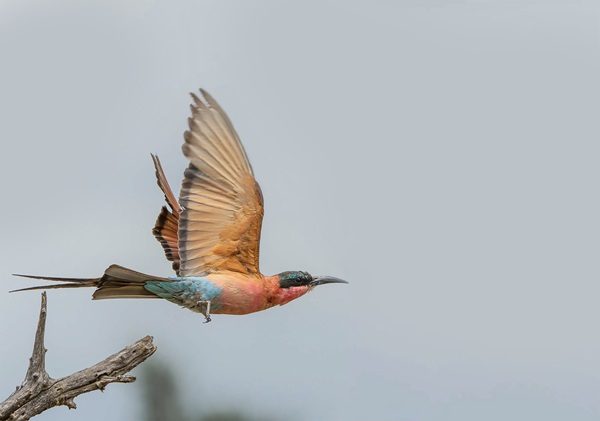
For those who believe the bush should be heard at night and admired at dawn, a new address is shaping up in Zambia’s South Luangwa Valley one with old-world manners, modern engineering, and just enough swagger to keep the big cats interested. Carmine’s River Lodge, opening June 2026, is positioning itself as a deliberately intimate entrant three two-bedroom villas to start with design choices that whisper rather than shout. A good instinct in the bush. Animals don’t much like shouting.
Travel trade specialist Travel Promoters has been appointed to oversee global trade sales and marketing for the launch—a traditional move that signals sensible distribution, serious rate discipline, and an eye on the right wholesalers. For those wanting the early brief, the lodge takes its name from the star of this stretch of river: the Southern Carmine Bee-eater, whose colossal nesting colony faces the site across the Luangwa Wafwa. If you’ve ever watched a cloud of carmines lift off in the sort of light photographers travel continents for, you’ll understand why the branding writes itself. The property line sums it neatly: “The Art of Nesting, Perfected.”
A location that reads like a field guide
Set on 54 acres of private island land between two rivers, the lodge sits in the so-called Valley of the Leopards, a wildlife corridor that lives up to its billing. Elephant, big cats and wild dog all work this area; birders will dine out on their checklists for years. Access is straightforward by African standards: about 70 minutes by air from Lusaka to Mfuwe, and then roughly 50 minutes by road to the lodge. From there, it’s less than 10 minutes by pontoon to South Luangwa National Park, or about 20 minutes to the Nsefu sector a classic double-act of habitats that rewards the patient and punishes the inattentive.
For context on the destination, South Luangwa is widely regarded as the birthplace of the walking safari, a tradition that continues here with guides who prefer dust on their boots to pixels on their phones. (If you’re new to Zambia, the national and park overviews are worth a look via Zambia Tourism and South Luangwa NP backgrounders: zambiatourism.com.)
Villas for grown-ups (with room for families)
The build sheet reads like a small-batch suit: three two-bedroom villas, each cleverly elevated under 20-foot ebony trees to reduce footprint and improve sightlines. At just under 240 sqm apiece, the pavilions are designed as private retreats with a central living and bar area, deck and plunge pool, and two identical bedrooms each with a freestanding bath and a fully glazed indoor/outdoor “infinity” shower you’ll probably post about and then pretend you didn’t.
The design language is eco-conscious contemporary, softened by locally crafted furniture, Zambian-made fittings, and some hand-picked antiques to keep the place from feeling like a showroom. There’s a dedicated accessible villa with a lift and level access to main areas sensible, inclusive and, frankly, overdue across the broader safari world.
Old-school service, new-school kit
Each party is looked after by a personal Nkhoswe literally “brother and protector” and a private, qualified guide. Game viewing will be conducted in new custom 6-seater vehicles fewer elbows, better sightlines and each villa also gets a second enclosed vehicle purely for private transfers, which will appeal to guests who think “shared transfer” is code for “late for sundowners.”
In a neat bit of bush-theatre, the three villas and vehicles carry paired avian names – Owl, Hamerkop and Kingfisher—tipping the hat to the area’s prolific birdlife and underwriting the lodge’s identity beyond those famous bee-eaters.
Night drives are a specialty here, using conservation-friendly red light to reduce impact on nocturnal species. There’s also a “starry night” option for astronomically inclined guests who know the Southern Cross is more than a pub. Daytime walking safaris will be standard this is South Luangwa, after all led by guides who understand that the point isn’t distance but detail.
Photographers, children and anyone who likes a decent pastry
There’s a lot to be said for generosity in the bush. Carmine’s will stock Canon camera gear on loan, and the main lodge includes a photographic studio and media room doubling as an education space useful for rainy afternoons, keen learners, and the indefinitely curious.
Families haven’t been forgotten. Children are welcome, with dedicated activities that should save a few bed-time negotiations. Evenings will orbit the boma and fire pit, as they should, with an infinity pool, indoor and outdoor dining, an elegant bar, wine room, and a boutique handling those items you forgot in Lusaka.
Fitness is catered for with a fully equipped gym, and in-room spa treatments can be pre-booked. Kitchen-wise, the lodge is taking a professional stance with separate catering, pastry, and halal kitchens a detail travel advisors will appreciate when fielding questions. An animal-proof greenhouse will supply a farm-to-table program; the chef’s brief is unambiguous: exceptional quality or bust.
Sustainability done quietly – and properly
Zambia has no patience for tokenism, and neither do experienced travellers. Carmine’s aims to operate 100% on solar power with emergency backups only, backed by a full water-filtration plant and comprehensive use of recyclable and biodegradable amenities. It’s the sort of infrastructure that costs money and rarely makes headlines but it does earn loyalty from guests who prefer substance over slogans.
A lodge that respects its neighbours
South Luangwa’s conservation story is both fragile and formidable, built on decades of tireless work by rangers, NGOs and communities. The lodge’s decision to minimise development footprint, elevate structures, and concentrate guest numbers signals a respectful approach. Add the red-light night policy and a clear nod to walking-led interpretation, and you get a property that wants to belong to its landscape not dominate it.
Rates, distribution and the trade play
Rates and fact sheets are flagged as “coming weeks,” with Travel Promoters coordinating trade communications and collateral. If you’re placing product or planning a recce, the early-stage assets site location, mood boards and villa plans are already posted via Travel Promoters (see their update: travelpromoters.co.uk/tp-news/travel-promoters-new-lodge-south-luangwa). For booking enquiries or preliminary briefings, the team is on [email protected] again, traditional, efficient, and precisely how the trade likes it.
Why it matters
The southern African luxury safari set is famously competitive. New builds must justify their existence beyond soft furnishings and a plunge pool. Carmine’s case rests on three pillars:
-
Place. A high-value wildlife corridor within easy reach of two premium game areas, plus that spectacular bee-eater colony across the water. You can create service; you cannot fabricate riverine ecology.
-
Proportion. Three villas to start 12 guests standard (18 with extra beds) keeps both footprint and human noise down. The bush wins; so do guests.
-
Practice. Solar power, filtration, walking-centric guiding, and a clear education component, threaded with quietly luxurious standards (a wine room, a halal kitchen, a lift in the accessible villa). It’s not just “new”; it’s thought through.
If Carmine’s can maintain guide quality, keep the pastry trolley honest and the greenhouse flourishing, it will arrive in 2026 not as a trumpet blast but as a well-tuned instrument designed to accompany, not drown out, the score already playing in South Luangwa.
By Stephen Morton












