

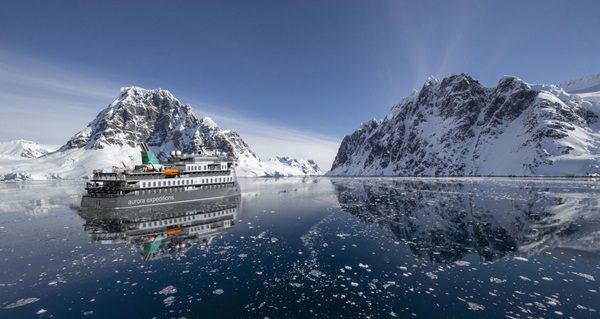
Aurora Expeditions, a small Sydney-based cruise line, is on a mission to dramatically change the cruise industry’s sustainability narrative.
With a focus on expedition cruises to the Arctic and Antarctic, the company is making bold claims about its environmental efforts, including becoming the first cruise line to get B Corporation bragging rights.
But can Aurora truly deliver on its promises? And does sustainability even matter in an industry notorious for pollution and waste?
Reality check: The cruise industry has long been criticised for its reckless environmental practices. According to a recent study, European cruise ships emit as much sulphur dioxide as one billion cars. The cruise industry’s overall environmental record is downright awful, from carbon emissions to waste disposal.
Against this backdrop, Aurora’s sustainability claims seem almost too good to be true.
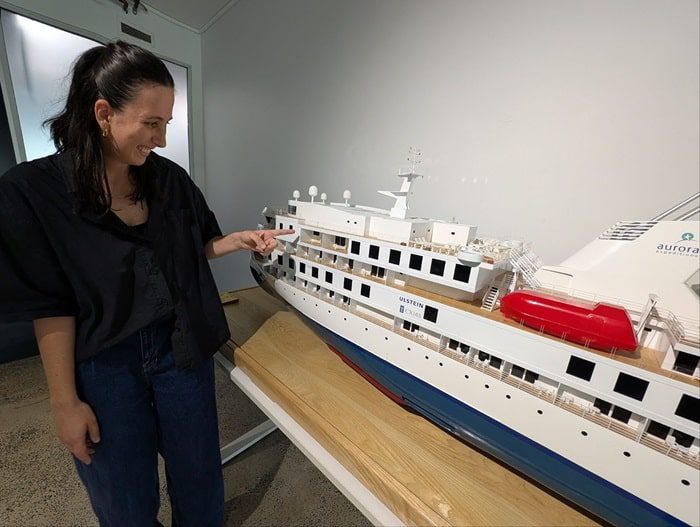
Aurora’s sustainability manager, Sasha Buch, with a model of the Greg Mortimer, one of its expedition vessels.
“Sustainability is who we are”
Sasha Buch, Aurora’s sustainability manager, met me at the company’s headquarters in the Surry Hills neighbourhood of Sydney, a quiet district filled with apartments, office buildings and cafes. One of the first things she told me was that Aurora is a different kind of cruise line.
“Sustainability is who we are,” she says, pointing to the company’s founding in 1991 by mountaineer Greg Mortimer and his wife, Margaret, both passionate environmentalists.
Aurora achieved the B Corporation certification last year. This designation requires companies to meet rigorous standards for social and environmental performance, accountability, and transparency. Becoming a B Corp is a journey, not a destination; standards are revised annually, keeping every B Corp on its toes.
A closer look at Aurora’s sustainability initiatives
Aurora’s actual sustainability efforts are wide-ranging. Here’s a breakdown of their key initiatives:
Innovative ships
Aurora’s fleet includes three state-of-the-art ships designed with sustainability in mind. Features like the X-BOW design, which reduces fuel consumption, and shore-based power systems promise to reduce cruising’s environmental impact.
“Our ships are a testament to what’s possible when you prioritize sustainability,” Buch says.
Climate action
Aurora achieved a carbon-neutral certification in 2021, meaning it measures and offsets its carbon emissions. The company has also partnered with Trace, a green technology company, to map a path to net-zero emissions.
“We’re not just offsetting,” Buch told me. “We’re actively reducing our emissions.”
Education and enrichment
Aurora’s Citizen Science Program allows passengers to participate in data collection, from photographing whales to testing for microplastics. Buch says the educational initiatives deepen their passengers’ understanding of the environment and, over time, will support a more sustainable cruising experience.
Waste and water management
The cruise line adheres to strict international waste and water management standards, eliminating single-use plastics and using eco-certified cleaning products.
Community engagement
Aurora’s Community Ambassador Program works with Inuit communities in the Arctic to promote cultural exchange and provide economic benefits to indigenous communities.
Aurora’s newest ship, the Douglas Mawson, also represents a leap forward. When it launches in December, it will set the bar for conservation in the Antarctic. Programs such as waste minimisation, carbon offset, and collaboration with leading conservation organisations will be built into the cruise experience. Aurora says the ship is designed to minimise environmental impact and will help travellers tread lightly on the fragile polar environment.
The big picture: Does sustainability matter?
The very nature of cruising — of transporting large numbers of people to remote and fragile ecosystems — is inherently destructive. And in this business, the most popular cruise lines are often the ones that can do it at the lowest price, not the most responsibly.
Aurora seems to know that the deck is stacked against a company that puts sustainability rather than profitability in the captain’s chair. And you get a sense in talking to someone like Buch that they like that challenge.
“We’re always trying to do more because there’s always so much more that can be done,” she says.
Buch emphasises the importance of transparency and accountability in Aurora’s sustainability efforts. The company constantly makes course corrections as it aims to become carbon-negative. She says the goal isn’t just recycling but regenerative tourism—going beyond minimising harm to actively restoring and improving the environments they visit.
“It’s about taking care of what we have now for future generations as well as repairing any damage that has been done,” she explains.
The company’s latest impact report outlines a checklist of accomplishments. These include becoming carbon-neutral, participating in cleanups to remove marine debris from the coastlines of Iceland and Svalbard, and demonstrating a “dramatic” reduction of single-use plastics in its operations.
The challenges ahead
Despite Aurora’s efforts, the fundamental question remains: Can an industry built on fossil fuels and mass tourism ever truly be sustainable?
Buch is optimistic.
“We have a responsibility to inspire, educate, and advocate for the protection and preservation of the places we visit,” she says.
Aurora is making giant strides in sustainability, and its B Corporation certification is a significant achievement. But the company’s efforts represent only one step in the cruise industry’s journey toward becoming green. And it won’t happen unless passengers want it to, so they’re booking more cruises with a company like Aurora.
“We know there’s a long way to go,” she says.
Aurora’s journey toward sustainability is a work in progress, one that will require ongoing accountability and scrutiny. In the meantime, the takeaway for travellers is clear: You have to carefully consider the effect of your next cruise on the environment. It may be worth spending a little extra to go with a company dedicated to long-term sustainability.
By Christopher Elliott
 BIO:
BIO:
Christopher Elliott is an author, consumer advocate, and journalist. He founded Elliott Advocacy, a nonprofit organization that helps solve consumer problems. He publishes Elliott Confidential, a travel newsletter, and the Elliott Report, a news site about customer service. If you need help with a consumer problem, you can reach him here or email him at [email protected].











