When the United States decides to hold a mirror up to its tourism industry, the reflection is rarely modest. The recently released National Travel and Tourism Office (NTTO) Study of International Visitor Satisfaction — a landmark report comparing America’s performance to its global peers paints a picture of a destination that still dazzles in shopping, beaches, and hospitality, yet occasionally forgets to serve the food hot.
Based on extensive surveys and online reviews from international visitors in 2023, the report compares the U.S. against leading destinations across ten categories from culture and transport to accommodation and food. In short, America remains a powerhouse destination, but even the mightiest empires occasionally cross their menus.
The Competitive Edge – and the Occasional Blunt Knife
According to the NTTO’s analysis, the U.S. had a competitive advantage in half the categories studied: shopping, culture and leisure, beaches and water activities, and the ever-subjective domain of hospitality and safety.
Overseas visitors in particular lauded America’s “range of shopping possibilities”, hardly surprising in a nation where malls still gleam like cathedrals. Ease of communication, amusement parks, generous opening hours, and smartphone travel tools also earned high marks.
Where the red, white, and blue lost a few stripes, however, was in the culinary arena. Visitors found the food experience wanting, citing poor value for money and uneven quality. The report diplomatically refers to this as a “competitive disadvantage.” In plainer English: international visitors love America’s theme parks but wish the burgers cost less and the salads looked fresher.
Neighbours with Benefits – Canada and Mexico Approve
The picture brightens considerably when viewed through the eyes of America’s closest friends, Canadians and Mexicans. The U.S. scored competitive advantages in nine categories for these North American neighbours, with only Historical Heritage trailing behind.
Canadians and Mexicans praised everything from parking convenience to cleanliness of beaches, opening hours, and — yes — that vast shopping range again. It seems even familiarity doesn’t dull the appeal of a good outlet mall.
Still, not all was perfect. Visitors across borders cited public transport accessibility and the price of getting around as weak points. In the land that invented the open road, the car remains king, but travellers gently remind the U.S. that not everyone wants to rent one.
The Top Five Takeaways – America’s Mixed Scorecard
For a nation long accustomed to topping global travel wish-lists, the NTTO study serves as both reassurance and a gentle nudge. The highlights read like a tourism brochure:
-
Shopping reigns supreme– Variety, hours, and sheer abundance lead the world.
-
Ease of communication – English proficiency and tech-savvy locals score highly.
-
Cultural and leisure diversity – Theme parks, museums, and events win hearts.
-
Beach and water activities – Sunshine still sells.
-
Hospitality and safety perception – Generally strong, though with regional variance.
The less flattering side? Food experience, historical depth, and transport affordability still lower America’s global average. Even the most patriotic traveller must admit that getting from the airport to the city can feel like navigating a maze built by a committee of accountants.
Ratings, Reviews, and the Modern Travel Jury
The NTTO didn’t stop at surveys; it delved into the vast digital grapevine of online ratings and reviews, comparing U.S. attractions, restaurants, and hotels with those in other destinations.
The findings are particularly telling here. U.S. attractions and restaurants generally held their own, with satisfaction levels “closely mirroring global competitors.” Accommodations, however, came in measurably lower, a reminder that the American service smile, while famous, doesn’t always translate into seamless stays.
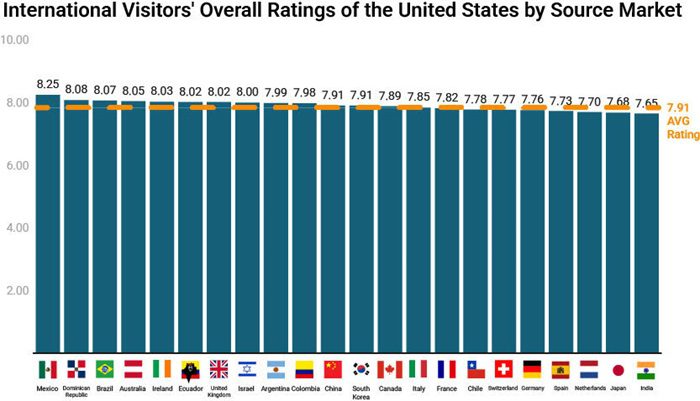
Despite these inconsistencies, the overall international sentiment toward the U.S. as a destination remained strongly positive, stretching across all nine Census divisions from the sun-bleached Pacific coast to the jazz-filled South.
By the Numbers – The 2025 Travel Landscape
For context, the NTTO also released July 2025 travel volume data, offering a snapshot of how recovery is tracking post-pandemic. The figures tell an uneven story.
International visitor arrivals to the U.S. reached 6.27 million, down 8.9% year-on-year but still a respectable 81.5% of pre-COVID July 2019 levels. The most significant sources of arrivals were Mexico, Canada, the United Kingdom, India, and France, accounting for nearly 60% of total inbound travel.
On the outbound front, Americans were more adventurous. In July 2025, U.S. citizens made 11.76 million international trips, up 4.6% from the previous year and exceeding pre-pandemic volumes. Mexico and the Caribbean remained the top holiday choices, claiming nearly half of all U.S. outbound journeys.
Europe was the second-favourite playground, welcoming 2.78 million American visitors, a healthy 6.4% rise on 2024 numbers. Evidently, wanderlust remains as American as apple pie, even if that pie occasionally costs too much.
Food for Thought – Literally
Of all the findings, perhaps America’s culinary conundrum is the most intriguing. The U.S. boasts some of the world’s most famous restaurants, yet visitors still rate the nation’s food experience as a weakness.
One suspects this is not a complaint about availability; this is the land of 24-hour diners and drive-thru everything. It’s about value, authenticity, and consistency. International travellers, increasingly seasoned by global exposure, want more than quantity; they want character.
A French visitor quoted in the survey summed it up neatly: “You can find food everywhere in America, but not everywhere you find flavour.”
The Competitive Landscape – Lessons from Abroad
Globally, tourism competition is fierce and fast-evolving. Destinations like Japan, France, Spain, and Thailand have raised the bar with seamless transport systems, food cultures steeped in heritage, and aggressive digital engagement.
America’s challenge is to balance its sheer scale and diversity with a renewed focus on visitor experience. The NTTO study suggests the U.S. remains a “destination of dreams,” but dreams alone won’t fill hotel beds or online reviews.
Perspective – Why This Matters
Beyond the statistics, this report is a gentle but pointed reminder that tourism competitiveness is about emotion as much as economics. Travellers today compare destinations not just on price or safety, but on how welcome they feel and how easily they can post a photo without finding the Wi-Fi password taped under a chair.
The NTTO’s work offers valuable insight into the U.S.’s evolving reputation, and the data deserves global attention. After all, as tourism recovers and recalibrates, the most successful destinations will be those that listen, adapt, and humanise their experiences, not just market them.
Jason’s Parting Thought
In many ways, America’s tourism story mirrors its national character: confident, generous, sometimes chaotic, and forever striving for better. The NTTO’s findings don’t signal failure; they signal opportunity.
As one could say of any good road trip across the States: “You’ll love the ride, just pack a sandwich and a little patience.”
By Jason Smith
BIO:
 Jason Smith has the kind of story you can’t fake, built on long flights, new cities, and that unmistakable hum of hotel life that gets under your skin and never quite leaves. Half American, half Asian, he grew up surrounded by the steady rhythm of the tourism trade in the U.S., where his family helped others see the world long before he did.
Eager to carve out his own path, Jason packed his bags for Bangkok and the Asian Institute of Hospitality & Management, where he majored in Hotel Management and found a career and a calling. From there came years on the road, Singapore, Malaysia, Vietnam — each stop adding another thread to his craft.
He made his mark in Thailand, eventually becoming Director of Sales for one of the country’s leading hotel chains. Then came COVID-19: borders closed, flights grounded, and a new chapter began.
Back home in America, Jason turned his knack for connection into words, joining Global Travel Media to tell the stories behind the check-ins written with the same warmth and honesty that have always defined him.