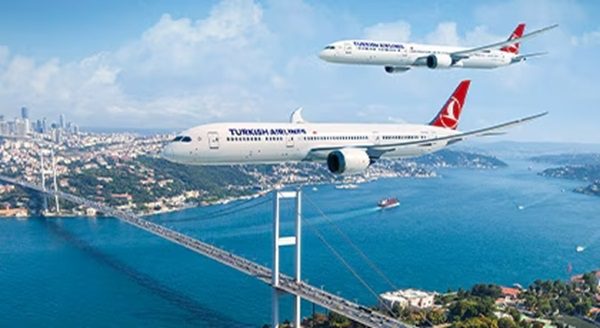
Flying to more countries than any other airline worldwide, Turkish Airlines has never been shy of bold moves. Now, the national flag carrier is strapping on another pair of wings, announcing a blockbuster agreement with Boeing that will see its fleet balloon to record-breaking proportions, putting Türkiye’s aviation ambitions on a sky-high trajectory.
Between 2029 and 2034, Turkish Airlines will add 75 wide-body Boeing 787-9 and 787-10 aircraft, comprising 50 firm and 25 option orders. This isn’t just window-dressing for the balance sheet. It’s a declaration of intent from a carrier that already outpaces most rivals regarding reach, service, and strategic vision.
A Century in the Making
As part of its Vision 2033, the grand plan coinciding with its centenary, Turkish Airlines wants a fleet of more than 800 aircraft, 90% of which will be next-generation by 2033 and 100% by 2035. That means greener, more efficient planes and a brand reputation polished brighter than a freshly buffed Dreamliner wing.
Chairman of the Board and Executive Committee, Prof. Ahmet Bolat, put it bluntly:
“This landmark agreement represents much more than a fleet growth. It is a reflection of our leadership in the industry as well as our dedication to innovation and operational excellence.”
And he wasn’t exaggerating. By 2033, the airline expects to sustain an average annual growth rate of 6%, which would leave most CEOs of Western flag carriers quietly reaching for their neckties.
Engines of Ambition
Behind every gleaming fuselage lies the matter of engines, those finely tuned beasts that keep the metal aloft. Turkish Airlines is deep in negotiation with Rolls-Royce and GE Aerospace for its new Dreamliners, while talks with CFM International may seal the deal for a parallel order of up to 150 Boeing 737-8/10 MAX aircraft.
If the MAX order proceeds, it will involve 100 firm and 50 option aircraft, giving Turkish Airlines the firepower to rule the long-haul skies and the crowded short- and medium-haul markets.
A Diplomatic Dance in the Skies
This is not just about jets and engines. The deal underscores the strategic partnership between Türkiye and the United States, strengthening ties that run deeper than most landing gear. Boeing Commercial Aeroplanes President and CEO, Stephanie Pope, was quick to highlight the history:
“We are honored that Turkish Airlines has once again chosen the 787 Dreamliner and 737 MAX to power its future growth. As a proud partner to Türkiye and the Turkish aviation industry for 80 years, we look forward to continuing our support of Turkish Airlines as they expand operations and deliver exceptional experiences to their passengers.”
When a Boeing executive waxes lyrical, you know the ink has dried on a lucrative contract.
Why It Matters
Turkish Airlines already operates over 200 Boeing aircraft, from Dreamliners to freighters, but this order brings something new. The 787-10, the most prominent member of the Dreamliner family, will be introduced into the fleet for the first time, offering 25% greater fuel efficiency compared with the previous generation. That means lower costs, higher capacity, and fewer emissions.
For passengers, it translates into more long-haul destinations across the United States, Africa, Southeast Asia, and the Middle East. For Istanbul, it cements the city’s status as a crossroads of the world — not just for travellers, but for freight too.
Tourism Gets a Lift
The broader impact is hard to miss. Bolat made it clear that the agreement goes beyond aircraft cabins:
“By offering greater connectivity and more long-haul destinations, these aircraft will help attract more visitors to discover our country’s unique cultural heritage and natural beauty, thereby further strengthening Türkiye’s tourism sector.”
It’s a well-polished sales pitch, but it holds water. With its “Widen Your World” slogan, Turkish Airlines has long made a point of flying where others don’t. Every new route means more tourists sipping Turkish coffee by the Bosphorus, more conferences held under Ottoman domes, and more revenue funnelled into the national economy.
The Bigger Picture
Fleet expansion is one thing, but the real story here is reputation. Turkish Airlines has weathered financial, political, and even volcanic ash storms and has become stronger. With its 100th anniversary looming, the airline is set to redefine what it means to be a global carrier.
With unparalleled service, one of the broadest networks on earth, and a gleaming new army of Dreamliners and MAX aircraft, the airline is not just competing with Emirates, Qatar Airways, or Singapore Airlines; it’s shaping up to outpace them.
Conclusion: A Sky Full of Promise
This deal is not simply about ordering planes. It’s about securing the next century of Turkish aviation, a century in which efficiency, sustainability, and sheer global reach determine who rules the skies.
Turkish Airlines is betting big. And if history is any guide, it will pay off handsomely. From the runways of Istanbul to the skies over Sydney, travellers can expect one thing: the crescent and star emblazoned on a tailfin soaring ever higher.
By Soo James