

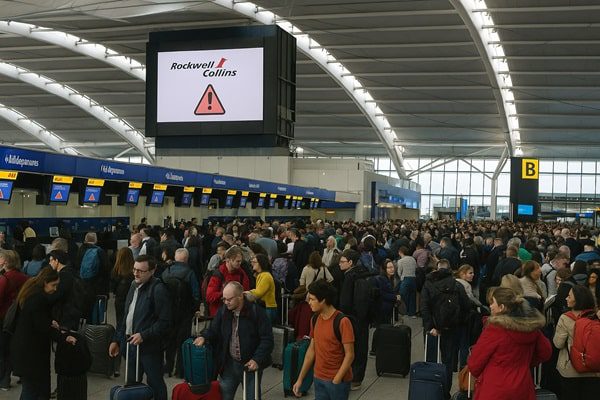
It was meant to be an ordinary weekend of comings and goings, cappuccinos in departure lounges, and the endless shuffle of trolleys down airport corridors. Instead, thousands of travellers at Heathrow, Brussels, and Berlin were left to discover that the glossy façade of modern aviation can crumble faster than you can say boarding pass.
The culprit? Not a thunderstorm, volcanic ash, or even a strike by ground staff. No, this was the 21st century flexing its digital muscles: a cyberattack on Collins Aerospace, the American aviation and defence heavyweight whose software has become so ubiquitous it might as well be air itself. When their Muse system blinked out, so did Europe’s check-in and boarding systems.
What followed was less the romance of air travel and more a scene from Dante’s Inferno, complete with snaking queues, confused announcements, and the odd passenger meltdown worthy of reality television.
Heathrow: Where Dreams Go to Queue
Heathrow, that grand dame of European aviation, bore the brunt. According to aviation data provider Cirium, 29 departures and arrivals had already been cancelled across Heathrow, Brussels, and Berlin by Saturday. Heathrow alone had 651 scheduled departures that day—a behemoth schedule that suddenly found itself reduced to chaos by software that decided to go on strike.
The queues were biblical, stretching longer than the line at Harrods’ Christmas sale. Families sprawled on the floor, business travellers paced with the menace of people who know their connecting meeting is already lost, and staff scurried about with clipboards, rediscovering that boarding passes can still be written by hand.
Collins Aerospace: Polishing the Apple
When the crisis hit, Collins Aerospace (part of RTX, formerly Raytheon Technologies) attempted the time-honoured corporate art of damage limitation.
“We have become aware of a cyber-related disruption to our Muse software in select airports. We are actively working to resolve the issue and restore full functionality to our customers as quickly as possible,” the company said in a statement.
Translation? “Yes, the system is down, but please don’t panic—just pretend you’re travelling in the 1980s again.”
The official reassurance that the impact was “limited to electronic customer check-in and baggage drop” was cold comfort to those caught in a five-hour shuffle toward a counter manned by staff who clearly wished they had called in sick.
Brussels and Berlin: Same Story, Different Accents
Brussels Airport bluntly told passengers that only manual check-in was available and warned that the chaos would drag into Saturday. Berlin, never famed for its lightness of touch, advised passengers to prepare for “extended waiting times”, a phrase as ominous as it is vague.
At Heathrow, travellers were advised to “check their flight status before heading to the airport,” a message about as helpful as being told to check the weather before stepping outside during a monsoon.
The European Commission, meanwhile, was quick to soothe nerves, saying there were “no indications of a widespread or severe attack.” That may be true, but tell that to the grandmother who missed her grandson’s wedding in Frankfurt because her boarding pass became hostage to corrupted code.
Fragile Skies
Cybersecurity experts have warned us for years that aviation’s obsession with efficiency and centralisation makes the system fragile. And here it was, live and in colour. Rely too heavily on one provider, and suddenly their misfortune is everyone’s nightmare.
The tech world calls it a single point of failure, and boy, did it fail. Attacks on the aviation sector reportedly jumped a staggering 600% between 2024 and 2025. When hackers smell weakness, they pounce, and the victims aren’t just airlines and airports but also passengers who end up sleeping on airport floors, clutching their luggage like life rafts.
The Take: The Theatre of the Absurd
There was a certain tragicomedy about it all. Airports, those temples of progress and technology, reduced to pen, paper, and fraying tempers. Staff fumbled with manual manifests, printers coughed out half-readable boarding slips, and travellers who once scanned barcodes now queued like ration lines in wartime.
If you squinted, you could almost imagine it as performance art: the fragile ballet of modern travel unravelled by a single corrupted line of code. One wonders whether the hackers, somewhere, were watching with popcorn in hand.
Where Do We Go From Here?
The aviation industry must now confront an uncomfortable reality: it has built castles in the sky on digital sand. Efficiency may have won the day in boardrooms, but when the systems fall, passengers pay the price.
Regulators will undoubtedly demand stronger cybersecurity, redundancy, and contingency planning. Experts argue that airports and airlines must diversify their digital suppliers. Put simply, don’t give one company the keys to the entire kingdom.
But will it happen? Aviation loves efficiency, and efficiency rarely coexists comfortably with redundancy. The temptation to put all your eggs in one digital basket will remain, and so will the risks.
Lessons for Travellers
For the everyday traveller, the lesson is humbler: in an age of facial recognition and paperless boarding, don’t laugh at the idea of carrying a book, a spare charger, or heaven forbid an old-fashioned printed itinerary. When the digital rug is pulled out, it may be the only thing between you and a nervous breakdown in the departures hall.
Conclusion
The Collins Aerospace cyberattack wasn’t just an IT glitch but a mirror held up to the aviation industry. It showed us how fragile the digital skeleton of travel has become, and how quickly a weekend getaway can turn into a test of patience and resilience.
As for the passengers? They’ll get where they’re going eventually. But they will carry with them the memory of endless queues, exasperated staff, and the dawning realisation that in 2025, one cyber strike can drag air travel back into the age of carbon paper.
And somewhere, you can almost hear the hackers chuckling.
By Susan Ng











