


Thailand has never been shy about polishing its crown jewels, and why should it? For decades, the kingdom has served up the intoxicating mix of spicy cuisine, tropical beaches, gilded temples, and the kind of hospitality that has made visitors return like migratory birds. But now, with a world still twitchy about safety, Bangkok has decided to place a formal seal on its most marketable virtue: trust.
Thus arrives the “Trusted Thailand” Stamp, a little emblem with a big ambition: to tell the world that the Land of Smiles is also the Land of Security.
A press conference with a purpose
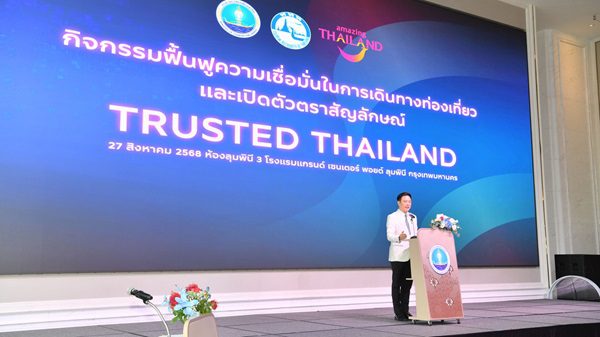
Mr. Jakkaphon Tangsutthitham, Vice Minister of Tourism and Sports.
The unveiling was more than just a ribbon-cutting ceremony. Jakkaphon Tangsutthitham, Vice Minister of Tourism and Sports, strode to the podium with the gravitas of a man entrusted with the nation’s reputation and tourist receipts. “China is a key source market, and it is crucial that we preserve trust among Chinese visitors,” he declared. His voice carried the weight of decades of economic dependence on tourists arriving in planeloads from Beijing, Shanghai, and beyond.
And he wasn’t content with platitudes. “This launch reflects an invitation to all tourism operators, partnered agencies and stakeholders to work together in advancing Thailand’s tourism towards safe, secure and sustainable growth.”
Perhaps this is a reminder that in a hyper-connected world, a single viral mishap—an accident in Phuket, a scam in Bangkok, or a misunderstanding at immigration—can ricochet across social media faster than pad thai disappears from a street vendor’s wok.
More than slogans
The Thai government has long been keen to lace safety into its tourism policy, but this initiative is different. It has the ring of permanence. As Mr Jakkaphon put it, the authorities have “continuously paired safety measures with tourism promotion,” upgrading attractions, tightening coordination with security agencies, and fine-tuning communication.
Seasoned travellers know this is Thailand’s polite way of saying: we’ll give you the coconuts and cocktails, but we’ll also keep a watchful eye so nothing spoils your fun.
A stamp with bite, not just shine.

Ms. Thapanee Kiatphaibool, TAT Governor.
Enter Ms Thapanee Kiatphaibool, TAT Governor, who added a note of candour. “The Trusted Thailand stamp is a practical mechanism to restore traveller confidence while laying the foundation for Thailand’s tourism industry to meet international safety standards. More than a symbol, it represents our commitment to making Thailand a destination where every visitor feels secure and truly welcome.”
And indeed, the scheme comes with teeth. Operators seeking the coveted stamp will be grilled across four fronts:
-
General safety — CCTV, emergency systems, disaster readiness.
-
Financial security — transparent payments on trusted platforms such as Alipay and WeChat Pay.
-
Communication — foreign language services and proper care in emergencies.
-
Mobility — clear signage, transport links, and information points that don’t vanish at dusk.
This isn’t just bureaucracy; it’s Thailand acknowledging the real fears of modern travellers.
Training, drills, and digital muscle
To give the campaign flesh and blood, agencies like the Tourist Police Bureau and the Department of Land Transport will be roped in for forums, safety drills, and hands-on workshops. A practical touch: emergency procedure demonstrations for passenger transport providers — an area where trust is earned not by promises but by performance.
And because Thailand knows that today’s battlefield is digital, a mini-site will go live in September 2025, offering operators self-assessment tools and travellers a directory of certified businesses. The full nationwide roll-out is slated for October 2025, paired with multilingual campaigns, influencer tie-ups, and online storytelling designed to make “Trusted Thailand” a trending hashtag rather than a bureaucratic afterthought.
Why now?
Tourism is fickle. It can surge like the Mekong in the monsoon and recede as fast. Thailand has learned, sometimes painfully, that confidence is the real currency of global travel. Safety is no longer a nice extra, whether it’s European families, American retirees, Japanese business travellers, or young Koreans on K-drama-inspired holidays. It’s the ticket to being chosen over Bali, Vietnam, or Dubai.
And then there’s China. With millions of outbound tourists ready to spend, the competition is brutal. Thailand’s stamp is a message to Beijing’s travellers: come back, we’ve tidied up, and your safety is our guarantee.
Old charms with new guarantees
The brilliance of the Trusted Thailand stamp is that it doesn’t replace the kingdom’s essence; it enhances it. Visitors will still be greeted by monks in saffron robes, the scent of lemongrass, and the warm “sawasdee” of a smiling host. But now, they will also have the reassurance that if things go wrong, someone has planned for it.
It’s Thailand saying, “Come for the temples and tuk-tuks, stay because you trust us to look after you.”
By Kanda Limw











