

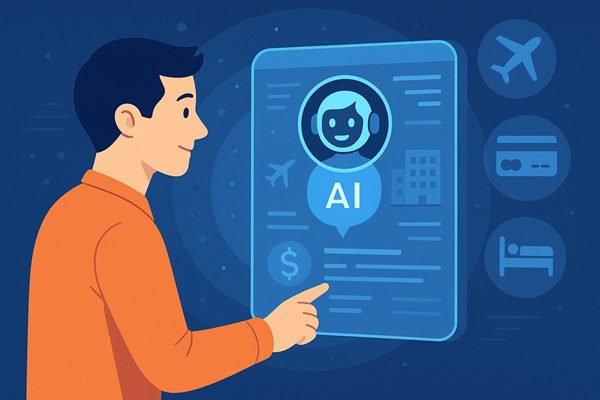
The travel industry, never shy of a trend or a buzzword, now finds itself amid a seismic shift so significant it makes the low-cost airline revolution look like a cheap upgrade. Phocuswright’s latest New Agents Trend Series webinar has unveiled a world where marketing strategies are no longer B2B or B2C but something far stranger, B to AI. That’s right: companies are now preparing to market not to people, but to the tireless, ever-hungry algorithms that increasingly act as travellers’ personal travel agents.
The agentic era arrives.

The event, hosted by Phocuswright’s Senior Manager of Research and Innovation, Mike Coletta, alongside Senior Technology and Corporate Market Analyst, Norm Rose, assembled a line-up of industry voices who seemed almost equally excited and unnerved. The message? Generative AI is not just another digital fad. It is driving what they call the “agentic era”, where AI agents negotiate, recommend, and even purchase on behalf of travellers.
Marketing, once aimed squarely at humans, must now appeal to algorithms. In short, the travel marketer’s new best customer may never touch a boarding pass.
From B2B and B2C to B to AI
The term “B to AI” was initially coined by Visa’s Chief Marketing Officer, and its meaning is both daunting and straightforward: rather than persuading individual consumers or business buyers, brands will increasingly need to convince the AI agents that filter information for them.
It’s a subtle but monumental shift. As ChatGPT, Google’s Gemini, and other platforms gain functionality, they already advise users on booking choices. Sometimes, they even suggest side-stepping the big online travel agencies in favour of local operators to save on fees. If the bots are whispering in your customers’ ears, then they, not you, control the conversation.
Julie White, Chief Commercial Officer of Europe and North Africa for Premium, Midscale and Economy Brands at Accor, welcomed the potential of these tools but was quick to stress that trust, transparency, and fairness must sit at the heart of this revolution. “Customers need to know the recommendations they get are unbiased, that they’re truly being offered value for money,” she said.
AI agents as booking channels
The stakes are high. AI platforms rapidly move beyond chatty suggestions to integrated shopping and payment features. This means tomorrow’s traveller might never set foot on a hotel’s website or even browse a third-party OTA. Their digital agent will fetch the deal, compare the amenities, and pay while they sip their morning flat white.
For suppliers, that changes the entire game. Tom Underwood, Co-founder and COO of travel tech start-up Bonafide, warned of “dramatic disruption” ahead. His firm is already working with hotels to structure property information so AI agents can consume it. Forget glossy brochures, tomorrow’s battle will be won with structured data that an algorithm finds appetising.
And if you thought this was just a fancy marketing ploy, think again. Erik Blachford, former CEO of Expedia, pointed out that this will trigger nothing less than a re-engineering of the entire travel tech stack — from PMS to GDS. In other words, prepare for a costly renovation.
Towards standards and interpreter layers
Of course, chaos looms once everyone is marketing to a hundred different AI agents. That’s why panellists stressed the urgent need for standardisation — or at least “interpreter layers” — that can translate content between various platforms. Like NDC transformed airline distribution, the industry will need a new lingua franca for AI. Without it, suppliers risk shouting into the void while the bots scroll silently past.
Hyper-personalisation on steroids
If all this sounds intimidating, there are upsides too. Armed with encyclopaedic knowledge of user preferences, AI agents will finally move beyond crude price comparisons. Matthias Keller, Chief Product Officer at Kayak, explained how Kayak.ai is designed to turn thousands of listings into laser-sharpened recommendations. “It’s about showing the best value for the customer, not just the lowest cost,” Keller said.
In this world, hotels aren’t simply beds for the night; they are bundles of micro-attributes waiting to be matched to a traveller’s quirks. Want a room with a quiet corner for podcasting, a balcony facing east, and walking distance to a sourdough bakery? Your AI agent will find it.
Keller added that Kayak’s edge lies in its direct API and NDC connections, which may help it transact seamlessly within AI interfaces. In short, whoever controls the pipe controls the customer.
But can we trust the bots?
And here lies the elephant in the algorithm. Can travellers trust these digital gatekeepers? Will the agents act in our best interests, or will they be quietly nudged by advertising dollars and commissions?
The panel agreed: trust is paramount. Without it, no amount of machine-generated personalisation will persuade weary travellers to abandon their judgment. After all, the average holidaymaker doesn’t want to second-guess whether their AI agent is secretly working for a rival tour operator.
The road ahead
The conversation will continue. Phocuswright’s New Age(nts) Trend Series returns on 17 September with Part Five, “The Convergence of GenAI with Digital Identity.” That episode will explore what happens when AI not only plans your trip but also safeguards (or mismanages) your digital ID. It is a brave new world indeed — and not necessarily one with fewer immigration queues.
For now, one truth is unavoidable: marketing has always been about influence, but never before has the influencer been an algorithm. Whether we’re ready or not, the B to AI era is here.
By Jason Smith











