

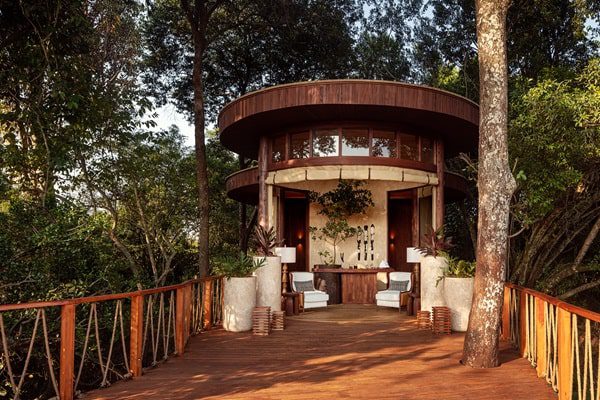
Luxury, that oft-abused word, has finally pitched its tent quite literally on the edge of Kenya’s Masai Mara, where lions still prowl, wildebeest stage their annual death-defying river crossings, and life is measured not by email notifications but by the calls of hornbills at dawn. Yes, The Ritz-Carlton, that bastion of polished service and discreet opulence, has opened a safari camp. And it’s not the safari camp where you unzip a tent and hope the zip holds. This one comes with plunge pools, stargazing decks, and butlers who know your whisky preference before you’ve told them.
A Hotelier’s Leap Into the Wild
It’s hard not to admire the audacity. For decades, safari purists have sworn by the dusty, mosquito-netted camps of old. And here comes Ritz-Carlton, planting its flag among acacias and declaring that five-star comfort and African wilderness are not mutually exclusive.
“Bringing The Ritz-Carlton to the Masai Mara is more than just opening a new property,” explained Tina Edmundson, President of Luxury at Marriott International. “It’s a deeply meaningful moment for us. This is a place that stirs your soul. Where land, wildlife, and culture create something truly extraordinary.”
She’s right. And The Ritz-Carlton knows its audience. These travellers may adore the thrill of a lion sighting but have no intention of roughing it on a camp bed. They want immersion without discomfort, drama without dirt under the fingernails.
Tents That Would Shame a Penthouse
There are twenty “tents” here, though the Ritz-Carlton should probably be sued under the Trades Descriptions Act for using that word. Designed by LW Design, they stand on raised platforms among acacia trees, as airy and elegant as anything in the world’s most refined cities. Canvas walls billow like sails, interiors are dressed in hand-carved wood and Maasai beadwork, and every suite comes with its plunge pool.
This isn’t camping. This is Camping’s wealthy cousin who went to finish school in Switzerland and now spends summers on the Riviera.
Even so, there’s a sense of place. The beadwork is real, the woven textiles handloomed by local women, and the colours are earthy and deliberate. And in case you think it’s all decoration, each guest is paired with an Encholiek, a Maasai cultural guide whose role is part butler, part storyteller, and part bridge between two worlds.
-

- The Ritz-Carlton, Masai Mara Safari Camp – Presidential Villa Bedroom View
-

- The Ritz-Carlton, Masai Mara Safari Camp – Presidential Villa Living Room
Art, Culture, and a Dash of Bravado
Art here isn’t hung as filler. Sculptor Simon Bannister’s bronze cheetahs sprint mid-stride through the camp, freezing motion in metal. Gian Paolo Tomasi’s portraits of local women gaze back at you with dignity, a reminder that Maasai culture isn’t simply a backdrop for tourist entertainment but a living, breathing heritage.
Vintage photographs of age-old ceremonies by Carol Beckwith and Angela Fisher remind guests that tradition isn’t contrived here. It’s daily life, whether tourists are watching or not. In a rare display of humility, The Ritz-Carlton seems content to let that truth speak for itself.
Safari, Ritz-Carlton Style
Of course, one doesn’t travel to the Masai Mara to admire tent stitching. You come for the animals; here, the Ritz-Carlton doesn’t disappoint. The camp’s open-air Land Cruisers are luxurious yet practical, and guests get front-row seats to lions, leopards, elephants, and buffalo. The “big five” are practically neighbours.
For those who crave extra theatre, sunrise hot air balloon rides end with champagne breakfasts on the savannah. The Kenya-Tanzania border stone provides a photo op. And for children, the Young Warrior Programme transforms them into pint-sized conservationists, complete with nature walks and a rite-of-passage certificate. (It beats a school merit badge any day.)
-
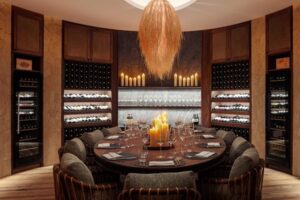
- The Ritz-Carlton, Masai Mara Safari Camp – Wine Cellar
-
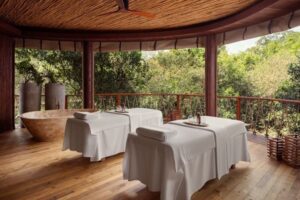
- The Ritz-Carlton, Masai Mara Safari Camp – Spa Double Treatment
Dining Under African Skies
This is the Ritz-Carlton, so food is taken as seriously as safaris. At Nest, the signature restaurant, international dishes are reimagined with African flair. At Canopy, cocktails arrive infused with Maasai spices, and guests can season their gin with a personal selection of botanicals.
Then there’s the Upeo Sky Deck, where dinners unfold beneath galaxies so clear you’ll wonder why you ever bothered with Netflix. The Wine Cellar offers sommelier-led tastings of vintages rarer than an honest politician, and the traditional Boma erupts nightly with Maasai music, dancing, and the crackle of fire-lit feasts.
It’s theatre, but it doesn’t feel forced. Dining here is a ceremony and a celebration, a reminder that food is culture, not just sustenance.
Wellness in the Whispering Trees
Even Ritz-Carlton guests can tire of G&Ts and game drives. For that, there’s the Whispering Tree Spa, named for the sacred acacias the Maasai believe carry ancestral voices in the wind. Treatments draw on marula and aloe, beginning with a ritual water blessing.
Here, wellness isn’t a tick-box amenity. It’s a slow exhale, recognising that the land heals as much as the therapists. Yoga sessions spill onto decks, meditation mingles with birdsong, and herbal infusions round out afternoons in the fitness centre or by the pool.
It’s luxury, yes, but it carries a rare sincerity.
-

- The Ritz-Carlton, Masai Mara Safari Camp – Upeo Sky Deck
-

- The Ritz-Carlton, Masai Mara Safari Camp – Photo Studio
Conservation Beyond the Buzzwords
Now, here’s where The Ritz-Carlton earns serious points. This camp delivers in a travel world drunk on “sustainability” slogans. It’s fully solar-powered, boasts a 650kW solar farm, and runs on a closed-loop water treatment system that recycles and reuses. Landfill waste? Zero.
The camp is also plugged into the bigger picture: biodiversity monitoring with infrared cameras, habitat restoration along the Sand River, and tree-planting sessions where guests get their hands dirty — literally. Over 70% of the staff are local, and apprenticeship programmes funnel young people into hospitality careers. Women are trained as wildlife rangers and guides. Schools receive books and fruit trees.
For once, “giving back” isn’t a marketing slogan but a measurable, visible reality.
Getting There (and What It’ll Cost You)
Reaching the camp is mercifully simple. A 45-minute flight from Nairobi’s Wilson Airport drops you at Serena Airstrip, from which the lodge is just minutes away. Prefer wheels? It’s a five-hour drive through the countryside that will leave your spine rattled but your eyes grateful.
Rates start at USD $3,500 per person, per night — all-inclusive. And all-inclusive here means butlers, twice-daily game drives, Wi-Fi, laundry, Canon photography equipment, binoculars, and more food and drink than is strictly decent.
Yes, it’s eye-watering. But then again, so is the view at dusk when the plains turn to liquid gold and a Maasai horn signals the start of the evening. That moment, I’d argue, is priceless.
The Verdict
So, what to make of the Ritz-Carlton’s African adventure? Cynics will sneer at the price tag, and purists may mutter, “Luxury is diluting the wild.” But having seen what’s on offer, I’d argue this camp does something rare: it elevates without erasing, indulges without intruding, and honours a landscape that needs reverence and protection.
It’s not for everyone. Nor should it be. But for those lucky enough to experience it, this is not simply another notch on the luxury belt. It’s a reminder that proper hospitality can still stir the soul.
By Michelle Warner











