

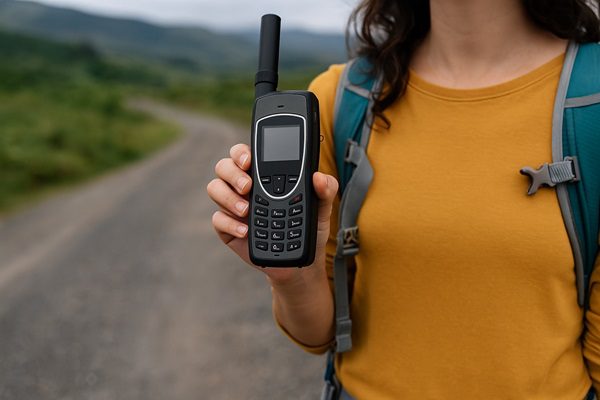
There was a time when the only people toting satellite phones were journalists embedded in deserts, explorers trekking across ice sheets, or perhaps a particular breed of oil executive keeping tabs on distant rigs. Fast-forward to 2025, and the humble satellite phone has apparently gone mainstream. According to the Global Rescue Summer 2025 Traveller Safety and Sentiment Survey, at least 51% of international travellers have used a satellite phone or messaging device while abroad.
It seems going “off grid” isn’t just for Bear Grylls anymore. Ordinary tourists, business travellers, and adventure seekers alike are plugging into the stars — quite literally — when Wi-Fi gives up and mobile networks vanish.
Who’s Dialling In From Space?
The survey reveals some fascinating divides. It seems men are keener to grab hold of a satellite handset, with 56% having used one, compared with 39% of women. Age plays its part as well. Those in the 35–54 age bracket lead at 55%, while younger travellers under 35 clock in at 48%. Older voyagers, aged 55 and above, sit comfortably at 50%.
Dan Richards, CEO of The Global Rescue Companies and a U.S. Travel and Tourism Advisory Board member at the Department of Commerce, notes the changing landscape.
“The use of satellite devices is growing among remote and adventure travellers,” Richards said. “But we’re also seeing a generational difference in how travellers access these tools whether they buy, rent or borrow them.”
In other words, the kids may borrow Mum and Dad’s gear, while the middle-aged set, true to form, prefer to own outright.
Why People Use Them
Not surprisingly, the top use is good old-fashioned survival: 44% of respondents said they whipped out their device while venturing off-grid. Emergencies accounted for 17% of use, while 14% liked the peace of mind of real-time check-ins.
The generational split is particularly telling here. Younger travellers under 35 were three times more likely (31%) to use their satellite device for constant location updates than 11% of those over 55. For the older generations, the preference was clear: use it when things go pear-shaped.
Ownership, Renting, and Borrowing – A Tale of Three Tribes
The ownership divide paints a lively picture. Nearly half (49%) of travellers own a satellite device, while 19% borrow and 24% rent. Younger folk under 35 are 140% more likely to borrow (29%) than those over 55 (12%), while being 75% less likely to rent (6% compared with 27%).
Once again, the 35–54-year-olds prove the most practical, with ownership peaking at 55%. Women, however, lag in ownership at 44%. Geographically, the data shows little difference: U.S. and non-U.S. travellers report the same ownership rate (49%).
Future Outlook – Buyers Beware
Despite the uptake, only 5% of travellers will purchase a satellite device shortly. Younger travellers under 35, however, show a surprising appetite for ownership, eight times more likely (24%) to plan a purchase than their older counterparts (3%).
Yet, the prevailing mood is “thanks, but no thanks”. 68% of travellers said they have no intention of buying, while another 27% sit firmly on the fence, considering but not committing.
The Bigger Picture
Satellite communication has crept out of the wilderness and into the luggage of mainstream travellers. Once the preserve of expeditions and emergencies, it’s now an accessory as everyday as noise-cancelling headphones or a portable charger. Whether borrowed, rented, or proudly owned, the sat phone is cementing itself as a travel essential for those venturing beyond the reach of roaming.
For the cautious, it’s about preparedness. For the adventurous, it’s about peace of mind. And for the tech-savvy under-35s, it’s simply another gadget to keep them plugged into the grid, even when deliberately trying to escape it.











