

Singapore Airlines Group has once again proven that when it comes to filling aircraft, the skies are anything but cloudy. The July 2025 operating results are in, and they paint a picture of an airline group basking in the glow of the traditional northern summer surge, while quietly keeping one eye on cargo turbulence.
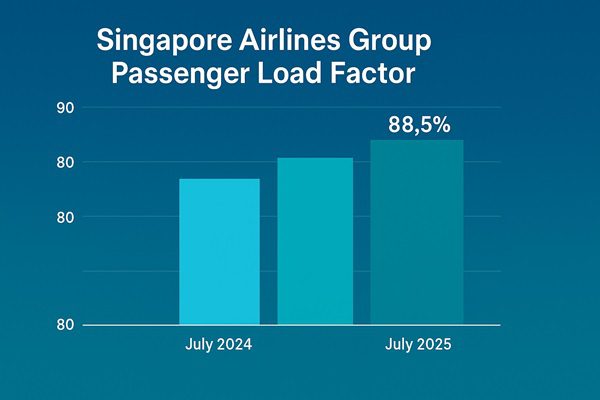
The group carried a staggering 3.54 million passengers in July, nearly 10% more than a year ago. With Singapore Airlines (SIA) and its younger sibling Scoot reporting full cabins, the Group’s combined passenger load factor (PLF) surged to 88.5%, a healthy leap of 2.9% points year-on-year. That’s aviation shorthand for the uninitiated: “if you were looking for an empty seat last month, good luck.”
Scoot Steals the Show
The low-cost arm, Scoot, deserves applause (and perhaps a few extra bar carts) for recording a blistering 92.2% PLF. The airline ferried over 1.22 million travellers, up an eye-catching 13.2% from last July. In aviation terms, that’s not just healthy—it’s positively glowing.
SIA was hardly left behind, hauling 2.31 million passengers, an 8 percent lift, while maintaining a robust 87.4% load factor. Regional numbers tell their own story: East Asia routes, once patchy due to pandemic restrictions, soared by 6.7% points, while the Southwest Pacific flexed its muscles with a 93.4% load factor.
Europe, however, was the lone laggard, slipping back slightly by a modest 1% point. One suspects competition, seasonality, and perhaps the odd Paris-bound traveller deciding to stay home to avoid Olympic-sized crowds.
Cargo Keeps Rolling, But at a Slower Pace
It wasn’t just passengers making the numbers hum. Cargo also enjoyed modest gains, though the champagne stayed firmly corked. Freight loads nudged 2.1 per cent higher, reaching 531 million tonne-km, supported by the ever-reliable tactic of “front-loading” ahead of tariff uncertainties.
Still, while gross cargo capacity climbed 2.7%, the load factor dipped slightly to 57.1%. Notably, the Americas bucked the trend with a substantial 3.7-point gain, while Europe’s cargo market slipped an unenviable 7.3 points, a reminder that freight, unlike passengers, has a mind of its own.
Network Reach Stays Expansive
By the end of July, the Group’s passenger network had expanded to 129 destinations in 37 countries and territories. SIA had 78 destinations, while Scoot wasn’t far behind with 73. The cargo network was even broader, linking 133 destinations across 38 countries.
The Singapore Airlines Group remains a serious banker in a world where connectivity is currency.
What It All Means
These results highlight the Group’s ability to harness peak-season demand across all regions. The fact that capacity rose only 2.8% while demand surged 6.2% speaks volumes about strategic planning, scheduling discipline, and a little old-fashioned good fortune.
The results for Scoot show a clear maturation: the airline is no longer the “budget experiment” but a core growth engine. For SIA, the numbers confirm that premium and full-service travel remains alive and well, even as travellers flock to low-cost options.
Cargo remains a question mark—steady enough to provide ballast, but still wobbling under global trade uncertainty. That said, an airline group that can post near-record passenger loads while keeping cargo afloat hardly needs sympathy.
Editorial Closing Thought
For July 2025, Singapore Airlines Group could confidently claim that it wasn’t just flying aircraft, it was flying high. With both premium and budget wings humming, the Group’s performance shows that aviation, like good theatre, is all about filling the seats. And in this case, it was standing-room only.
By My Thanh Pham











