

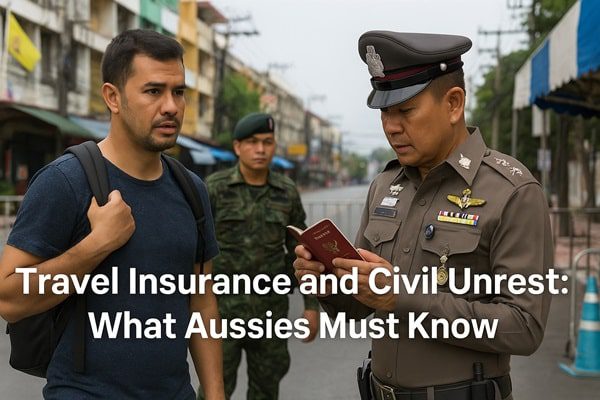
It’s a tale as old as time—sun-starved Aussies, lured by the siren call of Thailand’s beaches, cheap Chang and pad thai, booking their holidays blissfully unaware that civil unrest might lurk behind the next coconut palm. And while you might think your travel insurance has your back, when things turn from serene to skirmish, the fine print can pack a punch.
A ceasefire was declared late last month between Thailand and Cambodia following a harrowing burst of armed conflict that claimed 35 lives and displaced over 200,000 civilians. And while the guns may have fallen silent (for now), the travel warnings and confusion over insurance coverage remain louder than a Bangkok tuk-tuk in peak hour.
Ceasefire, but Caution: The Official Line
On July 24th, Smartraveller—the federal government’s trusted voice on overseas safety—urged Aussies to rethink any plans for Thailand or Cambodia, especially within a 50-kilometre radius of the border. The reason? Reports of “military strikes, violence and the use of landmines.” Charming.
Despite the ceasefire, the advisory hasn’t been lifted, which leaves potential travellers scratching their heads (and policies) to determine whether they’re covered or just catastrophically optimistic.
Natalie Ball, Managing Director of Comparetravelinsurance.com, issued a word to the wise—and a well-timed one at that:
“Although a ceasefire is in place, travellers should avoid impacted areas, especially those flagged by the government. If you’re already booked, contact your airline or travel agent. Many providers offer flexible, penalty-free changes, which is a lot easier than explaining your injuries to a hospital in rural Battambang.”
What Your Insurance Will—and Won’t—Cover
Here’s where things get thorny. If you’re hoping your insurer will pay out simply because you’ve developed a sudden distaste for military checkpoints, think again.
In most cases, insurers won’t cover you just because you’ve changed your mind. However, should your airline or hotel cancel your plans and refuse to refund you, the door to a claim swings open—albeit narrowly.
Brands such as 1Cover, Allianz, and Cover-More offer coverage for cancellation fees and lost deposits if your flight or pre-booked transport is cancelled due to civil unrest. And if your journey is disrupted mid-trip—say, your connecting flight from Siem Reap vanishes into the diplomatic ether—then you may be entitled to recoup expenses for alternative transport and accommodation. But before you book a suite at the Peninsula Bangkok, take heed: unnecessary upgrades could leave you footing the bill.
Ball clarifies:
“If civil unrest cancels your scheduled transport and your travel providers don’t reimburse your costs, you may be eligible to claim—provided you hold a comprehensive policy. Budget policies generally don’t include cover for cancellations or disruptions.”
But Wait—There’s a War Clause
Now here comes the rub. If the unrest you’re fleeing begins to resemble outright war—with troops, tanks, or anything resembling a Cold War flashback—your cover could vanish faster than a full moon party sunrise.
“Acts of war, including those involving armed forces or military intervention, are usually excluded. These are high-risk events where the Australian Government often steps in with consular support,” says Ball.
In other words, it’s not covered if it looks and smells like a war, especially if you bought your policy after the conflict became front-page news.
Ball warns that insurers are quick to place exclusions once a known event is underway:
“Travel insurance is intended for unforeseen incidents. Once an event like civil unrest is widely reported, it’s no longer considered unforeseen—meaning policies purchased after that point may not offer cover.”
And with the Thailand-Cambodia situation smouldering for weeks, insurers have already begun restricting coverage for the affected border regions. That’s bad news if your itinerary included temple-hopping in Surin or a riverside retreat in Sisophon.
Travel Warnings and Policy Fine Print
Here’s where the old-fashioned habit of reading things—yes, even the dreaded Product Disclosure Statement—pays off. Some policies become void once Smartraveller issues a Level 4 “Do Not Travel” advisory.
Even a Level 3 “Reconsider your need to travel” could trigger exclusions depending on your insurer.
Ball again:
“Your cover may change once an official advisory is issued. Always check the PDS and understand how your insurer treats different warning levels.”
In short, if the government says don’t go, think twice. You might not just be risking your safety—you could be left without coverage.
Also worth noting: if you choose to enter a conflict zone in spite of all warnings, don’t expect your insurer to tip its hat and pay your hospital bill.
“Deliberately entering high-risk areas or ignoring government advisories could invalidate your policy. Always take reasonable precautions and stay informed.”
It’s the grown-up version of “You made your bed, now lie in it”—except your bed is in a conflict zone, and the sheets are bulletproof.
Thailand: Popular but Risky
Despite it all, Thailand remains a top destination for Australians, with more than a dash of danger hidden beneath the tropical trappings.
According to DFAT’s most recent State of Play consular report, Thailand topped the charts for consular assistance in 2023/24. A whopping 827 Australians needed help—more than any other country. Most concerningly, it also saw the highest number of Australian deaths abroad, at 324.
Ball notes:
“Thailand is beloved by Aussie travellers, but it’s not without risk. The civil unrest only reinforces the importance of comprehensive insurance and staying up to date with government advisories. Don’t just assume you’re covered—read the fine print.”
It’s a sobering reminder that paradise isn’t bulletproof.
Final Word: Don’t Be Caught Short
With international travel roaring back and regions like Southeast Asia drawing Aussies in droves, travellers must adapt their planning, packing, and insurance strategies.
What was once a simple “she’ll be right” attitude needs to give way to a more cautious, informed, and—dare we say—grown-up approach. No one likes reading fine print, but if a ceasefire collapses mid-massage in Chiang Mai, you’ll be mighty glad you did.
So before you search for street food and serenity, check your destination, consult Smartraveller, and ensure your policy protects you from more than flight delays and sunburn.
As they say in insurance: hope for the best, but insure for the worst. And maybe give the border a miss this time.
For the latest government advice on travel to Thailand and Cambodia, visit Smartraveller.gov.au.
By Sandra Jones











