

Everyone and everything has a story to share.
When done well, everyone prospers.
In all likelihood, this issue has not attracted much attention, consideration, contemplation, and, therefore, commitment and resources.
Scripted thoughts are essential, as are rehearsals, practice, ongoing refinements, and customisation. Communication skills are an art form, and various media require specific capabilities. Voice moderation, projection from the diaphragm, pausing, and gesticulations increase impact, resonance, and memorability. Eye contact and facial expressions captivate and personalise the message and presence. Some call it theatre. Business leaders need to develop their thespian skills.
There are no easy answers or effective shortcuts. Attention should be directed to the essence of each story.
Television, radio, print, podcasts, and dedicated texts each have their own characteristics, demands, and capacity to convey storylines.
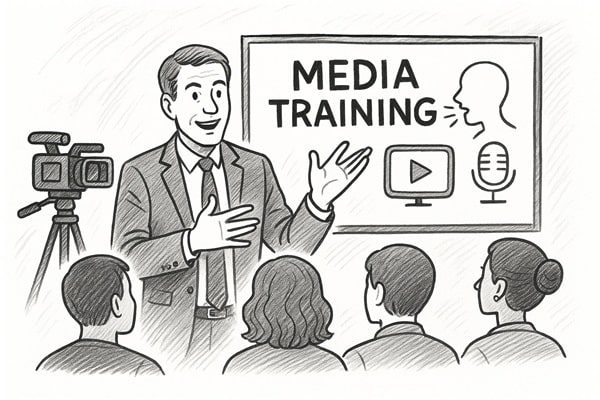
Media training can develop skills in the different processes. Fundamentally, in many life and commerce circumstances, the focus should not be on the communicator or what is being communicated. Instead, the primary orientation must be the individual recipient and the audience.
THE RHYME AND REASONS
Among the storytelling objectives is eliciting positive and appropriate responses from the targeted audience.
That is an application of the principle of putting the customer first (possibly foremost or front and centre).
PRESENTATION MATTERS
Presentations to customers, clients, suppliers, associates, team members, and stakeholders are important. They are often scene-setting, and each is simply another medium.
Small and large, live and electronic–connected audiences each require unique customised styles.
The rapid growth in the use of Zoom meetings faltered and was tempered by widespread poor presentation styles and content. The lack of training, experience, expertise, rehearsals, and practice was evident. The consequences, in many instances, were lamentable.
Attention to detail is the mark of professionalism, regardless of the discipline. Pharmacists, philosophers, barristers, baristas, architects, archaeologists, marketers, masseurs and a whole host of promoters need the skills to convey their essential stories and messages which have relevance, benefits and advantages to those with whom they wish to share their story.
WHAT CRISIS
For some, media training is inextricably associated with crisis management. Pause. Let’s dissect the parts of that proposition. The media is the channel through which a story is conveyed. It is not the destination. Crises are opportunities for some and challenges for others.
It is important for those involved to be promptly and readily accessible. Questions should be answered directly, concisely, and honestly.
Focus needs to be tight.
Reservations and fears about “gotcha” questions need to be set aside. Designated storytellers need to be assertive, authoritative, humble, gracious and believable in these instances. Given that some 80% or more of our daily communication is self-talk,
Don’t hesitate to interview yourself repeatedly. Practice may not make perfect, but it does contribute to progress.
Discourse, ideally, should be limited, concise and pertinent. Brevity is a virtue. Integrity is enhanced.
Be sensitive and aware. Attention spans are constrained. Make your point sparingly. It improves the prospect for comprehension and recall. Above all, make your point. Avoid being a one-shot pony. Rehearsed repetition can be “death” … by boredom.
On reflection, many will conclude that their contribution could have been better. That applies to all. Storytelling is a learning experience. Grasp those experiences to learn. It, and you, will only get better.
DISCIPLINED STRUCTURED STORYTELLING
NOMINATED STEPS TO SUCCESS:
-
Determine, detail and analyse the storyline.
-
Identify the primary, secondary and tertiary target audiences.
-
Outline the appropriate and optimal outcomes and the advantages and benefits to target audiences.
-
Select the full spectrum of media to convey and project the key and preferred points.
-
Structure the essence if the storyline.
-
Formulate and document the essential message – with the audience (customers) first.
-
Practice, rehearse and refine.
-
Where necessary, refine the total text to address differing targeted audience needs.
-
Scope possible external aspects, variables and dimensions – particularly in “crisis” circumstances.
-
Ensure you are readily accessible.
-
Be prepared, step up, stand up, speak up and shut up.
Barry Urquhart
Keynote Speaker
Marketing Focus
M: 041 983 5555
E: [email protected]
W: www.marketingfocus.net.au
COMMENTARY: SUCCESS BY CHOICE
Attracting attention, interest, demand and revenue is optimised by offering choice.
Not too much. Just tantalising and compelling. That is a valid value package.
CONSIDER. CHOOSE. CONSOLIDATE. COMMUNICATE. LIKE. SHARE.
By Barry Urquhart – Consumer and Retail Analyst | Marketing Focus
BIO:
 Barry Urquhart is a highly regarded market research and strategic planning consultant, recognised throughout Australasia for his insight, clarity, and thought leadership. A seasoned keynote speaker at premier conferences, Barry is also the acclaimed author of Serves You Right! And Service Please!, two of the region’s top-selling titles on customer service excellence.
Respected as a trusted voice in business strategy, Barry continues to lead influential workshops and development programs that help organisations drive sustainable growth, elevate service culture, and achieve competitive distinction.
For Media Enquiries or Speaking Engagements:
Email: [email protected]
Mobile: +61 041 983 5555











