

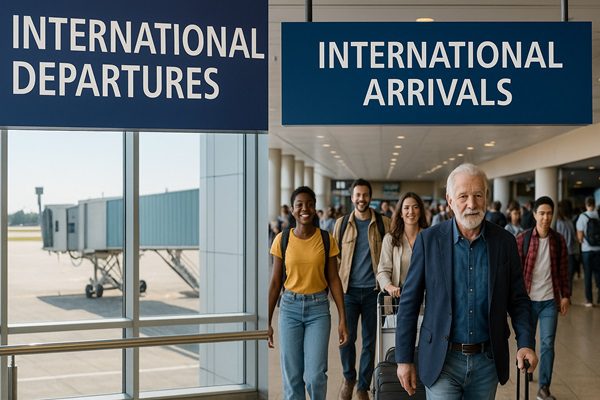
If ever there was a month to wave goodbye to the neighbours, May 2025 was it. Americans—God bless their spontaneous spirits and overstuffed Samsonites—left the United States in such staggering numbers that it’s a miracle there was anyone left to mow the lawn.
According to freshly unzipped data from the U.S. National Travel and Tourism Office (NTTO), 9.67 million U.S. citizens packed up and shoved off to parts foreign in May alone—up a healthy 4.5 percent from last year. That’s not just a post-COVID recovery. That’s full-throttle, tray-table-up, aisle-seat-only wanderlust.
It’s 113.4 percent of May 2019’s pre-pandemic levels, meaning the great American getaway is not only back, but it’s booming like a Fourth of July fireworks finale.
But as Uncle Sam was rolling out the red, white and blue welcome mat, far fewer foreign feet were marching in to trample it.
Yes, international arrivals to the Land of the Free totalled 5.63 million in May—down 7 percent from May 2024 and just 84 percent of pre-COVID figures. A curious reversal, really: the United States, it seems, is better at saying goodbye than welcoming hello.
The Great American Escape: Passports, Pesos and Prosecco
Now, let’s not be hasty with our judgment. Americans, after all, have been largely cooped up in their backyard for a few years—turning their gaze from Parisian cafés to Portland microbrews. But no more. This year, they’ve rediscovered the ancient and noble art of fleeing the country.
Mexico, unsurprisingly, reigned supreme, soaking up a whopping 3.36 million of those May departures—roughly 40 percent of the total. Beaches, tequila, and a blessed absence of airport surcharges undoubtedly helped.
Europe came in a strong second, with 2.53 million departures heading across the Atlantic to fill Italian piazzas and Instagram feeds. That’s a 6.1 percent jump on last year, which means the Amalfi Coast will soon need traffic lights.
The Caribbean, too, continued its run as America’s tropical escape hatch, with over 5 million visitors YTD. Not bad for a smattering of islands the size of a Texan driveway.
In short, Americans aren’t just dipping their toes back into international waters—they’re doing cannonballs.
But Who’s Coming In?
While Americans were on a global safari, international visitors coming into the United States appeared to be playing hard to get.
Total foreign arrivals for May tallied 5.63 million, marking a 7 percent drop compared to May 2024. And before anyone starts blaming the weather, the NTTO’s figures show the U.S. is now pulling in just 84 percent of the visitor volume it enjoyed in that golden, virus-free May of 2019.
So who braved the queues at JFK and the wild ride of LAX?
As usual, the most loyal guests were Mexico (1.39 million) and Canada (1.28 million), perhaps proving once again that you can’t beat proximity and familiarity.
Trailing behind them were the United Kingdom (364,071), India (263,108), and Brazil (159,149). Collectively, these five markets made up a chunky 61.4 percent of total international arrivals, which says something about the enduring appeal of U.S. malls and Michelin burgers.
Zooming in, overseas arrivals (excluding Mexico and Canada) reached 2.96 million, down only 2.8 percent—which isn’t dreadful. The UK, again, led the pack with 312,268 tourist arrivals, reminding us that Britons will cross oceans for a decent outlet sale and questionable coffee.
On the business front, it was again the UK, India, Germany, Japan, and China whose suits graced America’s boardrooms. Student arrivals, meanwhile, were strongest from China, India, and South Korea—an encouraging sign that America’s Ivy League still casts a long, lucrative shadow.
The Numbers Tell a Story—But Not the Whole Tale
Now, before we assume that the United States has developed an allergy to foreign visitors, let’s step back.
The truth is, getting into the U.S. can still be a bureaucratic tap dance—one that tests the patience of even the most seasoned traveller. There are lengthy visa queues, security rigmarole, and that ever-persistent question: “What is the purpose of your visit?” asked by someone who already looks suspicious of the answer.
For many would-be tourists, it’s just easier to holiday elsewhere.
And on the outbound side, the American traveller is in high spirits. With COVID concerns primarily in the rearview mirror and the dollar doing passably well on the global stage, they’re swapping New York brownstones for Normandy cottages, and suburban BBQs for Bali beach clubs.
It’s not just revenge travel anymore—it’s routine.
What This Means for Australia and Beyond
Here’s where it gets interesting for those watching from this sunburnt country down under.
This outbound surge is a signal flare for Aussie tourism operators: Americans are travelling, and they’re not just booking—they’re booking big.
It’s time for Tourism Australia to start dusting off the Crocodile Dundee charm offensive and show U.S. travellers there’s more to this continent than Bondi and the Big Banana.
And for those looking to attract U.S. inbound tourism? It’s a reminder that ease is everything. The nations topping the U.S. arrival list have fewer hoops to jump through. If America wants to reclaim its pre-COVID magnetism, it may need to streamline its welcome.
Until then, the trend is clear: Americans are on the move—just mostly away from home.
By Jason Smith











