

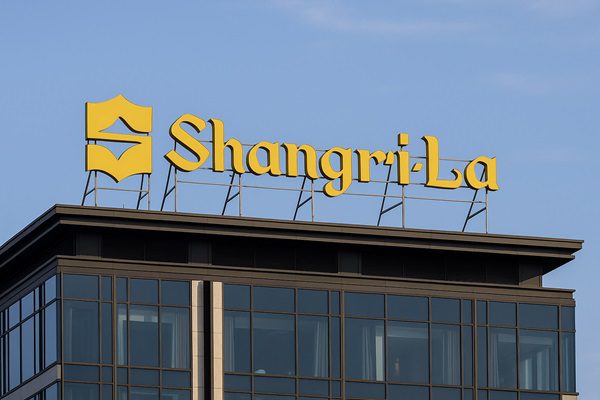
In a year where economic turbulence has forced many hospitality giants to tread water, Shangri-La Hotels and Resorts has thrown on a snorkel, swum upstream and emerged—gleaming cocktail in hand—among the world’s top five hotel brands in the prestigious Brand Finance Hotels 50 2025 rankings.
While three out of four of China’s leading hotel names saw their brand values take a tumble, Shangri-La managed to cling to its imperial perch. It was crowned not only as China’s most valuable but also its strongest, proving that resilience, like a good dumpling, is all in the wrapper.
According to the new report from Brand Finance, the London-based sovereign of brand valuation, the total brand value of Chinese hotel brands came in at a somewhat sobering USD2.56 billion, down 19% year-on-year. The culprit? A cocktail of lingering global economic woes and a new normal in business travel shaped by hybrid work models and longer, less frequent corporate jaunts.
Still, there’s gold in the gilt-framed corridors of Shangri-La. Despite a 23% dip in brand value—now resting at USD1.5 billion—the iconic group has returned to pre-pandemic profitability, with margins that would make an accountant weep with joy. Expansion continues, with dual-brand concepts and mixed-use developments blooming across Shenzhen and Kunming and, soon, a suite of fresh openings throughout mainland China.
Moreover, Shangri-La scored an 80.8/100 on the Brand Strength Index (BSI)—making it China’s strongest hotel brand and fourth in the global Luxury Hotels 2025 sub-ranking. Not bad for a brand founded in 1971 with a dream, a dragon, and a very expensive breakfast buffet.
But let’s not forget the dark horse galloping through the pack—JI Hotel, the fastest-growing Chinese brand in this year’s list. Up 12% to a respectable USD423.5 million, JI Hotel has done something many struggle with—it’s made itself likeable. Very likable. Brand Finance’s research shows that Chinese travellers have a soft spot for the brand’s blend of comfort, reliability, and familiarity, like your nan’s spare room, but with free Wi-Fi and turn-down service.
Speaking of global competition, Hilton remains the indomitable emperor of hotel brands for the tenth consecutive year, with a whopping USD15.1 billion in brand value, up a staggering 30%. The group’s ambitious expansion, particularly in luxury and lifestyle, pays dividends faster than a pokie jackpot on a Friday night.
Meanwhile, Taj Hotels strolled off again in India with the tiara for the world’s strongest hotel brand, boasting a BSI score of 92.2/100. Their secret? A near-sacred reputation for luxury, loyalty, and faultless home service proves that being beloved at home still matters in a world obsessed with going global.
Back to China’s leaderboard, Hanting Hotel held firm with a 2% dip to USD353 million, earning it the 39th globally. But the wooden spoon goes to Jinjiang, which saw its brand value plummet 38% to USD282 million, sliding to 46th in the rankings.
Still, I don’t count the Chinese brands out yet. As Scott Chen, Managing Director of Brand Finance China, puts it:
“Even with ongoing economic pressures, Chinese hotel brands continue to make their mark globally. Shangri-La remains a symbol of trusted, premium hospitality, not just as China’s most valuable hotel brand, but also the strongest.”
With all the calm of a seasoned strategist, Chen adds that JI Hotel’s momentum signals a travel market leaning towards “comfort, familiarity, and reliability”—three words that never go out of style, even in Mandarin.
So, what does all this mean?
It means that brand value, like good tea, isn’t brewed overnight. And while the dragons of China’s hotel industry may be momentarily grounded, brands like Shangri-La and JI Hotel show they still know how to soar—even when the wind’s against them.
And in a world increasingly fractured by shifting work habits, digital nomadism, and inflationary jitters, that’s no small feat. It might differ between being a passing guest and becoming a household name.
By Charmaine Lu











