
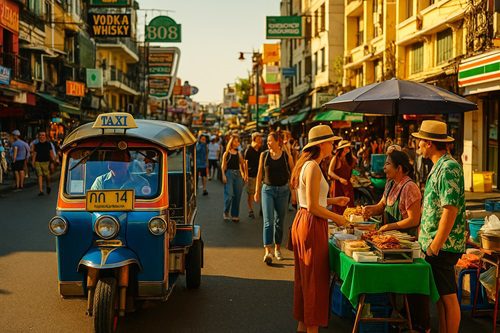
 Thailand, that ever-golden darling of international wanderlust, is not just back on the world stage—it’s doing a full-blown curtain call with jazz hands. According to the latest report from the World Travel & Tourism Council (WTTC), Thailand, also known as the Land of Smiles, is entering 2025 with a tourism sector that contributes a substantial THB 2.8 trillion to its national GDP. That’s not just recovery, folks—that’s renaissance.
It’s a mighty leap from the darkest pandemic days, when empty tuk-tuks outnumbered tourists and pad Thai vendors could take holidays themselves. Now, travel and tourism are on track to make up nearly 15% of Thailand’s economy this year, with international travellers responsible for almost 60% of total visitor spending.

And what are they coming for? With 86% of all trips taken for leisure, it seems the world still can’t get enough of Thai beaches, jungle sanctuaries, mango sticky rice, and that uniquely Thai way of making you feel at home, even when you’re melting in a Songkran water fight.
“Thailand’s tourism sector has long been a source of national pride,” says a (fictional yet plausible) Tourism Authority of Thailand official, Ms. Malee Suthipong. “But in 2025, we’re not just proud—we’re performing. The numbers speak for themselves.”
Indeed, they do. According to the WTTC, the industry is expected to support 8.4 million jobs in 2025 alone, a number projected to rise to over 10.1 million by 2035. That’s one in every seven jobs across the kingdom tied to someone, somewhere, packing a suitcase and boarding a plane.

And the tourists? They’re coming thick and fast, especially from China (19%), Malaysia (14%), India (6%), South Korea and Russia (5% each). That’s a cultural gumbo simmering in Thai spice. But the domestic market shouldn’t be overlooked either—Thais love travelling Thailand, with local spending still making up a sturdy 41.1% of total tourism revenue.
From Phuket to Chiang Mai, Bangkok to Koh Tao, Thailand’s infrastructure is straining at the seams—in the best possible way. Hotels are refilling, street markets are buzzing, and longtail boats are back to their old musical splutter across turquoise bays. If you’re in hospitality and not hiring right now in Thailand, you’re probably still asleep.
But it’s not all about baht and bodies. The social impact is just as significant. In 2023, a solid 56.7% of tourism employment went to women, and nearly 12% to youth aged 15–24. In a world often lamenting inequality, here’s a sector doing some heavy lifting for inclusion.

The forecast from WTTC isn’t just rosy—it’s practically a sunrise over Railay Beach. With compound annual growth in tourism GDP predicted at 2.5% through 2035, and more than 1.7 million new jobs expected in the next decade, Thailand isn’t just recovering—it’s rewriting the tourism playbook.
Of course, no boom comes without a burden. Environmental figures show that fossil fuels still dominate the energy mix for tourism-related activities (a slightly grim 84.8%). It’s a reminder that with great visitation comes great responsibility.
Still, as far as comeback stories go, this one’s a blockbuster. The sector that once staggered under the weight of border closures and travel bans is now buoying the national economy with renewed strength. With THB 2.8 trillion flowing through the tourism engine in 2025, it’s clear: Thailand’s travel sector isn’t just surviving—it’s thriving.
And somewhere in Bangkok, a street vendor selling grilled banana pancakes is smiling. The tourists are back, the baht is bouncing, and Thailand’s story rolls on.