

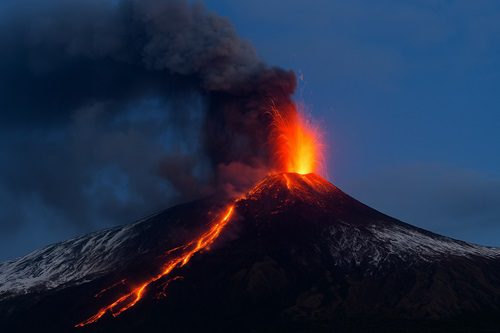
 In time-honoured Sicilian tradition, Mount Etna—Europe’s most reliably irritable volcano—has erupted once again, sending lava flowing and ash spewing skyward with all the theatrical flair of an opera diva taking centre stage.
And while Etna’s fiery tantrums are nothing new to locals, the latest outburst has grounded flights, unsettled travel itineraries, and sent Global Rescue’s elite teams scrambling into readiness.
Dan Richards, the unflappable CEO of Global Rescue, confirmed that the world’s leading medical and security evacuation firm has activated its watchful eye on the ancient volcano. “Our security, medical and intelligence operations teams are monitoring the eruption closely,” he said. “If the situation escalates, we’re ready to roll with field rescues and medical evacuations.”
For travellers stuck in Sicily, the message is clear: don’t panic, but do keep your overnight bag handy. Etna’s current eruption, reported by Italy’s National Institute of Geophysics and Volcanology (INGV), has been spewing lava from its southeastern crater, painting the night sky red and scattering volcanic ash like confetti at a Roman wedding.
Catania Airport—the lifeline to and from Sicily’s eastern coast—was temporarily shut down as a precaution. Flights were grounded, passengers were stranded, and queues formed faster than espresso orders at a Palermo café. And with Etna’s behaviour remaining as unpredictable as an Italian soap opera plot twist, authorities have issued further travel warnings for those bound to, from, or through Sicily.
Enter Harding Bush, Global Rescue’s no-nonsense Manager of Security Operations—and a former Navy SEAL who’s seen more chaos than a Vespa in Rome traffic. “Eruptions like this one can change rapidly,” he said. “Airports may close, and roads can become impassable due to ash fall. Travellers should be prepared to change plans quickly and use alternate routes—by land, sea, or air—if needed.”
It’s not just about grounded flights and blocked roads. Volcanic ash is no friend to aircraft, as any pilot will tell you. The fine, abrasive particles can wreak havoc on jet engines, impair visibility, and turn a routine landing into a nail-biter. The risk is severe enough to reroute flights, halt services, and upend entire air corridors across the Mediterranean.
Bush puts it plainly: “This situation is a reminder of how quickly a natural event can interrupt even the best-planned trips.”
He’s not wrong. The post-pandemic traveller, already bruised by border closures, medical emergencies, and a few too many PCR swabs, is now far more attuned to the unpredictable. And Global Rescue, to its credit, is stepping into the breach with the kind of calm preparedness that would make even a Swiss watch jealous.
“Today’s travellers understand that emergencies are not hypothetical,” Richards explained. “Whether it’s a volcanic eruption, civil unrest, or a sudden medical crisis, the ability to get help fast can be life-saving. Emergency evacuation protection is no longer optional—it’s essential.”
That’s sage advice for anyone caught mid-itinerary in a place where the ground occasionally rumbles and the skies can turn to soot in minutes.
So what’s next for Sicily’s smoke-belching icon? As of this writing, seismic tremors continue to ripple through Etna’s flanks, and INGV volcanologists are maintaining a watchful vigil. Catania Airport is tiptoeing back to operations, but disruptions may persist depending on the volcano’s temperament.
For now, if you’re planning to wander Sicily’s scenic east or sip wine on the slopes of Etna herself, maybe hold off on the picnic. And if your travel insurer doesn’t include emergency evacuation or volcanic ash delays, it might be time to reconsider.
Because, as any Sicilian will tell you, Etna has the final word.
By Susan Ng











