


 Once upon a not-so-distant time, the United States of America held an almost magnetic pull for international travellers. From the cobblestones of Paris to the shores of the Arabian Gulf and the cafés of Sydney, long-haul jet-setters bookmarked the Land of the Free for its allure of adventure, cultural punch, and capitalist dazzle. But in 2025, the compass is pointing elsewhere.
A new analysis from Mabrian – the global travel intelligence firm under the Almawave Group umbrella – has dropped a rather sobering pin on the international tourism map: travel intent to the United States is cooling, and cooling fast.
Drawing upon the company’s Share of Searches Index, which tracks spontaneous global flight searches as a barometer of intent, the data paints a picture of quiet hesitancy. Across Europe, the GCC, and Australia – all key outbound markets – travellers are flirting with alternative destinations, leaving the U.S. with a thinner slice of the long-haul pie than it enjoyed in 2024.
Let’s unpack why Uncle Sam may soon send more postcards than he’s receiving.
📉 A Fading Star in the Search Bars
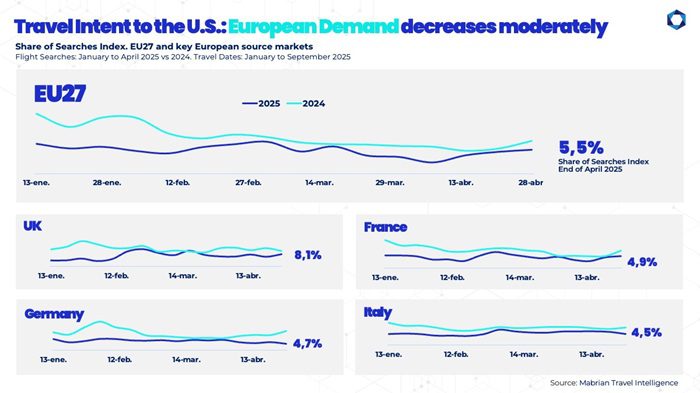
The Share of Searches Index covers travel searches from January through April 2025 for trips extending until September. It recorded a consistent downturn in demand for U.S.-bound flights.
-
Europe’s decline? A modest but meaningful -0.3 percentage points.
-
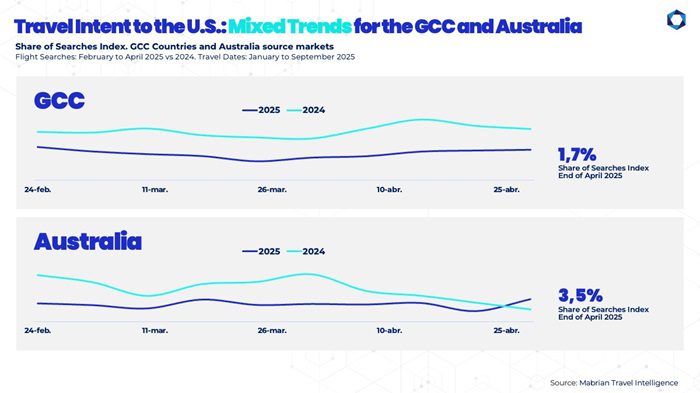
Gulf states and Australia? A sharper -0.5 percentage points – and in the unforgiving world of millions of flight searches, that’s not a rounding error. That’s a warning bell.
Carlos Cendra, Partner and Director of Marketing at Mabrian, didn’t mince words. “These variations reflect a growing uncertainty about long-haul travel to the U.S. Travellers aren’t necessarily losing interest – they’re just not pulling the trigger early.” And therein lies the rub.
🗳️ Post-Inauguration Jitters & Trade Tariff Tremors
Political shifts have always been travel’s uninvited bedfellows, and 2025 has delivered plenty. Since the January inauguration of the new U.S. administration, confidence has dipped, especially in Europe. But it wasn’t until the Trump Administration’s April announcement of renewed trade tariffs that the dam cracked.
By the end of April, just 5.5% of all EU 27 flight searches were aimed at the U.S. That figure dipped and wobbled week by week but never rebounded to 2024 levels.
Take the UK – always the U.S.’s plucky travel partner. A flicker of recovery in March was quickly extinguished after the tariffs made headlines. By early April, British interest in crossing the pond plunged by -0.8 percentage points year-on-year.
Meanwhile, sentiment fared no better in the EU’s Big Three—Germany, France, and Italy. Germany and Italy each saw a full percentage drop in their share of flight searches to the U.S., while France, nearly back to its 2024 enthusiasm, sagged again mid-April, ending the month with a -0.5 point slide.
🕌 Gulf Uncertainty: Interest Flickers but Falters
Over in the Gulf, American shores have never been the top draw, but they’ve always held a certain niche appeal among high-spending travellers from the UAE and Saudi Arabia.
Between February and April, only 1.7% of Gulf Arab flight searches were aimed at the U.S.; even that niche is narrowing.
-
In the UAE, travel interest dipped -0.75 percentage points per week, leaving the American share at just 2.1% by late April.
-
In Saudi Arabia, things looked no rosier: the market dropped -0.3 points year-on-year, with U.S. demand settling at a threadbare 0.9% of total flight searches.
Cendra notes, “These are not massive numbers to begin with, so any decline has an outsized impact. It’s a signal, not a statistic.”
🇦🇺 Australia: A Glimmer at the End of the Runway?
Ever the eager traveller, Australia has trailed 2024 U.S. demand levels for most of 2025. But there may be hope yet. In the final week of April, the Index jumped +0.3 percentage points, nudging total share to 3.5% – the first upward tick in ten long weeks.
A rebound? Perhaps. But it’s a fragile one, and with airfares still steep and global geopolitics in a tangle, the recovery may hang by a Qantas tailfin.
🧭 What’s Going On?
The trends speak louder than headlines. Mabrian’s data suggests that the U.S. isn’t losing allure—it’s losing lead time.
Travellers are no longer keen to plan far in advance. Whether they fear policy shifts, economic headwinds, or simply a yearning for flexibility, long-haul visitors hedge their bets and book later.
And during that crucial window, when destinations must dazzle to secure the commitment, the U.S. is losing ground to more “stable” alternatives.
Places like Japan, Spain, Canada, and the UAE are increasingly stealing the show. They’re perceived as safer, more welcoming, or less politically fraught.
📊 What This Means for the U.S. Travel Sector
American tourism operators, airlines, and policymakers cannot ignore these trends.
They represent not just a dip in bookings, but a decline in confidence, and restoring that takes more than splashy campaigns. It demands clarity, consistency, and collaboration.
As Cendra states, “It’s during the planning phase that America is most vulnerable. If uncertainty remains, travellers will look elsewhere – and once they discover new favourites, they may not look back.”
🎯 The Road Ahead
What’s needed now is a recalibration. The U.S. travel industry must embrace data-driven diplomacy, align with global expectations, smooth visa frictions, and showcase stability across policies and partnerships.
The recent bilateral agreement on tariffs between the UK and the U.S., announced on May 8th, could help patch the British pipeline. But other key markets are still waiting to be reassured.
Mabrian’s research reminds us that in 2025, travel isn’t just about destinations – it’s about certainty, security, and sentiment. And while America may still be great, it must once again prove itself dependable.
By Jason Smith











