 There’s something refreshingly old-school about Malaysia Airlines’ latest international play. No glitzy launches or viral stunts. Just three quietly powerful signatures on three very well-targeted Memorandums of Understanding (MoUs)—each pointing a different compass direction, but all heading towards a future where this legacy airline stays relevant and profitable.
Call it diplomacy at 38,000 feet.
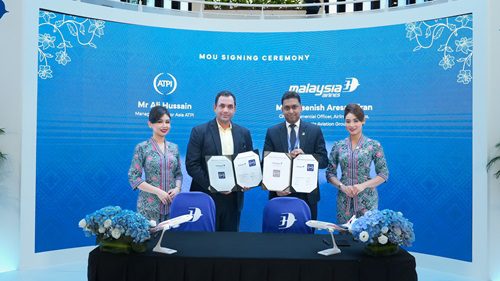
The carrier has inked new partnerships with APG (the global godfather of airline representation), StudentUniverse (the Tinder of student travel), and ATPI (your go-to if your passengers wear hard hats and steel-capped boots rather than business class slippers).
Each MoU is a deft little nudge into a lucrative niche: less shouty marketing, more smart alignment. And frankly, in an age of noise, that’s the sort of thing seasoned travellers—and investors—notice.
The APG Play: Going Old School, with a Modern Twist

Three smiles, two sarongs, one bold deal signed at 38,000 feet.
First cab off the rank is APG. If you haven’t heard of them, chances are your travel agent has. They’ve got tendrils in over 150 countries and are the type of partner airlines that court when they want to slip back into offline booking markets without setting up house there.
Through the APG Platform—essentially a digital express lane for NDC (New Distribution Capability) content—Malaysia Airlines is opening up its full product range to travel agents worldwide. Think bundled fares, dynamic offers, and yes, even hotels and hire cars thrown in if you ask nicely.
“We’re not just plugging gaps—we’re creating opportunities,” said Dersenish Aresandiran, Malaysia Aviation Group’s Chief Commercial Officer, with the quiet confidence of someone who’s spent enough time in boardrooms and airport lounges. “This is about making it easier for the right travellers to find us—even when they’re not looking online.”
It’s like dusting off a Rolodex in the age of AI—and discovering half the world still uses one.
Students: Still Broke, Still Travelling
Meanwhile, the youth of the world—forever optimistic, short on cash, and hungry for adventure—are front and centre in Malaysia Airlines’ renewed courtship of the student travel market.

Youth, wanderlust and a handshake—StudentUniverse boards the Malaysia Airlines journey.
The airline has now bagged a spot as a Global Airline Partner through its expanded partnership with StudentUniverse. Translation: more marketing muscle, better brand visibility, and special airfares that don’t require selling a kidney.
Let’s be real—this isn’t a CSR initiative. It’s good business. Since the tie-up began in 2024, student bookings in Australia, New Zealand, the UK and the US have surged—the cash flows in from backpackers and uni students heading home, away, or somewhere warmer.
“Students may travel cheap, but they travel often,” said one airline insider. “And if they fall in love with our product young, they’ll stick with us when they graduate—hopefully into higher-paying jobs and bigger cabin classes.”
With StudentUniverse now giving Malaysia Airlines full marketing support, the carrier’s appeal to Gen Z travellers has gone from “Maybe later” to “Booked, packed, gone.”
Anchors Aweigh: Cracking the Marine Market
Then there’s the sea-faring crowd—the oil-rig technicians, maritime engineers, and nautical nomads who view a Boeing cabin less as a luxury and more as a change room between choppers and crew cabins.
Enter ATPI, one of the world’s most respected travel management companies for the marine and energy sectors. Under the new MoU, ATPI becomes Malaysia Airlines’ preferred marine travel partner from 1 May 2025 to 30 April 2026.
This isn’t your average codeshare fluff. These are precision travel needs—flight timings, remote locations, and cargo allowances. One delay can throw off an entire rig rotation. ATPI, with its expert hand and global footprint, makes sure those wheels (and propellers) keep turning.
Malaysia Airlines, in turn, gets a golden ticket to tap into a fiercely loyal, deeply specialised market. It’s not glamorous, but it’s good business. And with Malaysia perched conveniently between Asia’s marine hubs.
A Different Kind of Take-Off
So, what’s the bigger picture here?
Malaysia Airlines isn’t chasing headlines—it’s chasing margin. These MoUs might not trend on Twitter, but they speak volumes to those who still believe in long-term strategy over flash-in-the-pan PR.
Student loyalty. Agent reach. Industry-specific traffic. These are the travel trade’s equivalent of frequent flyer points—hard-earned, quietly powerful, and surprisingly valuable when you tally them up.
And let’s be honest: in a post-pandemic world where even the mightiest airlines have been brought to their knees, these kinds of smart, relationship-driven moves can separate the survivors from the spectacularly overleveraged.
Malaysia Airlines knows this. It’s not just getting bigger. It’s getting smarter. And frankly, that’s a lot harder to do.
By Soo James