

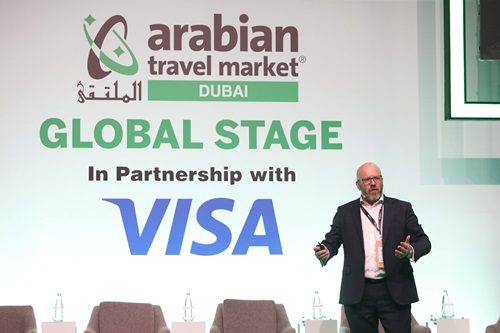
 The ink was still drying on day two’s ATM event schedules when it became crystal clear: the Middle East isn’t just riding the travel recovery wave—it’s doing backflips off the high dive. With over 55,000 attendees fluttering through the Dubai World Trade Centre’s halls like optimistic migratory birds, the 32nd edition of the Arabian Travel Market (ATM) was less conference, more coronation. The region’s tourism sector isn’t just bouncing back—it’s taking off with the fanfare of a royal flypast.
And yes, this year’s theme – “Global Travel: Developing Tomorrow’s Tourism Through Enhanced Connectivity” – was more than a hollow catchphrase.
Tourism Economics Drops the Curtain on the Numbers
Kicking off the analytical fanfare was Oxford Economics’ well-suited and well-spoken Dave Goodger, managing director for EMEA, who unveiled the ATM Trends Report: Leisure, Luxury and MICE – Leading Trends for the Middle East. Think of it as the traveller’s equivalent to the Farmer’s Almanac—equal parts prediction, prophecy, and polite warning.
“Global travel will hit new record levels this year,” Goodger declared with all the gravitas of a man who’s stared down a spreadsheet and seen the light. “People are prioritising travel over just about everything else.”
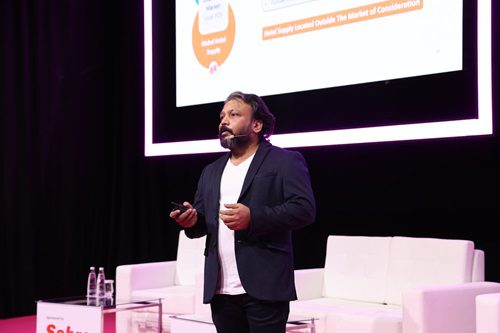
Virendra Jain Founder and CEO VIDEC consultants
And who can blame them? After years of pandemic hand-wringing and a global wanderlust bottled up tighter than a Dubai duty-free perfume cabinet, folks are ready to get out. The Middle East—particularly the Gulf Cooperation Council (GCC)—has become their golden ticket. Goodger’s team forecasts that a staggering 85% of growth in accommodation demand will come from international travellers. That’s not just a trend. That’s a cultural shift in motion.
Luxury Gets Louder
If the region’s travel boom were a symphony, luxury tourism is playing the crescendo. ATM 2025 saw an explosion of activity around high-end travel, from lavish desert resorts with private astronomers to hotels that serve caviar with your check-in cocktail. And why not?
Luxury travel in the GCC is no longer niche—it’s now the default setting for a region that’s always leaned towards gold-plated ambition. Reports predict that the global luxury travel industry will reach a staggering USD 391 billion by 2028. In this part of the world, where five-star is often the starting point and falcons occasionally travel business class, that number doesn’t seem so outlandish.
Danielle Curtis, Exhibition Director ME of Arabian Travel Market, noted the sweet symphony of Asia’s rising middle class intersecting with the Gulf’s appetite for the opulent. “The surge in inbound tourism, particularly from Asia, is feeding this luxury momentum,” she said.
Translation: if you build it with marble, they will come.
MICE: Not Rodents, but Revenue
Then there’s the rise of MICE. No, not the furry kind nibbling through your pantry—but Meetings, Incentives, Conferences, and Exhibitions. The grown-up part of the travel pie. And it’s getting a big slice.
The launch of IBTM@ATM at this year’s show carved out serious real estate for business events, proving that the Middle East isn’t just a leisure playground—it’s also a boardroom with a skyline. Between Riyadh’s urban megaprojects and Dubai’s ceaseless networking luncheons, the MICE sector is making itself heard. And judging by the buzz, this isn’t a passing phase—it’s an anchor of the region’s tourism strategy.
Trip.com: Bridging Continents (and Possibly Dimensions)
Trip.com Group, never one to shy away from bold statements (or markets), rolled out their future-gazing insight during a session cleverly titled “Partnering for Progress.” CEO Jane Sun, equal parts oracle and optimist, offered this:
“The Middle East presents tremendous growth opportunities… Convenient entry policies, increased direct flights, and robust investments have powered its recovery.”
She’s not wrong. Thanks to smart visa schemes and direct air links, the region is now a plug-and-play destination for Europeans, Africans, and Asians alike.
Trip.com highlighted new streams of travel: entertainment tourism, educational travel, and the wonderfully niche “elderly explorers” segment. Grandma’s not knitting anymore—she’s in Abu Dhabi, sipping saffron tea and learning about the Big Bang.
VIDEC and the OTA Boom: Click, Book, Repeat
If anyone had doubts about the online travel agency (OTA) juggernaut, VIDEC Consultants laid them to rest faster than you can say “dynamic packaging”. Their new Travel Market Sizing and OTA Benchmarking study covered the UAE, Saudi Arabia, and India in surgical detail.
Founder and CEO Virendra Jain painted a picture of a digital-first traveller with deep pockets and a hunger for cultural immersion. “The UAE is the ultimate global village,” he said, highlighting its magnetism for Saudi and Indian travellers. He also praised the cultural, religious, and air connectivity trinity binding the three nations together.
Highlights from the data buffet:
- UAE’s Total Air Market (TAM) to hit USD 5.4 billion by 2028
- OTA air bookings in the Emirates up 20% year-on-year to USD 679 million in 2024
- Airline websites/apps own 56% of online air bookings (worth USD 851 million)
What’s fuelling this? User-friendly airline sites, lavish loyalty programs, and the flydubai–Emirates Skywards tag-team effort, to name a few.
And while OTAs may struggle to pin down loyalty in such a transient population, the upside is staggering. According to VIDEC, the UAE’s OTA scene is now one of the most lucrative and competitive on the planet.
Saudi Arabia: The Desert Rose in Bloom
Saudi Arabia didn’t just show up at the ATM—it arrived in full national regalia with a vision as bold as its booth. The Kingdom welcomed 30 million international visitors in 2024, and it’s not slowing down.
From the high-octane mega-project of Qiddiya to the floating palaces of Cruise Saudi, the Kingdom is building its tourism future with the same resolve it once reserved for oil exploration.
Notably, SAUDIA and flynas both showcased innovations in fleet and route expansion, while spiritual tourism and Red Sea luxury retreats were top billing.
Tomorrow’s Tech Today
In true Dubai fashion, ATM 2025 also gave a starring role to the future. Its Start-Up & Innovation Zone felt like walking through a travel-themed version of Silicon Valley.
Twenty-one plucky start-ups pitched everything from AI travel concierges to virtual reality desert tours (though the concern about sand in the headset remains). There was even talk of biometric border crossings and blockchain-backed baggage tracing. Somewhere, George Jetson is nodding in approval.
Final Boarding Call: The Future’s Already Taxiing
As ATM 2025 wraps its four-day odyssey, it’s left us with more than tote bags and a few dozen business cards. It’s delivered a clear-eyed view of where Middle Eastern travel is heading—and why the rest of the world should take notice.
Luxury is the new normal. MICE is no longer the sideshow—it’s a main event. Digital is king. And Saudi Arabia’s tourism story is just beginning.
It’s not just a recovery. It’s a reinvention. And the Middle East, it seems, is very much open for business—falcons, VR goggles, and all.
By Jason Smith, Reporting from Arabian Travel Market, Dubai
========================================











