

 In a world where air connectivity remains the backbone of economies and global engagement, the International Air Transport Association (IATA) has released its latest passenger traffic report for February 2025. While overall growth decelerated slightly compared to previous months, the industry has much to celebrate — notably, a record-setting February in global demand.
According to IATA, global revenue passenger kilometers (RPKs)—the gold standard for measuring passenger demand—increased by 2.6% year-on-year. Though this figure moderates from January’s robust surge, it reflects a strong underlying momentum in international travel, underscored by seasonal nuances such as the leap year and the earlier Lunar New Year celebrations.
“Although traffic growth slowed in February, it’s important to consider calendar-driven effects. The month still posted an all-time high in traffic, and scheduled flights are expected to accelerate into March and April,” noted Willie Walsh, Director General of IATA.
International Travel Remains the Driving Force
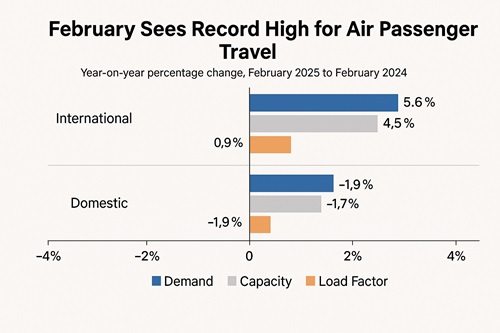
The aviation sector’s international segment was particularly buoyant, with global international RPKs climbing 5.6% versus February 2024. Capacity rose by 4.5% year-on-year, and the load factor improved to 80.2% — a 0.9 percentage point increase.
Regionally, Asia-Pacific airlines led the charge with a 9.5% year-on-year increase in international demand, while their load factor reached an impressive 85.7%. Europe followed closely, with a 5.7% rise in RPKs and a 75.5% load factor. Middle Eastern carriers posted modest but solid gains of 3.1%, while Latin America and Africa registered demand increases of 6.7%.
The only outlier was North America, where international RPKs declined by 1.5% year-on-year, a troubling signal underscored by a corresponding 3.2% drop in capacity.
Domestic Travel Mixed Across Markets
Domestically, the picture was more nuanced. Aggregate domestic RPKs fell by 1.9% compared to February 2024, and total domestic capacity declined by 1.7%. However, there were bright spots.
India, for instance, surged ahead with a 13.2% increase in domestic passenger demand, boasting a staggering 90.3% load factor — the highest globally. Brazil also posted strong figures, with domestic traffic up 8.0%. Conversely, significant markets such as China and the United States experienced 3.2% and 4.2% contractions, respectively, partly due to seasonal shifts and softening consumer confidence.
Domestic traffic slipped by 3.8% in Australia, while Japan recorded a healthy 5.8% gain. China’s slight pullback is mainly attributed to the Lunar New Year moving to January this year.
Load Factor Stability a Sign of Strength
Globally, the average load factor — an efficiency measure reflecting how well airline seats are filled — stood at 81.1%, up 0.4 percentage points from a year ago. While this might seem incremental, in an industry driven by thin margins and high fixed costs, even slight improvements are substantial.
“Airlines continue to demonstrate remarkable resilience and adaptability in matching capacity with demand,” said Walsh. “In many regions, we’re witnessing historical peaks in February travel, a testament to robust consumer confidence in international flying.”
Structural Reforms Urged for Passenger Rights Regulations
Amid this cautiously optimistic landscape, Walsh also used the opportunity to highlight outdated regulatory frameworks—particularly EU261, the passenger rights regulation in Europe and the UK.
“The Heathrow shutdown is a case in point. Current compensation regimes unfairly penalize airlines for delays caused by third-party infrastructure issues,” he stated. “While the Polish EU Presidency’s proposed reforms are a step forward, they fall short of balancing responsibility across all stakeholders.”
Walsh stressed that true reform should encompass accountability for all entities influencing a passenger’s journey — not solely airlines.
A Region-by-Region Snapshot: Key Highlights from February 2025
- Asia-Pacific: 9.5% increase in international demand, 85.7% load factor
- Europe: 5.7% growth in demand, 75.5% load factor
- Middle East: 3.1% demand growth, 81.9% load factor
- Africa: 6.7% increase in demand, 75.3% load factor
- Latin America: 6.7% growth, 81.7% load factor
- North America: -1.5% decline in demand, 78.9% load factor
Domestic Highlights:
- India: +13.2% demand, 90.3% load factor
- Brazil: +8.0% demand, 80.3% load factor
- Japan: +5.8% demand, 83.9% load factor
- US: -4.2% demand, 78.7% load factor
Looking Ahead: Continued Momentum Expected
With March and April poised to bring additional flight frequency and seasonal demand surges, the overall trajectory of air travel remains pointed skyward. Yet, stakeholders are reminded that resilience must be coupled with reform.
“Growth is promising, but the industry’s long-term sustainability hinges on fair and balanced policy frameworks,” Walsh concluded.
Written by Charmaine Lu











