

 The hospitality industry stands at a critical crossroads as artificial intelligence (AI) and robotics redefine operational efficiency and customer service. Once considered futuristic, these innovations are now integral to the sector, addressing labour shortages, automating routine tasks, and enhancing the guest experience. But amid rapid technological advancements, one question remains: can AI truly preserve the human touch that defines hospitality?
China’s tech sector has taken bold strides, with companies like DeepSeek AI unveiling humanoid robots designed to perform domestic tasks. At the same time, UBTech aims to mass-produce AI-powered robots by the end of 2025. Meanwhile, in the U.S., robotics startup Skild AI is poised for a potential $4 billion valuation. SoftBank is considering a $500 million investment to develop scalable robotic systems capable of safe human interaction.
Despite concerns of job displacement, these advancements provide a beacon of opportunity. Studies predict that AI may replace specific roles and generate new positions. A PwC report estimates that by 2038, up to 21% of China’s service sector jobs could be automated. Similarly, robots could replace up to 25% of employment in the hospitality industry by 2030. Yet, for hospitality leaders, the goal is not replacement but enhancement—leveraging technology to improve service while retaining the essential human element.
AI and Robotics: Catalysts for an Enhanced Workforce
Hospitality remains one of the fastest-growing industries, projected to reach $5.8 trillion by 2027 with a 6.2% compound annual growth rate. However, retaining skilled staff remains a persistent challenge, with global turnover rates hovering between 30% and 73%—far higher than the 12% to 15% average in other sectors.
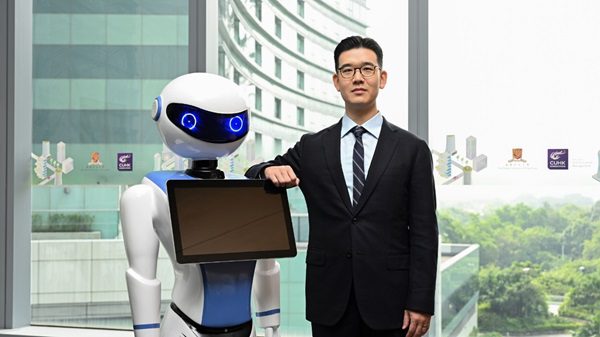
Professor Sungwoo Choi, Assistant Professor at the School of Hotel and Tourism Management at the Chinese University of Hong Kong (CUHK) Business School, emphasizes that AI and robotics solve the workforce crisis by alleviating employees from repetitive and labour-intensive tasks.
“Hospitality is an emotionally and physically demanding industry,” says Professor Choi. “Many frontline workers enter the field with a passion for service but soon find themselves burdened by tedious, repetitive work. AI and robotics can relieve them of these tasks, allowing them to focus on creating meaningful guest experiences.”
By handling operational logistics—such as check-ins, housekeeping coordination, and data management—AI enables human employees to refine their expertise in personalized guest interactions. Hotels that embrace this technology can improve efficiency while fostering a work environment where staff feel valued and empowered.
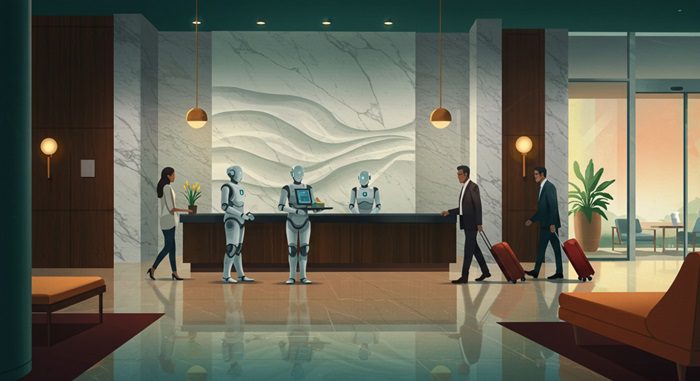
In the new era of AI, will the friendly smile and warm handshake of hotel staff be replaced by facial recognition systems and humanoid robots? (Image generated by Google Whisk)
Balancing High-Tech Efficiency with the Human Touch
While automation enhances operations, hospitality remains deeply rooted in personal connections. Professor Choi notes that AI can simulate human interaction but cannot fully replace genuine warmth and empathy.
“As sophisticated as AI becomes, we are hardwired to crave authentic human interactions,” Choi explains. “Guests expect a personal connection, a sense of warmth, and an emotional bond that machines—no matter how advanced—cannot truly replicate.”
A key case study is the Henn na Hotel in Tokyo, which initially operated with robotic staff but later scaled back due to customer dissatisfaction. This demonstrates that while technology is an asset, over-reliance on automation may alienate guests who seek human engagement.
Future-Proofing Hospitality: Merging Innovation with Tradition
Understanding different customer expectations is vital. Business travellers may appreciate AI-driven efficiency for seamless check-ins, while leisure travellers and families may desire personalized, human-centric interactions. The key for industry leaders is to find the optimal balance, integrating AI where it enhances convenience without overshadowing the essence of hospitality.
“It’s about strategic implementation,” states Choi. “Operators must assess which areas benefit most from AI while preserving human-led interactions at critical touchpoints. Whether it’s intuitive AI concierges or robotic room service, each brand must decide how to weave technology into their unique hospitality narrative.”
As AI continues evolving, its role in the industry will expand beyond operational automation to include predictive analytics, allowing hotels to anticipate guest preferences and curate highly personalized experiences.
A Tech-Enhanced Future Rooted in Human Connection
The hospitality industry must embrace AI as a complementary tool rather than replacing human interaction. While robots and AI-driven assistants streamline efficiency, the warmth of a genuine smile, an attentive concierge, or a heartfelt recommendation truly defines a remarkable guest experience.
Professor Choi concludes, “Technology should enhance, not replace, the human connection that makes hospitality truly special.”
The industry’s future lies in a seamless blend of AI-powered innovation and authentic personal engagement—an evolution that ensures hospitality remains as welcoming as ever while embracing the possibilities of tomorrow.
Original Article Source: CUHK Business School
Written by: My Thanh Pham











