


 Australia’s domestic aviation sector is soaring to unprecedented heights, with demand for flights outpacing available seating capacity, the latest Australian Competition and Consumer Commission (ACCC) Domestic Airline Competition Report has revealed. While airlines have worked to expand their services, the relentless surge in passenger numbers is filling flights to their highest levels in years.
Unprecedented Growth in Domestic Air Travel
Virgin Australia and Jetstar have experienced a remarkable increase in passenger numbers throughout 2024, culminating in strong travel figures during Christmas. According to the ACCC report, Virgin Australia saw a 15.8% increase in domestic passengers in December 2024 compared to the same month the previous year, while Jetstar recorded an 11.2% rise. Qantas reported a modest 3.2% increase.
Despite airlines’ efforts to boost seating capacity, demand has consistently outstripped supply, leading to flights operating at near-maximum capacity. ACCC Commissioner Anna Brakey noted that airline seat availability had expanded in 2024, but passenger growth continued to exceed it, leading to more congested flights.
“The demand for domestic air travel is at an all-time high, and while aircraft delivery delays have posed a significant challenge, airlines need to explore alternative solutions to accommodate growing passenger numbers,” Brakey stated.
Flights Fuller Than Ever: Passenger Load Hits 90.4%
The report highlighted that domestic flights were operating at 90.4% capacity in November 2024, the highest figure recorded since January 2019, indicating a post-pandemic boom in domestic travel.
Airlines have been facing ongoing delivery delays of new aircraft, limiting their ability to increase capacity in response to demand. The high occupancy rates mean fewer available seats, resulting in fewer affordable flight options for travellers and, at times, difficulty securing tickets on popular routes.

Source: ACCC calculations using data from the ABS and data collected by the ACCC from Bonza (up to March 2024), Jetstar, Qantas, Rex and Virgin Australia.
Note: (1) Average revenue per passenger includes both economy and business fare revenue. It excludes data associated with ancillaries, such as baggage fees, fees for seat selection and food and drink sold on board. (2) Data has been adjusted for inflation using ABS CPI quarterly data up to December 2024. (3) Grey bars indicate December and Easter holiday periods.
Flight Cancellations Improve, But Delays Persist
While airlines have managed to reduce flight cancellations, punctuality remains a concern. The industry-wide cancellation rate improved to 1.8% in December 2024, marking the third time in four months that it remained below the long-term industry average of 2.2%.
Virgin Australia led the improvement, achieving a remarkably low 0.6% cancellation rate in December 2024. Qantas, on the other hand, recorded the highest cancellation rate at 2.7%.
“Flight cancellations have been a major issue for passengers since the pandemic, so it’s encouraging to see some airlines significantly improving in this area,” Brakey noted. “Virgin Australia, in particular, has made substantial progress in reducing disruptions.”
However, delays remain persistent, with only 74.7% of flights arriving on time in December 2024. Among the major domestic carriers, Rex led in punctuality with a 75.9% on-time arrival rate, while Jetstar ranked lowest at 73.3%.
Airfares Stabilize After Surging in Late 2024
After experiencing a significant spike in October and November 2024, domestic airfares stabilized in December, relieving travellers. Compared to December 2023, the average airfare dropped by 3.0%.
The decline was most noticeable on major city routes, where average revenue per passenger fell by 4.4%. In contrast, regional and remote routes saw smaller declines of 0.4% and 2.3%, respectively.
“After months of rising airfares, travelers saw some respite in December, particularly business passengers who benefited from the price adjustments,” Brakey explained.
30 Years of Airline Competition: A Sector in Flux
The ACCC’s report also explored the evolution of competition in Australia’s domestic airline industry over the past 30 years, highlighting fluctuations in market dynamics and their impact on consumers.
A History of Competition and Market Shifts
- Early 2010s: Fierce competition emerged as Virgin Blue rebranded to Virgin Australia, challenging Qantas in the business travel sector. Jetstar and Tiger competed aggressively for budget-conscious travellers, leading to lower airfares and increased service options.
- In the mid-2010s, competitive pressure eased as Qantas and Virgin Australia scaled back their price war, leading to more stable but higher airfares. Service reliability also declined, with the average cancellation rate worsening over the decade.
- 2024 Trends: The current market remains dynamic, with demand pressures pushing airlines to their limits, raising concerns about pricing, service quality, and competition.
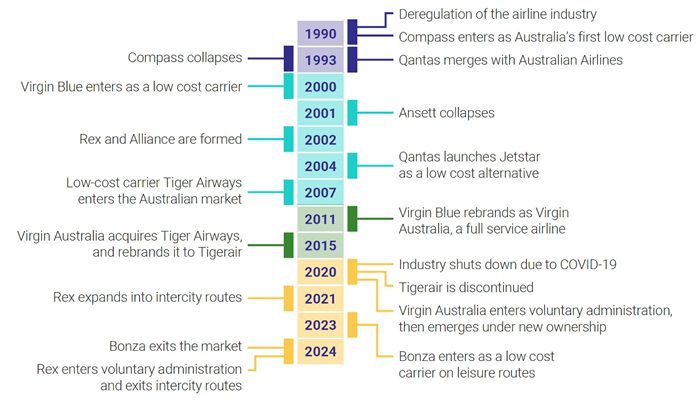
Timeline of domestic aviation since 1990
Government Oversight & Airline Monitoring Continue
In November 2023, the Australian government directed the ACCC to resume monitoring domestic airline competition. The agency collects Qantas, Virgin Australia, Jetstar, and Rex data and tracks pricing trends, profit margins, and operational performance.
Adding another layer of complexity, Rex entered voluntary administration in July 2024 yet continues to operate regional routes. The federal government has stepped in to guarantee regional flight bookings, ensuring minimal passenger disruption.
The Future of Australia’s Domestic Aviation Industry
Looking ahead, Australia’s aviation sector faces both opportunities and challenges. Aircraft delivery delays, fluctuating airfares, and growing passenger demand will test airlines’ resilience in 2025.
The ACCC’s continued oversight will ensure healthy competition, encourage airlines to expand capacity, improve service reliability, and maintain fair travel pricing.
As the demand for domestic flights continues to soar, airlines must adapt swiftly to balance customer needs with operational challenges. This industry is in flux, with passengers eagerly awaiting the next phase of domestic air travel.
Written by: Soo James
=======================================











