

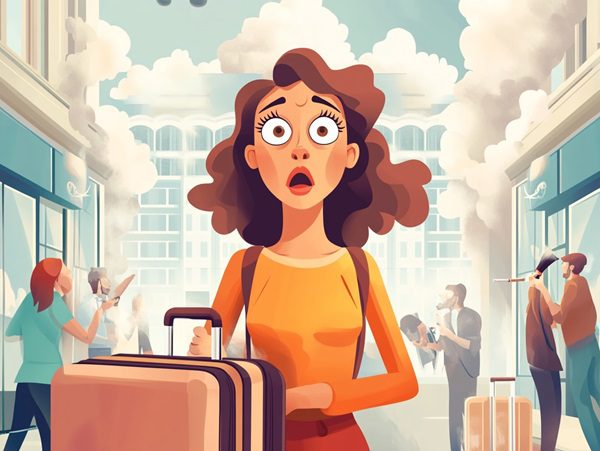
 If you think your next trip will be smoke-free, think again.
On a visit to a five-star hotel in New Jersey, Cindy Montgomery checked into a room that reeked of cigarette smoke, which aggravated her asthma. Within minutes, she was gasping for air.
But that wasn’t the worst of it.
“There was a card on the table in our room that said there’s a $250 cleaning charge if you smoke,” remembers Montgomery, an author from Park Ridge, Ill. “If we hadn’t complained, we would have been charged.”
Montgomery is hardly the only one whose vacation threatened to go up in smoke. Other travellers say they’ve experienced the same thing on their recent trips — and they’re fuming.
When it comes to the travel industry’s smoking policies, there’s a cloud of confusion. Travel companies seem to be quietly relaxing their smoking bans while at the same time selectively enforcing their smoking policies when they can monetize them.
Travelling? Here’s where the smoke is the worst.
Smoking rates fluctuate globally, with some popular tourist destinations having notably high rates. Southeast Asia and the Balkan region get incredibly smoky. Croatia ranks the highest among destinations popular with U.S. visitors, with more than one-third of the population identifying as smokers. Barbados has the lowest smoking rate among popular tourist destinations, at just 7%.
In the U.S., West Virginia has the highest smoking rate (26 per cent), and Utah has the lowest (9 per cent).
I’ve found that these rates correlate somewhat with how much smoke one breathes while travelling.
For example, when I lived in Croatia, I choked on cigarette smoke the moment I stepped on the cobblestone streets of Split. And I can’t remember seeing anyone smoking when I visited Barbados last year.
Having a smoke-free experience in a country that loves its cigarettes is almost impossible. Threats of pricey cleaning fees may keep hotel guests from lighting up, but these fines don’t typically apply to hotel staff.
When I lived in Chile, for example, the hotel’s outdoor areas were often filled with workers on their smoke breaks. The fumes seeped into my room and saturated my clothes. It happens in the States, too. I remember returning to my room at a small hotel in Washington’s San Juan Islands. My door was ajar, and a housekeeper had just finished servicing my room. A freshly lit cigarette dangled between her fingers.
Travel insurance companies don’t take sides when it comes to smoking. Most policies have no restrictions related to smoking, and no medical exam is required to purchase coverage. “However, remember that most travel insurance plans won’t cover pre-existing conditions,” notes James Nuttall, vice president of operations at Insubuy. “So any health conditions related to smoking that occur during your trip might not be covered.”
There’s no such thing as smoke-free travel.
Now, perhaps more than ever, it’s almost impossible to have a smoke-free travel experience (but not downright impossible, which I will explain in a minute). The indoor smoking bans put into place a generation ago have given way to the reality of marijuana legalization, in which people are taking more liberties with their smoking habits.
Nowadays, it isn’t uncommon to find cruise berths, rental cars and hotels that smell stale cigarette smoke or worse.
A recent study by San Diego State researchers found that 80 per cent of guest complaints about tobacco, electronic cigarettes, and cannabis were related to the smoke residue. The complaint rate was 30 per cent higher at hotels with designated smoking rooms than at so-called smoke-free hotels.
“I’m concerned about secondhand smoke that is absorbed into the walls, ventilation systems, tapestries, and furniture,” says Mo Ziaei, a physician from New Zealand, a place with some of the strictest smoking laws in the world. “Cigarette smoke is deadly and can linger for a long time.”
New Zealand’s smoking laws are legendary. It’s illegal to smoke in indoor workplaces and public places, on public transport, and in cars carrying children under 18 years old.
Ziaei is deeply worried about the uptick in smoking in hotels and rental cars, as well as the uneven enforcement of smoking bans. He thinks the lax attitudes could backfire and affect the health of all travellers.
Does the travel industry have a double standard when it comes to smoking?
I’ve been following smoking bans in travel for decades, and I agree with Ziaei that we’re entering a dangerous new phase. I receive regular complaints from readers about paying cleaning fees related to smoking, often as high as $450 and charged to their credit cards without advance notice. And yet, they’re also inhaling lungfuls of secondhand smoke when they travel.
It’s made me wonder if there isn’t a double standard at play here.
How so? Well, hotels or car rental companies look the other way when guests or employees light up — unless they can make money from it. Often, they’ll charge a guest on the flimsiest of evidence. A housekeeper “smelled” cigarette smoke in the room, or they found matches on a dresser. They wheel in the ozone machine and charge the previous guest $450.
Interestingly, even when travellers explain that they didn’t smoke or show that the smoke came from outside the room, they’re still on the hook—until, maybe, a consumer advocate such as myself asks about it.
How do you avoid smoke when you travel?
Of course, there are ways to avoid smoke on the road.
- Travel to a smoke-free place. In the United States, Calabasas, Calif., has one of the strictest anti-smoking laws. You can’t even light up in some outdoor public spaces. Canada, Mexico, Uruguay, and most of Scandinavia have reputations for being smoke-free, but as always, it depends on where you go.
- Stay in hotels with strict smoke-free policies. Research shows that hotels with 100 per cent smoke-free building policies have fewer complaints than those with designated smoking rooms. Look for hotels like Marriott and Comfort Inn that explicitly commit to a smoke-free environment.
- Avoid smoker magnets. If you’re sensitive to cigarette smoke, stay away from places that tend to get smoky. I live across the street from a pub in Dublin, which gets very smoky in the evenings. I wouldn’t recommend it if you like breathing fresh air. There’s also a path along the River Liffey with park benches favoured by the smoking crowd.
The solution was even more straightforward for Montgomery, the woman who stayed at the smoky five-star hotel. She asked for a different room. Since then, she’s cut back on travel, slipping from diamond to silver status with Hilton.
“The smoking bans just aren’t consistently enforced anymore,” she says.
And until they are, she plans to stay closer to home.
Hotels and car rental companies should do everything to provide the clean air they promise their customers deserve. They shouldn’t look the other way when their guests or employees light up.
Cigarette smoke should never, ever be a profit opportunity for the travel industry.
Written by: Christopher Elliott
BIO:
Christopher Elliott is an author, consumer advocate, and journalist. He founded Elliott Advocacy, a nonprofit organization that helps solve consumer problems. He publishes Elliott Confidential, a travel newsletter, and the Elliott Report, a news site about customer service. If you need help with a consumer problem, you can reach him here or email him at [email protected].











