

 Air Astana Joint Stock Company, the largest airline group in Central Asia and the Caucasus regions by revenue and fleet size, today announces its financial and operational results for the third quarter and nine months ended 30 September 2024.
Highlights
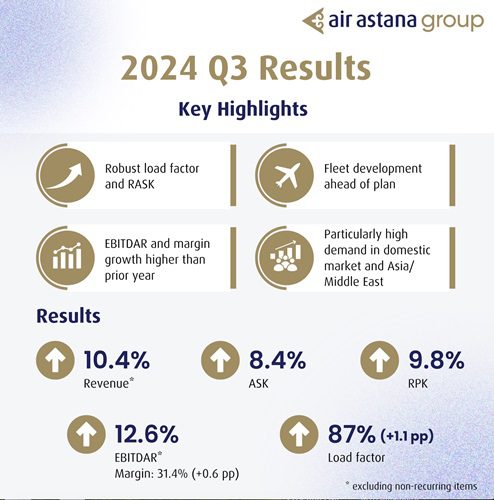
Robust RASK, EBITDAR and margin growth continued in Q3
- Total revenue and other income, excluding non-recurring items, increased 10.4% YoY to USD 0M (Q3 2023: USD 371.5M).
- Adjusted EBITDAR excluding non-recurring items1 was up 12.6% YoY to USD 128.8M (Q3 2023: USD 114.4M). Adjusted EBITDAR margin excluding non-recurring items1 expanded to 4% (Q3 2023: 30.8%).
- ASK up 4% YoY to 5.9B (Q3 2023: 5.4B).
- RPK of 1B, an increase of 9.8% YoY (Q3 2023: 4.7B).
- Proactive yield management across both airline brands resulted in RASK excluding non-recurring items1 growing 8% YoY to USD 6.95¢ (Q3 2023: 6.83¢), while CASK rose 2.8% YoY.
- The negative growth gap between RASK and CASK improved from 2.0pp in Q1 to 0pp in Q3.
- Along with 8.4% capacity growth, the number of Group passengers carried in the reporting quarter totalled 2.8M, an increase of 9.9% YoY, with an average load factor of 87.0%, a 4.2pp uplift on the previous quarter and 1pp on Q3 2023.
Strong 9M performance with accelerated EBITDAR growth and margin
- Total revenue and other income, excluding non-recurring items, increased 11.9% YoY to USD 2M (9M 2023: USD 890.6M).
- Adjusted EBITDAR excluding non-recurring items1 was up 11.1% YoY to USD 267.4M (9M 2023: 240.7M) with adjusted EBITDAR margin excluding non-recurring items1 of 26.8% (9M 2023: 0%).
- ASK increased 4% YoY to 14.6B (9M 2023: 13.2B).
- RPK amounted to 3B, up 10.4% YoY (9M 2023: 11.1B).
- RASK excluding non-recurring items 3% YoY to USD 6.82¢ (9M 2023: USD 6.73¢); CASK increased 2.7% YoY.
- The total number of Group passengers carried in 9M 2024 grew by 6% to 6.8M, with a steady average load factor of 84.0%.
Notes:
(1) Non-recurring item (NRI): Q3 2024 included net IPO-related US $2.0m expenses. Q3 2023 included IPO-related expenses of US $0.5m and US $1.1m revenue from the extraordinary market event (EME) impacted by partial mobilisation in Russia. 9M 2024 included net IPO-related expenses of US $11.4m and donations of US
$2.7m in connection with the flood situation in Kazakhstan. 9M 2023 included IPO-related expenses of US $0.9m and US $10.0m revenue from the extraordinary market event (EME) impacted by partial mobilisation in Russia.
Peter Foster, CEO of Air Astana Group, commented:
“I’m pleased to report such a solid third quarter performance from the Group, despite ongoing pressures across the broader aviation industry.
The successful execution of our Pratt & Whitney mitigation plan has enabled us to outperform the wider sector and achieve accelerated EBITDAR growth in the third quarter’s peak season. It also demonstrates the value of our central geographical location and flexible, dual-brand model. This has enabled us to optimise capacity by swiftly reallocating aircraft from lower-performing Western routes towards higher-margin routes in Asia and the Middle East, creating internal margin competition between our two airlines and hundreds of routes. As a result, the Group has mitigated cost pressures and delivered a robust adjusted EBITDAR margin of 31.4%[1].
We are also making great strides in increasing the Group’s capacity and operational efficiency. Our fleet development plan remains ahead of schedule, reaching 57 aircraft, and we have accelerated the simplification of our fleet with the redelivery of two E2s in 2024, with the remainder scheduled for 2025.
We have successfully introduced additional central fuel tanks on the Airbus A321LR, enabling nonstop flights over long-haul distances. Starting with a nonstop flight to London, Air Astana now offers one of the longest narrow-body routes in the world on our most efficient fleet.
In August, we announced signing a codeshare agreement with Japan Airlines (JAL), one of the world’s best airlines. Together, we will enhance connectivity between Kazakhstan and Japan for both business and leisure travellers and foster greater movement of people and goods between our two countries. The agreement with Japan Airlines is in the context of the ongoing evaluation of enhanced strategic partnerships with leading airlines to improve connectivity and access to key markets.
I want to thank my colleagues for their hard work, continued commitment to excellence, and the highest levels of customer service, which is the foundation of our growth. Our strong competitive position in a growing aviation market provides a solid platform as we confidently look to the future.”
Outlook
Guidance maintained on robust financial performance.
As previously guided, RASK is expected to be outpaced by CASK in 2024 due to industry-wide pressures. RASK growth is on track as proactive yield management successfully narrows the negative gap between RASK and CASK. Capacity continues to be realigned to ensure the highest margin delivery and to mitigate inflationary cost pressures while retaining a load factor broadly consistent with 2023, with Q3 2024 1.1pp ahead of Q3 2023.
Fleet development is expected to close out the year ahead of expectations, with the redelivery of E2s ahead of schedule. This will bring the total fleet to 57 aircraft across both brands by the end of 2024 (the initial plan was 56 aircraft), up from 49 at the end of 2023.
As a result of proactive and efficient cost management, and successful execution of the mitigation plan for the Pratt & Whitney engine issues, including a proactive resting programme in low seasons, the Group remains on track to meet its medium-term expectation of mid-to-high 20s EBITDAR margin with liquidity ratio above 25% and leverage below 3.0x Net Debt/EBITDAR.
[1] Excluding non-recurring items
Financial and Operational review
| 9M-24 | 9M-23 | % YoY | Q3-24 | Q3-23 | %YoY | |
| Passengers (millions) | 6.8 | 6.0 | 12.6 | 2.8 | 2.5 | 9.9 |
| Aircraft (end of period –
fleet) |
56 | 47 | 19.1 | 56 | 47 | 19.1 |
| Load factor (%) | 84.0 | 84.0 | 0pp | 87.0 | 85.9 | 1.1pp |
| Revenue and other income excl. Non-recurring items (million USD) |
996.2 |
890.6 |
11.9 |
410.0 |
371.5 |
10.4 |
| Revenue and other income (statutory) | 996.5 | 900.6 | 10.6 | 409.3 | 372.6 | 9.9 |
| Adjusted EBITDAR excl.
Non-recurring items (million USD) |
267.4 |
240.7 |
11.1 |
128.8 |
114.4 |
12.6 |
| Adjusted EBITDAR (statutory) | 253.3 | 249.8 | 1.4 | 126.7 | 115.0 | 10.2 |
| Adjusted EBITDAR margin
excl. Non-recurring items (million USD) |
26.8 |
27.0 |
-0.2pp |
31.4 |
30.8 |
0.6pp |
| Adjusted EBITDAR margin (statutory) | 25.4 | 27.7 | -2.3pp | 31.0 | 30.9 | 0.1pp |
| ASK (billion) | 14.6 | 13.2 | 10.4 | 5.9 | 5.4 | 8.4 |
| RPK (billion) | 12.3 | 11.1 | 10.4 | 5.1 | 4.7 | 9.8 |
| RASK excl. Non-recurring items (US cents) | 6.82 | 6.73 | 1.3 | 6.95 | 6.83 | 1.8 |
| RASK (statutory) | 6.82 | 6.81 | 0.2 | 6.94 | 6.85 | 1.4 |
| CASK excl. Non-recurring items (US cents) | 5.98 | 5.83 | 2.7 | 5.65 | 5.49 | 2.8 |
| CASK (statutory) | 6.08 | 5.83 | 4.3 | 5,67 | 5.50 | 3.1 |
| Cash and bank balances (million USD) | 473.9 | 314.4 | 50.7 | 473.9 | 314.4 | 50.7 |
| Net Debt/EBITDAR (%) | 1.3 | 1.2 | 0.1pp | 1.3 | 1.2 | 0.1pp |
| Cash/sales (%) | 37.3 | 26.5 | 10.8pp | 37.3 | 26.5 | 10.8pp |
Proactive capacity management supports continued RASK expansion
In the first 9M 2024, Air Astana reported a 10.4% YoY increase in Group ASK to 14.6B, with domestic ASK growing 15.7% YoY vs international of 6.4% YoY. This growth reflects the Group’s successful execution of its fleet expansion strategy.
The unique geographical location and its dual-brand model have enabled the Group to be flexible in allocating resources to higher RASK routes—this balanced passenger growth with a continued focus on operational cost efficiency, which improved the EBITDAR margin.
The Group RASK excluding non-recurring items1 expanded by 1.8% YoY in Q3 and 1.3% YoY in 9M 2024, reflecting the Group’s proactive capacity management across both airline brands.
The unique geographical location allows capacity to be reallocated to higher-performance routes in Asia and the Middle East.
The Group’s geographical location allows it to dynamically reallocate capacity from lower-performing markets such as Europe to stronger markets in Asia. In Q3, particularly high demand was seen in regions across Asia, including India, China (which benefitted from a visa-free scheme), Thailand, the Middle East, and the domestic Kazakh market.
During the reporting period, the Group announced new lifestyle services to destinations in Asia – Vietnam and Thailand, further boosting its presence in the Middle East with new services to Dubai and Abu Dhabi, reflecting the rapid growth in business and leisure traffic between Kazakhstan and the
region. The Company also expanded its network of services to Saudi Arabia by launching direct flights to Jeddah and Medina from Shymkent and Almaty, respectively.
In August 2024, Air Astana signed a codeshare agreement with JAL, one of the world’s best airlines. The agreement enhances connectivity between Kazakhstan and Japan for business and leisure travellers and widely fosters a more significant movement of people and goods between the two countries. The agreement with JAL is in the context of the ongoing evaluation of enhanced strategic partnerships with leading airlines to improve connectivity and access to critical markets.
In September 2024, Air Astana announced that it had completed the installation of the first Additional Central Fuel Tanks (ACT) on the Airbus A321LR. These tanks enable nonstop flights over long-haul distances, making it possible to offer one of the longest narrow-body routes in the world. This modernisation is a key component of Air Astana’s long-term strategy to enhance operational efficiency. It incorporates all the necessary technical and safety features, providing passengers with more comfortable conditions for long-haul flights and improving the airline’s operational performance.
Highly effective cost management supports EBITDAR growth and keeps unit costs at a very competitive industry level.
As a result of operational cost efficiencies, the Group’s CASK remains a critical competitive advantage. In the reporting quarter, the Group maintained competitive CASK levels, resulting in the EBITDAR margin growing to 31.4% from an already impressive 30.8% in Q3 2023. The moderate increase of 2.8% in CASK, excluding non-recurring items1, was driven by industry-wide cost inflation, higher airport rates, the Company’s continued investment into customer experience, and higher aircraft depreciation expenses from the fleet expansion. Lower engineering and maintenance costs primarily offset this.
The Group remains focused on delivering operational excellence to improve operational cost efficiency. In Q3, the Group completed its first in-house 12-year C-check for the Airbus fleet, allowing further cost optimisation.
The Company achieved significant cost savings after re-implementing the Fuel Tankering programme earlier this year. Approximately 30% of the fuel is sourced internationally, which the Company hedges using call options. The Group is fully hedged for the anticipated international fuel uplift for 2024 and Q1 2025 and partly for Q2 2025, at USD 75-85 with options without downside risk.
Robust balance sheet and leverage ratio
As of 30 September 2024, the Group’s cash position stood at USD 473.9M (9M 2023: USD 314.4M), with a cash-to-sales ratio of 37.3% (9M 2023: 26.5%) before available facilities.
Group Net Debt / Adjusted EBITDAR reduced from 1.5x in FY23 to 1.3x for 9M 2024, driven by organic cash generation and IPO proceeds.
Due to strong cash flow and operating results, the Company has voluntarily brought forward the remaining payments of finance leases for two A320 family aircraft to Q3. Two more will be repaid in Q4. By the end of Q4 2024, all A320 family aircraft finance leases will have been fully repaid.
Fleet development ahead of plan
The Group’s fleet expanded ahead of schedule from 49 aircraft at the end of 2023 to 57 aircraft year to date, already exceeding the Company’s plan for 2024.
In line with the Group’s fleet simplification strategy, Air Astana brought forward the redelivery of Embraer E2s to 2024, with the remainder to be completed in 2025.
As part of the Pratt & Whitney mitigation plan, three additional A320ceo family aircraft were delivered this year, and two more are expected in Q1 2025.
The Group also signed the operating lease of seven additional Airbus A321neo LR, with deliveries expected to start in 2026. This is the largest single order in our history, reflecting our confidence in Kazakhstan’s future as an air transport hub.
Successful execution of the mitigation plan for Pratt & Whitney engine issues – ahead of the industry
In March, Air Astana reached an agreement with Pratt & Whitney to compensate and provide other support for the impact on the Group’s operations arising from the GTF neo engine availability issues.
In Q3, the Company successfully executed its mitigation plan by strategically resting the existing engines to optimise fleet deployment during the peak season, increasing the number of A320 classic aircraft, and purchasing seven and leasing three additional spare engines.
Successful execution of this plan resulted in accelerated EBITDAR growth in the peak season of Q3.
Year-to-date results of the share buy-back programme
On 30 April 2024, the Company commenced a buyback programme to purchase ordinary shares of the Company (“Shares”) and global depositary receipts representing Shares (“GDRs”) (the “Programme”) to meet the Company’s obligations arising from its employee incentive programmes. For the first part of the programme, the Company intends to purchase up to 4,786,800 Shares (in the form of Shares and GDRs), which currently constitutes approximately 1.3% of the total number of placed Shares of the Company (including those represented by GDRs), for a maximum consideration of USD 12 million (including ancillary costs).
As of 30 September 2024, the Company had purchased 1,936,620 Shares and 278,427 GDRs (representing 1,113,708 Shares) for a total consideration of USD 5.7M, completing 64% of the Programme.
====================================











