


 Sure, Finland has always been a green and sustainable destination, and to hear someone like Kristiina Kukkohovi talk about how residents have cared for the environment. They are embracing recycling, renewable energy, and the elusive circular economy.
But visitors haven’t always known about its commitment to sustainability, which is where Kukkohovi comes in. As the CEO of the newly-formed Visit Turku Archipelago, an organization that promotes tourism to the Turku region of Finland, she’s had a once-in-a-generation opportunity to reintroduce the world to one of Europe’s most sustainable places.
“We have 40,000 islands,” she says. “We have solitude. We have nature.”
Finland has a message for visitors. You can hear it in places like Turku, a medieval city on the banks of the Aura River, and the remote islands scattered between Finland and Sweden. And you can’t miss it in places like Tampere, where city officials constantly look for ways to push the sustainability envelope.
If you visit these Finnish destinations, you might come away with the impression that being green is possible and easier than you think. And that’s precisely the point.
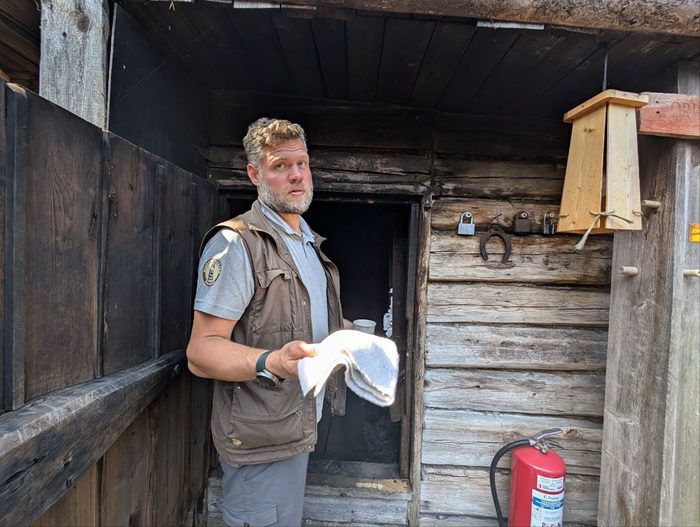
Karioskari Kangas, manager of Herrankukkaro, inspects one of his resort’s saunas.
Have you seen the Saaristo yet?
Kukkohovi is about to launch a new campaign to introduce the world to the Saaristo, the Finnish word for archipelago. On a map, the archipelago looks like shards of glass spread across an ocean. It’s a collection of small islands stretching from Turku into the Baltic Sea.
A project like this requires a lot of messaging, but at the top of Kukkohovi’s to-do list is informing visitors about the region’s commitment to sustainability.
“It all comes down to our values,” she says. “We have a huge respect for nature. We have had to survive here for hundreds of years. It’s that respect that has allowed us to build our sustainability programs.”
But to understand how it’s done, you must go to Saaristo and see for yourself.
Karioskari Kangas manages a small convention centre called Herrankukkaro on one of the islands. The accommodations are distinctive birdhouses with circular windows offering stunning views of the restless Archipelago Sea. Kangas installed solar panels on his cabins, and a few years ago, he switched to city water and sewage, which helps protect the environment. The meals are primarily plant-based, and the cabins are constructed from locally harvested fir trees.
But Kangas wants to get off the electrical grid, and the solar panels aren’t cutting it. On a recent Sunday afternoon, he was scrolling through his cell phone, looking for a windmill supplying the electricity he needed.
“This one will work,” he says, looking at a Finnish-made windmill called a Silentmill. “We’re just waiting for a power adapter to become available.”
Kangas doesn’t have a formal sustainability program at Herrankukkaro. Instead, it’s been pushed and pulled along, first by his conservation-minded father, who founded the resort and then by meeting planners looking for a sustainable venue. He says the process has so much momentum that he can’t imagine stopping. It’s not whether he’ll be off the grid and carbon-negative, but when.
“Our sustainability mission is to make it our best — and then go a little further,” he says. “It’s in our DNA.”
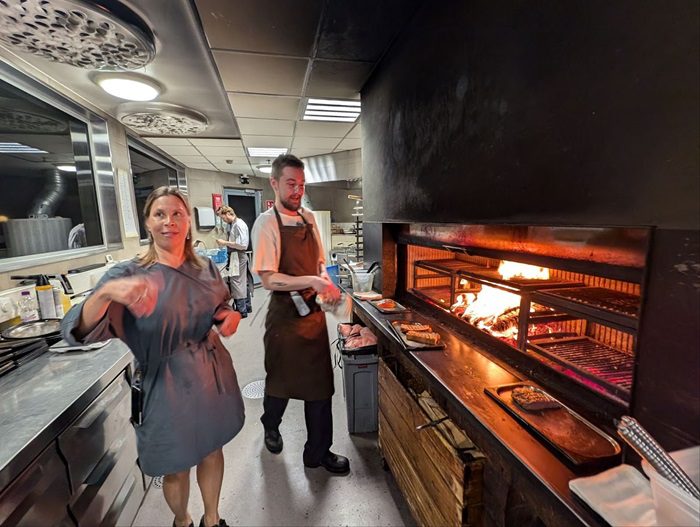
Sanna Gullsten, one of the owners of the restaurant Kakolanruusu, where the food is grilled over an open flame.
Turku is going carbon-negative
Turku, the former Finnish capital known for its pharmaceutical and shipbuilding industries, is implementing an advanced sustainability program. By 2029, the city aims to be carbon-negative and plans to continue reducing emissions beyond that. At the same time, it’s preparing for climate change—hotter summers and more intense winters.
Minna Arve, Turku’s mayor, will tell you about the city’s many plans to go carbon-negative in the coming years. They include a climate-neutral district heating system and the creation of a Digital Climate Situation Room, where officials collect and analyze information about the city’s energy use and emissions and then share it with citizens.
Arve also expects an influx of visitors as the summers become warmer. One significant tourism trend is ” colocation”—heading to a northern climate when the weather gets hot at home. And with Southern Europe suffering from a series of summer heat waves, it’s probably just a matter of time before crowds of visitors land in the Saaristo.
You would think expensive sustainability programs would be controversial, but they haven’t been. Arve says the Turku City Council’s decisions to fund these green projects were unanimous, and they have reduced energy bills and made the city more liveable.
“Of course, there are a lot of questions about sustainability,” she says. “But we want to be part of the solution.”
If you’re visiting Turku, you probably won’t see the heating system or the many sustainability initiatives that will turn the city carbon-negative in time for its 800th anniversary. But you’ll notice the small touches, like the tickets to the city’s cultural events. If you have a pass to the Turku Music Festival, City Theatre, or Turku Philharmonic Orchestra, it includes a free bus pass to encourage you to leave your car at home.
And you can even taste it in restaurants like Kakolanruusu, an organic, farm-to-table restaurant inside an old prison. It’s part of an innovative project to repurpose an old jail in Turku’s Kakolanmäki district into apartments and small businesses.
“It’s a very vibrant area,” says Sanna Gullsten, one of the restaurant’s owners. The best part is that she can source all of her ingredients locally – and some of them next door. “There’s a brewery where we get our beer, and a bakery across the street. So there’s no carbon footprint in transporting those products to us.”
However, in Finland, no part of society has been unaffected by the country’s sustainability efforts, and that includes the arts.
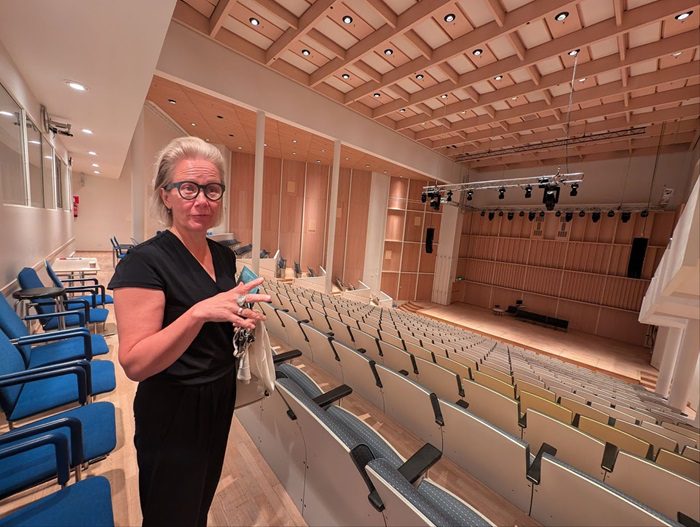
Paulina Ahokas, CEO of Tampere Hall, in one of the venue’s sustainable performance halls.
In Tampere, a convention centre goes green.
In nearby Tampere, another type of sustainability is taking root—and it involves the area’s culture. Tampere Hall, the largest congress centre in the Nordic countries, was not designed with sustainability in mind when it opened in 1990.
“We had an expense problem,” explains Paulina Ahokas, CEO of Tampere Hall. “And that led to a need for energy savings.”
The complex of performance centres and meeting venues, which also houses the famous Moomin Museum, desperately needed to push the restart button regarding sustainability — and so it did.
The program began as a bootstrapped initiative to save resources. In the early days, Ahokas says conservation-minded officials placed empty vodka bottles in the tanks of its public toilets to displace water, which saved water with every flush. Then, they started working on recycling trash, cutting back on electricity usage, and even making their offices paperless.
The efforts paid off. In 2019, Tampere Hall and the new Courtyard by Marriott Tampere City Hotel became carbon-neutral properties, creating a carbon-neutral block that the city hopes other businesses in town will emulate.
On a recent afternoon, everyone in Tampere Hall was focused on the dress rehearsal for a new Lord of the Rings musical in the main performance hall. But the real action was happening on Tampere Hall’s roof. That’s where you can find four massive solar panel plants, two greenhouses growing vegetables and berries for its restaurants, and four bee colonies. It may not get any more sustainable than that.
What being green means when you visit Finland
If you come to Finland, you’re unlikely to see the windmills in the archipelago or the beehives on top of the buildings. However, you may notice the locally sourced menu or the free bus pass attached to the Turku Music Festival ticket.
That’s the idea behind these green initiatives. Tourism authorities are engaged in a kind of quiet evangelism. They’re showing tourists—and maybe also each other—how sustainable a destination is and can become. They’re careful not to turn it into a lecture because they know that at some point, everyone will have to work together for sustainability, including the people visiting Finland and admiring its sustainability initiatives.
Written by: Christopher Elliott











