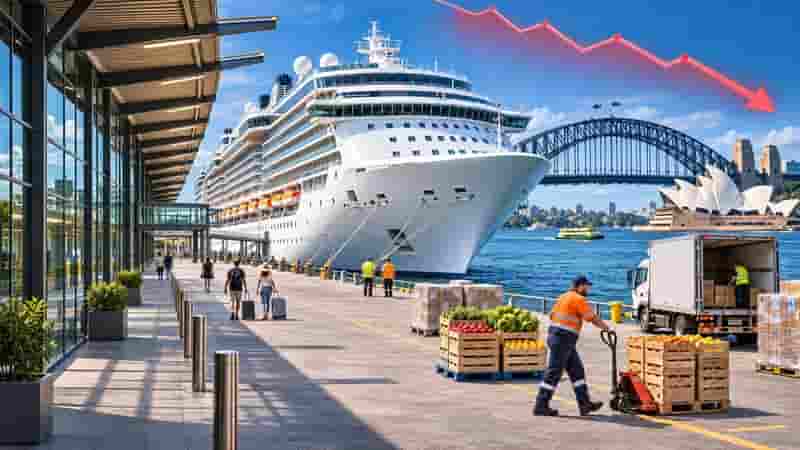
Australia has a curious problem at sea. More Australians than ever are taking cruise holidays, yet the economic rewards of cruising are increasingly bypassing Australian ports.
A new industry assessment reveals that cruise tourism generated A$6.68 billion in Australian economic output during 2025–26, down from A$8.43 billion just two financial years earlier. That represents A$1.75 billion, or 20.8 per cent, less annual economic activity, not A$1.75 billion in cruise line revenue or a cumulative tally of money lost over two years.
The employment figures are equally sobering. Cruising supported 20,021 full-time-equivalent (FTE) positions and generated A$2.15 billion in wages in 2025–26. Employment supported was 22,720 FTE positions the year before and 26,370 in 2023–24. That amounts to 2,699 fewer FTE positions supported in the latest year and 6,349 fewer across two years.
Those are measures of employment supported by economic activity, not a verified count of individual workers made redundant. Either way, the decline deserves more than a sympathetic nod from Canberra.
A growing appetite, a shrinking local return
The Value of Cruise Tourism report, prepared by AEC Group for Cruise Lines International Association (CLIA) Australasia and the Australian Cruise Association (ACA), records a second consecutive annual downturn.
Economic output fell from A$8.43 billion in 2023–24 to A$7.32 billion in 2024–25, before slipping another A$640 million to A$6.68 billion in 2025–26. The latest decline was 8.7 per cent.
Cruise ships visited 43 Australian ports and destinations, 23.2 per cent fewer than the previous year. Ship visit days declined 7.8 per cent to 1,567, while passenger visit days fell 13.5 per cent to 3.1 million.
Passengers who reached Australian shores were hardly keeping their wallets locked. Average daily shore spending increased 4.1 per cent to A$459 per person. But fewer passenger visits meant total direct passenger expenditure dropped 9.7 per cent to A$1.65 billion. Crew spending was A$50.3 million, down 6.3 per cent.
Cruise lines themselves spent A$1.38 billion directly in Australia, a decline of 7.7 per cent. Put simply, customers are spending more per visit, but there are too few visits to make up the difference.
Yet the 2025 Australian cruise passenger figures tell a very different story about demand. A record 1.45 million Australians took an ocean cruise in calendar 2025, up 9.5 per cent, keeping Australia the world’s fourth-largest cruise source market.
Most (1.16 million) cruised in Australia, New Zealand, or the South Pacific, up 8 per cent. Another 286,000 cruised further afield, up 17 per cent. The average Australian cruise passenger was 47.3 years old, and 34.2 per cent were under 40.
These passenger and economic figures cover different reporting periods, but together they expose an uncomfortable contrast. Cruising is attracting more Australians. Australia’s share of the activity generated by visiting and homeported ships is going backwards.
Regional Australia feels the absence
The pain is not confined to Sydney’s cruise terminals.
New South Wales and Queensland remained the largest beneficiaries. But South Australia’s cruise output plunged 62.6 per cent, and Victoria and Western Australia each recorded falls of 32.3 per cent.
| State or territory | Economic output | Annual change | FTE positions supported |
|---|---|---|---|
| New South Wales | A$3.87bn | −1.6% | 11,774 |
| Queensland | A$1.84bn | −9.4% | 5,493 |
| Victoria | A$287.7m | −32.3% | 831 |
| Western Australia | A$249.2m | −32.3% | 712 |
| Tasmania | A$120.4m | −19.4% | 347 |
| South Australia | A$74.2m | −62.6% | 219 |
| Northern Territory | A$235.5m | +14.6% | 643 |
The Northern Territory was the lone exception to the national pattern, recording 14.6 per cent growth.
That difference matters to the businesses behind the glossy brochures. Fewer ship calls mean fewer bookings for tour guides, less business for cafés and attractions, and fewer orders for the transport companies and food suppliers servicing vessels.
Select Fresh Providores has previously illustrated the scale of a single ship’s appetite: an average 10-day cruise can consume around 3.5 tonnes of watermelon, 4,000 litres of milk and 4,000 dozen eggs. The ship does not grow those watermelons at sea. Australian producers and their supply chains benefit when vessels provision locally.
ACA chief executive Jill Abel says cruise visits matter to operators across regional and remote Australia, as well as the main gateways. Her point is straightforward: a ship’s economic reach extends well beyond the passenger gangway.
Two Carnival ships are leaving
This is no longer merely a warning about what might happen.
Carnival Cruise Line confirmed in October that Carnival Luminosa and Carnival Adventure will depart the Australian market in March 2028 as part of its global fleet planning.
Carnival Splendor will continue sailing year-round from Sydney and Carnival Encounter from Brisbane. Carnival has also released a 2028–29 Australian program covering voyages through mid-2029.
Carnival cited a range of deployment factors, including competitive operating conditions and the need for long-term certainty. It would be wrong to assign the decision to any single regulation or port charge without evidence.
Nevertheless, the mismatch between cruise planning cycles and Australian policy settings is impossible to ignore.
A two-year answer to a three-year question
On 2 October, Infrastructure and Transport Minister Catherine King extended the coastal trading exemption for eligible cruise vessels until 31 December 2028.
The government says it intends this to be the final exemption while developing longer-term arrangements under the Coastal Trading (Revitalising Australian Shipping) Act 2012.
From 1 January 2027, eligible vessel owners must ensure their policies and crew agreements do not restrict seafarers’ ability to bargain collectively. Operators must also report information on onboard Maritime Labour Convention complaints to the Australian Maritime Safety Authority. The exemption excludes services between Victoria and Tasmania covered by existing Australian general-licence operators.
These are important protections, not obstacles to be waved away. The Maritime Union of Australia has raised serious concerns about the treatment of foreign seafarers, and protecting workers should remain central to any settlement.
The unresolved question is what the rules, obligations and costs will be after 2028. No automatic move to Australian pay rates can be assumed from the present announcement; the outcome will depend on the final legal framework.
Meanwhile, the Port Authority of NSW booking policy allows berth applications up to three years in advance. A company planning a ship’s future deployment needs to know considerably more than which minister will be answering the telephone.
CLIA’s Joel Katz has warned that Australia is losing cruise opportunities “at an alarming rate” despite strong global demand. His organisation attributes the trend partly to operating costs and regulatory uncertainty. Those concerns deserve examination against transparent, comparable evidence, rather than being accepted or dismissed on assertion alone.
Singapore plans ahead. Where is Australia’s plan?
Other destinations are moving to secure future deployments.
On 16 November, the Singapore Tourism Board announced a three-year partnership with MSC Cruises, with MSC Orchestra scheduled to homeport in Singapore from the fourth quarter of 2028.
New Zealand has also brought government and cruise representatives together through ministerial forums and taken its case to international cruise operators.
Australia has no shortage of attractions, capable travel agents or people eager to set sail. What it needs is a coordinated response involving the Commonwealth, states, ports, cruise companies, unions and the businesses that rely on ship visits.
Trade and Tourism Minister Don Farrell and Catherine King should convene a national cruise summit, publish a timetable for resolving the post-2028 rules and require a clear comparison of Australian port costs with competing destinations.
Sydney Harbour cannot be left in the too-hard basket
Terminal capacity deserves equal urgency. The NSW Government established an industry panel in 2024 to examine options for another cruise terminal, while Port Kembla has been promoted as a possible alternative.
Global Travel Media believes Sydney Harbour should remain at the centre of the city’s international cruise offering. Garden Island deserves careful consideration as a possible shared-use facility, but Defence requirements, operational feasibility and cost cannot be brushed aside. Port Kembla’s potential should also be assessed on its merits, including the practical experience of passengers expecting to embark in Sydney.
A national plan should identify who makes the decisions, what they will cost and when they must be made. It must protect seafarers’ rights as firmly as it protects the tourism opportunity.
Cruise tourism still contributes A$6.68 billion to Australia. Nobody should mistake this for an industry that has run out of passengers.
The danger is simpler: Australians are discovering the world by sea, while more of the spending that supports their cruises is finding a home somewhere else.
And unlike a delayed ship, an economic opportunity that has sailed may not return on the next tide.
By: John Alwyn-Jones – © 2026.
Read Time: 7 minutes.
Author Bio:
 John Alwyn-Jones is one of those rare figures who can make the business of travel sound positively adventurous.
A lifelong communicator with the polish of a broadcaster and the curiosity of a journalist, he’s spent decades shaping stories and strategies across tourism, aviation, and the cruise world. He’s led from the front as CEO, director, mentor, and advisor, and still brings warmth and wit to every boardroom and microphone.
Known for his sharp insight into global cruise lines and destinations, John has an old-school belief in professionalism, tempered with the sparkle of someone who’s genuinely seen the world. He’s not just in the travel business; he’s made it an art form.