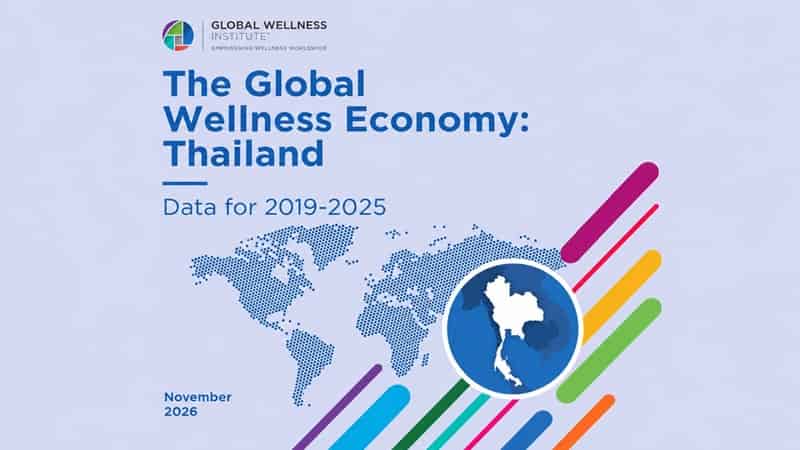
Thailand’s wellness economy is in rude health. Its international wellness tourism business, however, could still use a little restorative attention.
New research from the Global Wellness Institute (GWI) puts the kingdom’s wellness economy at US$46.53 billion in 2025, up 8.8% from the previous year. But beneath that handsome figure lies an awkward distinction: overseas wellness visitors spent less, even as Thai travellers, spa operators and health-focused property developers helped push the wider market higher.
Thailand’s international wellness tourism market, it seems, cannot be restored with a massage and a herbal tea alone.
The findings, released on 12 November 2026 during the Global Wellness Summit in Phuket, place Thailand 26th worldwide and ninth among 45 Asia-Pacific markets for overall wellness economy size. GWI estimates that wellness represented 8.06% of Thai GDP in 2025.
“Thailand’s wellness economy has demonstrated remarkable momentum over the past several years,” said GWI chair and chief executive Susie Ellis. The numbers support her assessment. They also reward a closer look.
More wellness trips, but barely more tourism spending
Wellness tourism remains Thailand’s largest wellness sector, valued at US$14.54 billion in 2025. That was a modest 1% increase on 2024 and still below the US$15.89 billion recorded before the pandemic in 2019.
The volume figures tell a different story. Domestic and inbound wellness trips rose from 16.28 million in 2024 to 17.46 million in 2025, an increase of about 7.2%. More journeys, in other words, did not translate into a similar increase in overall expenditure.
The distinction is sharper when international arrivals are separated from domestic travellers. Inbound wellness tourism spending fell from US$11.02 billion to US$10.38 billion, a drop of about 5.8%. The number of inbound wellness trips slipped from 7.06 million to 7.00 million.
Meanwhile, domestic wellness trips jumped from 9.22 million to 10.46 million, with expenditure rising from US$3.37 billion to US$4.16 billion. Local demand was doing much of the heavy lifting while the international recovery remained uneven.
Indeed, GWI’s 2026 Global Wellness Economy Monitor identifies Thailand as the only one of the world’s 20 largest wellness tourism markets whose expenditure remained below its 2019 level in 2025. That is a sobering distinction for a country with one of the world’s most recognisable wellness reputations.
The unexpected opportunity is already on holiday
There is another finding travel advisers, hoteliers and tour operators should examine carefully. Most wellness travellers are not travelling primarily for wellness.
Of Thailand’s 17.46 million wellness trips in 2025, GWI classified just 1.07 million as primary wellness journeys, where wellbeing was the main reason for travelling. The remaining 16.39 million were secondary wellness trips, where a wellness experience formed part of a holiday or journey undertaken for another reason.
Think of a couple visiting Bangkok for its food and culture who add a spa visit, or a Phuket holidaymaker who books a yoga session between beach days. Neither needs to sign up for a week-long retreat to become a wellness customer.
The spending potential differs. GWI estimates an average US$1,660 per primary wellness trip compared with US$779 for a secondary trip. These are averages across the journeys, not prices for a massage, retreat or other single treatment.
For the travel trade, that points to a practical opportunity: package credible wellness experiences into established itineraries rather than assume every interested visitor wants to spend seven days discussing inner balance.
Spas revive; property developers move even faster
Thailand’s spa industry delivered a notably stronger performance. Revenue grew 19.6% to US$2.29 billion in 2025, while the number of spa establishments increased from 2,969 to 3,158. Hotel and resort spas accounted for approximately US$1.62 billion of that revenue.
Yet the fastest-growing category was wellness real estate. GWI estimates that construction spending on residential, hospitality and other properties incorporating intentional wellness features surged 66.7% to US$1.20 billion.
Such projects can incorporate design, materials, amenities and services intended to support healthier living. Wellness-focused projects represented an estimated 3.27% of Thailand’s total construction output, up from 2.16% in 2024.
It is impressive growth, although percentage headlines deserve perspective. Wellness real estate is expanding from a substantially smaller base than tourism. Spending on construction is not the same as proven financial returns, occupied rooms, or satisfied residents.
A business far larger than the resort spa
Healthy eating, nutrition and weight-loss products and services generated US$10.66 billion in 2025, an increase of 14.4%. Personal care and beauty contributed US$7.64 billion, up 11.4%.
Physical activity was valued at US$3.65 billion, with traditional and complementary medicine close behind at US$3.54 billion. Mental wellness reached approximately US$985 million, while public health, prevention and personalised medicine accounted for US$2.91 billion.
These figures demonstrate the breadth of the economy, but they require careful handling. They include domestic consumer and other spending, not simply purchases made by foreign tourists. GWI also notes that its 11 sectors overlap; their totals must not be added together as though each dollar were counted only once.
Just as importantly, expenditure on a wellness product does not itself establish that the product delivers a proven health benefit. As the industry promotes longevity, personalised programmes and preventive services, credible evidence and clear consumer information will matter as much as polished marketing.
Thailand changes the pitch for 2027
The findings arrive as the Tourism Authority of Thailand (TAT) advances its already-announced 2027 “Value Over Volume” strategy, reinforced at World Travel Market London on 4 November 2026.
The approach seeks greater value from each visitor, more tourism spending outside established hotspots and stronger benefits for local communities. Wellness is central to its ambition to establish Thailand as a global health and healing destination, drawing on medical expertise, science-based wellness and traditional local knowledge.
TAT is targeting at least 5% growth in total tourism revenue in 2027. That is an ambition, not a result, and the sector will have to earn it in a competitive regional market.
For hotels and travel advisers, the opportunity extends from resort spas and restorative escapes to longer stays, thoughtful itineraries and experiences that give travellers a reason to spend more. The challenge is turning Thailand’s formidable hospitality heritage into value without dressing every ordinary holiday extra as a medical breakthrough.
A healthy outlook, with one stubborn symptom
The GWI country report was prepared through a research partnership supported by BDMS Wellness Clinic. Its findings are economic estimates developed from industry research, international datasets and country-level modelling, rather than audited national accounts. GWI has also revised earlier-year figures to maintain consistent comparisons.
Thailand has abundant reasons to be optimistic. Its wellness economy is expanding, its spas are prospering, and investors are finding new applications for health-conscious design. But international wellness tourism spending remains the stubborn symptom in an otherwise encouraging report.
The industry’s next test is not simply attracting more visitors. It is convincing them the experience is worth the journey and the expenditure. A welcoming smile remains a fine start. A stronger commercial result would be better medicine.
By: May Marclay – © 2026.
Read Time: 5 minutes.
Author Bio:
 May Marclay’s career hasn’t followed a straight line, and she’s better for it. She began in real estate, then moved into hospitality, finding her rhythm with Centara in the Maldives. There, she worked the Asian markets the old-fashioned way: building trust, closing deals, and turning conversations into lasting business.
The UAE sharpened its focus. At IHG, supporting an Area General Manager, she saw the machinery of a major travel hub from the inside, no gloss, just how things actually get done.
Now, with her sights set on healthcare, May brings a broader lens than most. She speaks three languages, reads widely, travels with intent, and writes with the calm assurance of someone who understands both the detail and the bigger picture without needing to say so too loudly.