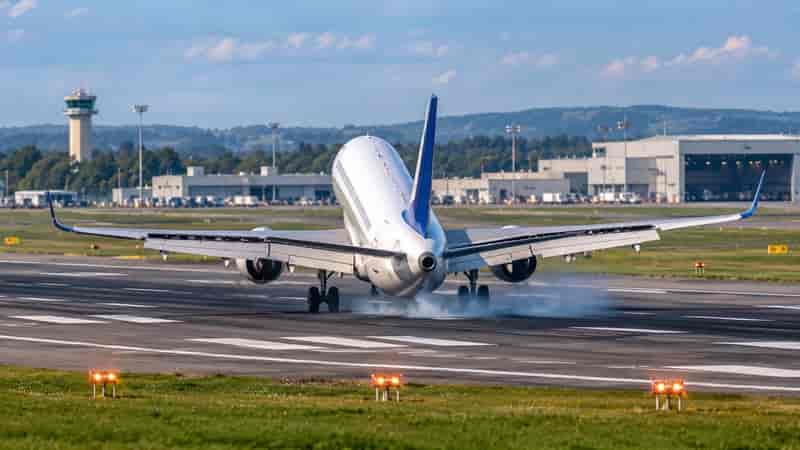
A routine flight from Amsterdam ended with more contact with Heathrow’s runway than British Airways would have wanted when an Airbus A321neo suffered a tail strike on its first landing attempt. The passengers eventually arrived safely. The aircraft, meanwhile, acquired a date with the engineers and the attention of Britain’s air accident investigators.
Flight BA431 was approaching London Heathrow on Thursday, 12 November 2026, when its landing on runway 27L went wrong at about 10.35 am local time.
Video recorded by aviation livestream channel Big Jet TV shows the aircraft touching down, bouncing and pitching upwards. Its rear fuselage appears to scrape the runway twice around the point at which the pilots initiate a go-around and climb away.
The footage has been widely described as a “double tail strike”, although investigators have yet to establish publicly whether there were two separate contacts. That distinction matters: a dramatic video is evidence, but it is not an accident investigation.
The aircraft, registered G-TNEB, climbed to approximately 4,000 feet, according to specialist aviation reporting, before positioning for another approach. It touched down safely on the same runway at about 10.50 am, roughly 15 minutes after the first attempt.
No injuries have been reported, and passengers were able to leave the aircraft normally. For those on board, the journey had an unexpected extra circuit of west London. For British Airways, the questions were only beginning.
Investigators examine the landing
British Airways has confirmed that it is assisting the UK Air Accidents Investigation Branch (AAIB).
“The aircraft landed safely, and we’re assisting the AAIB with its investigation and are legally unable to comment further at this stage,” an airline spokesperson said.
That is a sensible limit on commentary while investigators examine the sequence of events. The AAIB’s role is to determine what happened, why it happened and whether there are lessons for aviation safety. Its eventual findings should not be anticipated by amateur diagnoses from the comfort of a video replay.
The available footage shows a bounce and a rapid transition back into flight. It does not, by itself, establish whether aircraft handling, a gust of wind, landing dynamics or another factor caused the contact.
The incident also raises a practical question for the airline: what happens to an aircraft after its tail meets a runway?
Why tail strikes demand attention
A tail strike occurs when the underside of an aircraft’s rear fuselage contacts the ground during take-off or landing. Depending on the force and position of the impact, the result can range from surface marks to damage requiring extensive structural repairs.
The Airbus A321neo belongs to the stretched end of the A320 family. Its longer fuselage means tail clearance must be carefully managed when the nose rises close to the ground. A bounced landing can complicate matters by changing the aircraft’s attitude and the timing of the next runway contact.
Airbus has addressed the subject in its own Safety First guidance, Preventing Tailstrike During Go-around Near the Ground. The manufacturer explains that go-arounds initiated close to the runway require particular attention to pitch control and aircraft clearance.
That guidance helps explain why such incidents are taken seriously. It does not explain the cause of BA431’s particular landing, which remains a matter for the investigation.
Nor does a safe second landing mean that the aircraft necessarily escaped damage. Engineers must assess the affected structure and complete any required maintenance before an aircraft can be released back into service. The distinction between arriving safely and being ready for the next departure is important.
Is the British Airways aircraft still grounded?
Following the incident, G-TNEB was reportedly withdrawn from service for engineering inspections. Early reporting identified Saturday, 14 November, as a tentative return date, conditional on the inspection findings.
That date has passed, but a provisional roster is not an airworthiness certificate. As of Sunday, 15 November, British Airways had not publicly confirmed the extent of any damage or a definitive return-to-service date in the sources reviewed for this article.
Flightradar24’s public flight history continued to list BA431 on 12 November as the aircraft’s most recent recorded flight. That is a useful indicator, not proof of its present engineering status; flight-tracking histories are not the airline’s maintenance records.
The incident did not prevent BA431 from completing its journey. It may, however, have removed an aircraft from the airline’s tightly planned short-haul operation while inspections took place. How long that interruption lasts depends on what engineers find.
For passengers, the reassuring fact is that the crew took the aircraft airborne again and returned for an uneventful landing. For investigators, the focus now moves from the visible bounce to the less obvious sequence of decisions, aircraft movements and physical evidence.
Heathrow’s cameras captured the spectacle. The AAIB will have the less theatrical, and considerably more important, task of explaining it.
By: Alison Jenkins – © 2026.
Read Time: 4 minutes.
Author Bio:
 Alison Jenkins has lived most of her working life in the slipstream of aviation, where timetables matter, and people matter more. In airline sales, she built a reputation the old-fashioned way: by knowing her clients, her routes, and never missing the human detail.
Quick with a smile, quicker with a solution, she made deals with warmth and kept her edge intact.
Trade shows, FAM’s, airport lounges and hotel lobbies became her second address. And somewhere along the way, notebook in hand, she began writing the journeys rather than selling them. Her reports grew lively, observant, full of the small truths only travellers notice.
That was the moment it dawned on her: she wasn’t simply travelling. She belonged in its stories.