New Zealand wins women’s confidence as a global survey reveals a sharp divide in how travellers judge safety.
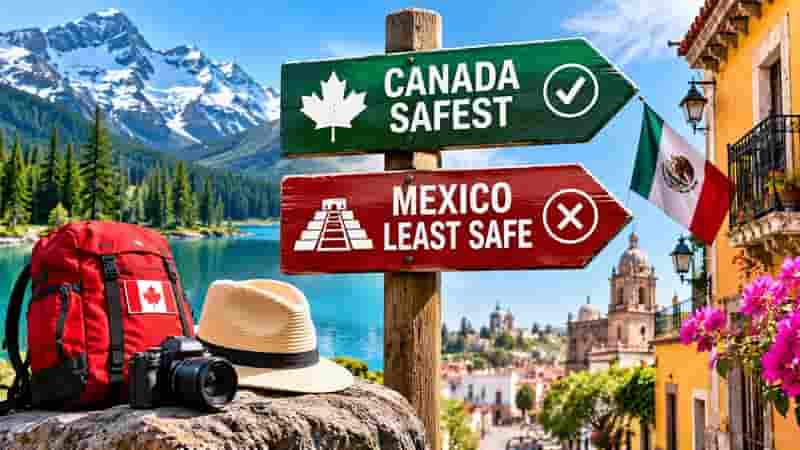
Canada has won a vote of trust from seasoned travellers. Mexico has been handed the sort of result no tourism board wants to see.
In a new travel safety survey, people said Canada was the country where they had felt safest. Mexico drew the most votes as the place where they had felt least safe.
The results tell us how people felt on past trips. They do not prove that one nation is the safest, or another the most dangerous.
Global Rescue’s Fall 2026 Traveller Sentiment and Safety Survey was held from 6 to 10 October. New Zealand ranked second for feeling safe, followed by the United Kingdom, Japan and Switzerland. South Africa, France, Brazil and Egypt followed Mexico on the least-safe list.
For the travel trade, this is far more than a contest for bragging rights. A fine beach may sell the dream. Feeling at ease can clinch the booking.
Canada wins, but travellers disagree elsewhere
Both US and non-US respondents put Canada first. From there, their views took rather different routes.
Americans picked New Zealand next, then the United Kingdom, Japan and Argentina. Those from outside the US put Singapore second, ahead of Japan, Switzerland and Norway.
Non-US respondents were almost six times as likely to pick Singapore as those from the US. Americans, in turn, were almost twice as likely to choose New Zealand.
The least-safe list showed an even wider gulf. Americans picked Mexico first, followed by South Africa, France, Russia and Egypt. Those outside the US chose South Africa, then Brazil. France, Kenya and Mexico shared third place.
US respondents were nearly four times as likely to name Mexico as their least-safe country.
One market’s fears, it seems, are not always shared by the rest of the world.
New Zealand tops the women’s list
Women put New Zealand first for safety, followed by Canada and the United Kingdom. Ireland, Italy and Japan shared the next place.
Men picked Canada first, then New Zealand, Japan and the United Kingdom, with Argentina and Switzerland tied after them.
Women were about 39 per cent more likely than men to choose New Zealand. Men were about 30 per cent more likely than women to pick Canada.
Mexico led the least-safe list for both groups. Yet men were more than twice as likely as women to name it. Women put Egypt second, while France, Israel and South Africa shared third.
There is a lesson here for those who sell travel: a sense of safety is personal. What puts one client at ease may leave another with doubts.
What the rankings do not tell us
This is a poll about how safe people felt. It is not a crime index, a risk map or a check of health care and rescue services.
The public summary does not give enough detail to treat these answers as the views of all world travellers. The results also depend on where those surveyed have been, and what they saw there.
Nor can one label sum up a whole nation. A city hotel, a busy resort and a remote mountain trail can pose quite different risks.
Australia’s Smartraveller advice for Canada and New Zealand calls for normal safety precautions. Its advice for Mexico asks travellers to use a high degree of caution, with stricter advice for some areas.
Those are official travel warnings. They are not the same as this poll of past experience.
Dan Richards, chief executive of The Global Rescue Companies, sums up why the finding matters: “Feeling safe is one of the most powerful ways travelers remember a destination.”
The message for Australian travel advisors
For travel advisors, the poll is a good way to start a chat. It is no reason to skip the hard work.
Know the client. Check the route. Read up-to-date advice. Review the insurance. Find out what help is on hand if things go wrong.
A family break in a Canadian city, a trip through several Mexican states and a walk in remote New Zealand each call for a different plan. The detail matters more than the flag on the airport wall.
For tourism boards, the lesson is plain enough. People want scenery, good food and a story to take home. They also want peace of mind.
And unlike a beach photo, that cannot be made to look better with a little extra sunshine.
Canada tops this survey. Keeping travellers’ trust is the real prize.
By: Michelle Warner – © 2026.
Read Time: 4 minutes.
Author Bio:
 Michelle Warner has always carried stories the way others carry passports lightly, faithfully, and with purpose. She learned her craft in newsrooms, shaping sentences with care, before swapping deadlines for departures as a flight attendant with some of the world’s great airlines. Years aloft sharpened her eye for character and deepened her fondness for the small, dignified rituals of travel, the quiet kindness of strangers, the poetry of arrival, the patience learned between time zones.
Now grounded by choice, Michelle has come home to writing with the same calm authority she once brought to turbulent cabins. Her prose blends an editor’s discipline with a traveller’s wonder, tinged with humour and reverence for the golden age of travel. Each piece feels like a handwritten boarding pass, gracious, observant, and unmistakably alive.