

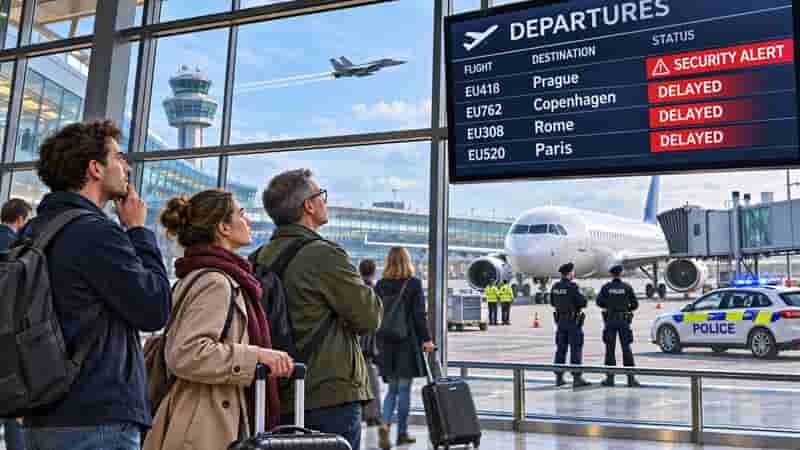
Europe’s week of flight bomb scares took a darker turn on Friday, 6 November. A third major wave hit planes and TV newsrooms. Fighter jets took off, police searched aircraft and TV staff left their offices. The public pays the price for each hoax, even when no bomb exists.
No bombs were found, and no one was hurt in the cases reported so far. But even a false threat calls for a real police response.
Friday’s figures tell a bigger story
EU Transport Commissioner Apostolos Tzitzikostas reported 11 new flight threats on Friday. Later reporting by The Guardian identified at least 18 affected flights that day and put the week’s reported total above 50. The figures come from reports made at different times and are not final official totals.
Eurocontrol had recorded threats involving 14 flights on Thursday and seven on Tuesday. Separate alerts were reported on Sunday and Monday. Friday was the third major wave, not the third day threats were made.
For context, those 18 flights were a tiny share of the 26,709 flights due to operate across Europe on Friday. Most services ran. That will be little comfort, of course, to a passenger whose aircraft has just been diverted for a bomb search.
Prague, Copenhagen and fighter jets
Prague faced one of Friday’s largest groups of alerts. Czech police reported threats to nine flights arriving or leaving. Officers made checks, while the airport said flights ran much as normal.
One Wizz Air service travelling from Prague to Rome was diverted to Venice, where passengers left the plane after it landed. In Copenhagen, Danish police returned to the airport after new threats directed at air traffic. They assessed there was no danger to passengers, and the airport continued operating.
Hungary sent fighter jets to escort three flights, its defence minister said: one from Brussels to Sofia and two from Prague to Romania and Cyprus. He also reported a NATO patrol near Romania, although NATO had not separately confirmed that detail.
France said four more flights in its airspace had faced threats. All landed safely at Paris Orly, where bomb teams carried out checks.
The threats were serious enough to need fighter jets and police, but Europe’s skies did not close. Crews and air traffic staff handled the alerts while most flights continued.
An Aer Lingus diversion under investigation
Thursday’s Aer Lingus flight EI402 from Dublin to Rome showed how a threat can take a strange turn. The aircraft was diverted to the French military airbase at Évreux and escorted by fighter jets. Its passengers and crew were safe, and searches found no bomb.
French prosecutors then began an inquiry into a claim that the captain at first did not comply with an order to land there. Both pilots were questioned and permitted to leave France. The inquiry was still open. No criminal finding had been made.
Aer Lingus stood by its crew, saying they had acted well during the scare. An allegation is not proof that a pilot did anything wrong.
Threats spread from aircraft to newsrooms
Friday brought a new twist: threats against the media. Ireland’s public broadcaster RTÉ evacuated its Dublin headquarters after receiving a bomb threat, disrupting some broadcasts. Bulgaria’s NOVA TV and Britain’s Sky also reported threats.
Reuters said the emails claimed to be from someone behind the flight scares. The news agency could not confirm who sent them, where they came from or whether they were linked to the airline threats.
Other messages earlier in the week invoked the name of a far-right movement banned in Russia. That does not prove that the group, or any government, took part.
Spain’s foreign minister, José Manuel Albares, suggested the pattern could amount to “hybrid aggression and a form of psychological warfare”. That was his view, not a police finding. Copycats or lone actors may also be behind some alerts. No state, group or person has been proven to be behind the threats.
What this means for Australian travellers
Australian travellers and agents have good reason to stay alert, but little cause to panic. No search has turned up a bomb on an affected plane.
A separate scare at Sydney Airport on Thursday night saw armed Australian Federal Police officers meet an All Nippon Airways flight arriving from Tokyo. The AFP said it made checks after threats were sent to the airport. No link with Europe has been confirmed.
For agents with clients in Europe, the steps are simple: check flight updates, watch tight connections and keep receipts. On separate tickets, a diversion can put the next flight at risk. Insurance may help, but each policy has its own terms and exclusions.
Where EU passenger rules apply, travellers hit by a cancelled flight or long delay may qualify for care, a new route or a refund. A serious security threat may count as an extraordinary circumstance. That can mean no fixed cash payment if the airline meets the legal test. It does not erase all other passenger rights.
Australia’s Smartraveller warns that the EU Entry/Exit System has caused waits of up to six hours at some airports. The checks apply when eligible travellers cross a country’s external borders using the system. They do not apply to every flight within Europe. Leave more time where border checks are needed.
Europe looks for a common response
The EU has switched on a system to share aviation security alerts. Experts are due to meet in Brussels next week to discuss how to deal with the threats.
The task is not just to find who sent an email. It is to keep people safe without letting hoaxers bring a vast flight network to a halt.
Each false alert has a cost: fuel, crew time, police work, missed flights and lost trust. The absence of a bomb is welcome news. It does not mean the disruption comes free.
Until police learn who is behind the threats, the best plan is the old one: check the facts, follow the rules and get people home safely.
By: Alison Jenkins – © 2026.
Read Time: 6 minutes.
Author Bio:
 Alison Jenkins has lived most of her working life in the slipstream of aviation, where timetables matter, and people matter more. In airline sales, she built a reputation the old-fashioned way: by knowing her clients, her routes, and never missing the human detail.
Quick with a smile, quicker with a solution, she made deals with warmth and kept her edge intact.
Trade shows, FAM’s, airport lounges and hotel lobbies became her second address. And somewhere along the way, notebook in hand, she began writing the journeys rather than selling them. Her reports grew lively, observant, full of the small truths only travellers notice.
That was the moment it dawned on her: she wasn’t simply travelling. She belonged in its stories.













