

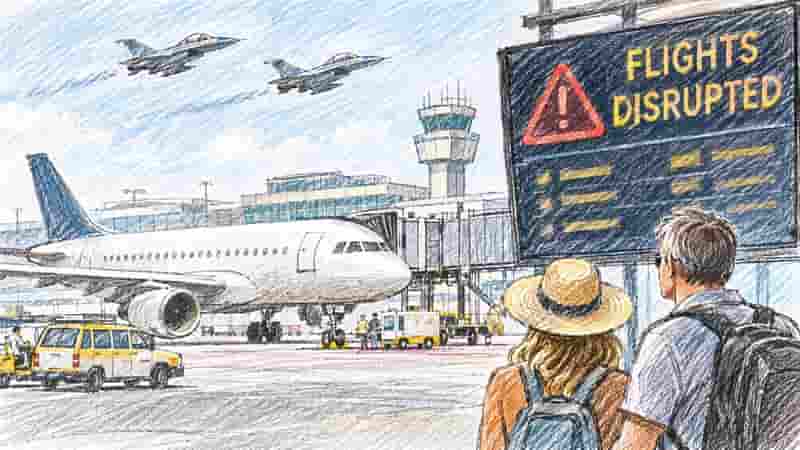
Europe’s airlines are confronting a wave of bomb hoaxes that has forced emergency diversions, military interceptions and security searches. Now an airport threat in Sydney has brought the story closer to Australia, although authorities have not established any connection.
Europe’s aviation nightmare arrives by email
Europe’s airlines have encountered an unwelcome new form of turbulence. It is not coming from the weather, industrial disputes or an unruly passenger. This time, trouble is arriving in the inbox.
At least 27 passenger flights across Europe were targeted by bomb threats on Thursday, 5 November, according to Reuters, triggering emergency diversions, fighter-jet escorts and extensive security searches.
The incidents followed earlier threats on Tuesday involving at least seven flights and a cruise ship.
No explosives have been discovered in the affected aircraft examined so far. Nevertheless, the disruption demonstrates how anonymous messages can unsettle an aviation network built around precise schedules and passenger confidence.
The story has also taken on an Australian dimension.
On Thursday evening, Australian Federal Police conducted precautionary searches at Sydney Airport after threats were sent to the airport. Passengers arriving from Tokyo faced additional security checks.
Authorities have not established whether the Sydney incident was connected to Europe’s threats.
Fighter jets intercept Dublin–Rome flight
The most extraordinary European incident involved Aer Lingus flight EI402, travelling from Dublin to Rome with 151 passengers and six crew members.
Following a bomb warning, French authorities directed the Airbus A320 towards Évreux military air base, approximately 100 kilometres west of Paris.
French Prime Minister Sébastien Lecornu ordered fighter jets to intercept the aircraft after concerns arose about the flight crew’s response to instructions.
Évreux prosecutor Rémi Coutin said the pilot had allegedly preferred landing at a civilian airport rather than the designated military facility.
Aer Lingus disputed any suggestion of non-cooperation, stating that the airline and its pilots had fully cooperated with French authorities.
The aircraft landed safely. Passengers were evacuated, and specialist teams searched the aircraft.
No explosive device was reported.
For travellers expecting a straightforward arrival in Rome, an unexpected visit to a French military installation was presumably absent from the itinerary.
Bulgaria, Italy and Austria join the disruption
The Aer Lingus incident was far from isolated.
Bulgarian fighter jets escorted three Ryanair aircraft travelling towards Sofia from Madrid, Copenhagen and London.
The Madrid and Copenhagen services landed in Sofia, while the London flight diverted to Plovdiv. Security inspections found no explosives.
A Wizz Air flight travelling from Milan to Warsaw was redirected to Vienna, while another Wizz Air service from Milan to Bucharest landed safely at its intended destination.
Italian military aircraft escorted a Finnair service from Helsinki to Rome, which subsequently landed normally.
Another Finnair flight arrived safely in Vienna after receiving a threat.
Prague Airport also dealt with warnings affecting four inbound aircraft operated by Ryanair, easyJet and SKY express.
The common feature was the security response, not an identical outcome. Some aircraft diverted; others continued to their destinations under heightened precautions.
Who is behind the bomb threats?
Investigators have yet to identify those responsible or establish whether the incidents form part of a coordinated operation.
AFP examined threatening emails sent to aviation authorities in Rome and Sofia containing misogynistic language and claiming to originate from individuals associated with the Male State.
A far-right movement using that name exists in Russia and was designated extremist by Russian authorities in 2021.
However, AFP could not authenticate the claimed connection.
No publicly verified evidence links the threats to the Russian government, nor is there confirmation that every incident originated from the same source.
European authorities have previously raised concerns about hybrid threats involving sabotage, cyberattacks and other disruptive activities.
Those broader concerns do not establish responsibility for these particular bomb warnings.
Suspicion may justify an investigation. It does not amount to proof.
European Union activates security coordination
The escalating incidents have prompted a coordinated European response.
EU Transport Commissioner Apostolos Tzitzikostas confirmed that the bloc had activated its aviation-security information-sharing mechanism.
The arrangement enables national authorities to exchange information about reported threats while working with airlines, airports and law enforcement agencies.
Tzitzikostas cautioned against drawing premature conclusions about possible connections between incidents.
British Transport Secretary Heidi Alexander described the warnings as malicious hoaxes.
For European aviation authorities, the challenge is balancing rigorous security procedures with the operational consequences of repeated false alarms.
Aviation security cannot assume the next warning will be as empty as the last.
Sydney incident brings concerns closer to home
The Australian development deserves particular attention.
According to ABC News, passengers aboard All Nippon Airways flight NH899 from Tokyo were met by armed Australian Federal Police officers after arriving in Sydney on Thursday evening.
Passengers said they remained aboard the aircraft before undergoing additional security checks involving police and detection dogs.
The AFP confirmed that precautionary searches followed threats sent to an airport shortly after 6 pm.
The incident illustrates how security warnings can inconvenience travellers even when aircraft have already landed safely.
Importantly, authorities have not established a connection between the Sydney incident and the European warnings.
It would therefore be premature to describe the events as one international campaign.
The cost of a threat that proves empty
A bomb hoax does not need an explosive device to cost a lot.
An unexpected diversion can trigger additional fuel consumption, aircraft handling charges, crew scheduling problems and missed passenger connections.
Security inspections can require passengers and baggage to be unloaded, examined and subsequently reprocessed.
For airlines operating tightly scheduled fleets, a disruption involving one aircraft may affect later services.
Travel advisors, insurers and tour operators can also become involved when passengers miss onward flights, cruise departures or prepaid arrangements.
These are potential industry consequences, not verified financial losses from the latest incidents.
The uncomfortable reality is that an anonymous warning can generate considerable expense while the person responsible remains unidentified.
Is flying in Europe still safe?
Despite the alarming headlines, perspective remains essential.
The affected services represent a small proportion of the thousands of flights operating across Europe each day.
Aircraft involved in the reported incidents landed safely, and inspections found no explosives.
No evidence shows a continent-wide breakdown in aviation safety.
Indeed, the diversions, military escorts and inspections demonstrate that established security procedures are being implemented.
They may be inconvenient, occasionally expensive and thoroughly unwelcome. Their purpose remains passenger protection.
What Australian travellers and advisors should do
Australians travelling through Europe should monitor airline notifications, confirm connections and allow sensible contingency time where practical.
Passengers joining cruises or escorted tours should pay particular attention to fixed departure deadlines.
Check travel insurance against individual policy conditions. A security-related delay does not automatically establish entitlement to compensation.
Under European passenger-rights rules, extraordinary circumstances may affect fixed compensation, although airlines can retain obligations concerning assistance, care and alternative arrangements.
Travel advisors should monitor affected clients, liaise with suppliers and help distinguish confirmed operational changes from speculation circulating online.
For passengers facing an unexpected diversion, experienced professional assistance can make the difference between a manageable inconvenience and an expensive travel problem.
Europe’s aviation industry awaits answers
The immediate priority is to identify those responsible and determine whether the warnings share a common origin.
For airlines, the task is to maintain security without letting repeated false alarms overwhelm normal operations.
For passengers, the message is straightforward: follow official advice, stay informed, and avoid assuming every alarming headline signals widespread danger.
Europe’s aviation industry has survived volcanic ash, pandemics and extraordinary geopolitical disruption.
It now faces a challenge that can create considerable chaos without anyone necessarily leaving their keyboard.
The investigations continue. Fortunately, so do the flights.
For further information: Consult EASA, EUROCONTROL and Smartraveller. Travellers should contact their airline for immediate operational information and always consult their travel advisor first for itinerary assistance.
By: Jason Smith – © 2026.
Read Time: 6 minutes.
Author Bio:
 Jason Smith didn’t learn travel from textbooks. He learned it in airports, taxis and hotel lobbies, watching the business unfold long before he played his own part. Half American, half Asian, he grew up around the quiet workings of tourism, where people come and go, and stories rarely stand still.
Bangkok came first, then formal study, then a career that carried him through Singapore, Malaysia and Vietnam. Each place left something behind. In the end, Thailand felt like home, along with a senior role in hotel sales.
Then everything stopped. Borders shut, planes grounded, and Jason found himself back in America with time to reflect.
Now at Stephen’s EGT Media, he writes travel as it really is, not polished, not perfect, but human, and all the better for it.













