
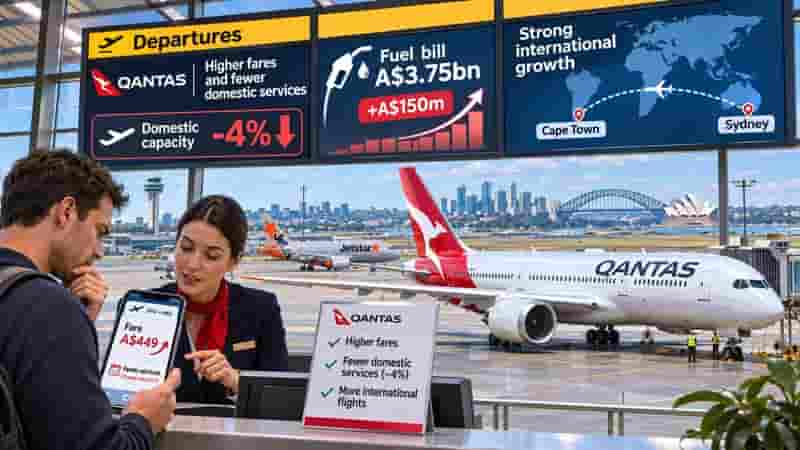
Qantas passengers face higher fares and fewer domestic seats as the airline confronts a fuel bill forecast to reach A$3.75 billion in the six months to 31 December 2026.
That is A$150 million more than Qantas expected in August. The airline says it has already adjusted fares and flying capacity and will continue to do so while fuel prices remain elevated. It is not quite the kind of frequent-flyer reward passengers had in mind.
The latest warning came in a market update released on Friday, 6 November, ahead of Qantas’s annual general meeting. The six-month period is the first half of the airline’s 2027 financial year, which began on 1 July 2026.
Domestic flying loses altitude
Qantas forecasts that combined Qantas and Jetstar domestic capacity will be 4 per cent lower in the January–March 2027 quarter than in the corresponding quarter a year earlier. Within that figure, Qantas Domestic capacity is projected to fall 5 per cent and Jetstar Domestic 3 per cent.
For the July–December 2026 half-year, the group expects domestic capacity to be 3 per cent below the equivalent period in 2025.
These percentages measure available seat kilometres, rather than the number of flights cancelled. Capacity can change through altered schedules, aircraft sizes or routes. A 4 per cent reduction in capacity does not automatically mean 4 per cent of flights are disappearing.
Nor should the latest forecast be added to the 5-percentage-point domestic capacity reduction announced in April. That earlier decision changed the airline’s planned capacity for the April–June 2026 quarter. It was not an additional 5 per cent year-on-year fall to be carried into 2027.
The reductions are real enough without turning them into a fictitious 9 per cent cut.
Fuel hedging offers some shelter
Qantas says it has hedged about 85 per cent of its fuel exposure for the full 2027 financial year, mainly against Brent crude oil prices. Hedging can cushion price swings, but it does not remove all cost pressure, particularly from jet-fuel refining margins.
The airline expects fuel prices to remain high throughout the financial year, with the conflict involving Iran continuing to disrupt oil markets and air travel.
In its April market update, Qantas estimated fuel costs of A$3.1 billion to A$3.3 billion for January–June 2026. That was a different six-month period and should not be confused with the latest A$3.75 billion forecast.
Oil markets have been volatile following the United States midterm elections and renewed concerns about shipping in the Middle East. For airlines, predicting the next move in fuel prices remains like predicting the next airport queue: experience helps; certainty does not.
Passengers pay more; demand holds up
Despite cost pressure, Qantas says people are still prioritising travel. It reports strong domestic leisure demand, while government and non-resource corporate travel remain stable.
International demand across Qantas and Jetstar is also holding up, with the airline reporting that some customers are redirecting journeys away from the Middle East.
Qantas expects total revenue per available seat kilometre, a measure of unit revenue, to rise 8 to 10 per cent across both its domestic and international businesses in the first half of FY27. That is not a forecast that every airfare will rise by the same percentage.
The distinction matters to travellers, and particularly to travel advisors trying to explain why a seat that was affordable last month now comes with a less cheerful price tag.
International growth tells a different story
While domestic capacity contracts, Qantas forecasts international capacity growth of 2 per cent for the group in July–December 2026 compared with the previous year.
On Friday, it also announced a seasonal non-stop Sydney–Cape Town service, scheduled to begin on 19 October 2027 and operate three times weekly until March 2028. The proposed route will add nearly 30,000 seats between Australia and South Africa.
That is not necessarily a contradiction. Airlines regularly shift aircraft and investment towards routes where demand and returns look stronger. But it does underline that the pressure is not being shared equally across Qantas’s network.
Meanwhile, Qantas Loyalty, which includes its Frequent Flyer business, remains on track for underlying earnings before interest and tax growth of 5 to 7 per cent in FY27.
And what about the executive suite?
Qantas has signalled that net capital expenditure for FY27 should come in at the lower end of its previously forecast A$4.3 billion to A$4.6 billion range. This concerns investment spending; it is not an announced reduction in executive remuneration.
Its November trading update did not announce cuts to executive salaries or bonus arrangements. That does not establish that none will occur, but it leaves a reasonable question for management: as passengers absorb higher fares and reduced capacity, what burden, if any, will be borne at the top?
For travel advisors and their clients, the practical response is to compare flight options early, check fare conditions carefully and monitor schedule changes. Anyone affected by a change should review the airline’s rebooking and refund options before accepting an alternative.
The fuel bill may be Qantas’s problem. The airfare, inconveniently, belongs to the passenger.
By: John Alwyn-Jones – © 2026.
Read Time: 4 minutes.
Author Bio:
 John Alwyn-Jones is one of those rare figures who can make the business of travel sound positively adventurous.
A lifelong communicator with the polish of a broadcaster and the curiosity of a journalist, he’s spent decades shaping stories and strategies across tourism, aviation, and the cruise world. He’s led from the front as CEO, director, mentor, and advisor, and still brings warmth and wit to every boardroom and microphone.
Known for his sharp insight into global cruise lines and destinations, John has an old-school belief in professionalism, tempered with the sparkle of someone who’s genuinely seen the world. He’s not just in the travel business; he’s made it an art form.